

Personality
To Jordan Wright, the time to engage young voters is now
The incoming president of the Manhattan Young Democrats reflects on this year’s mayoral race and looks to his second year in the Assembly.
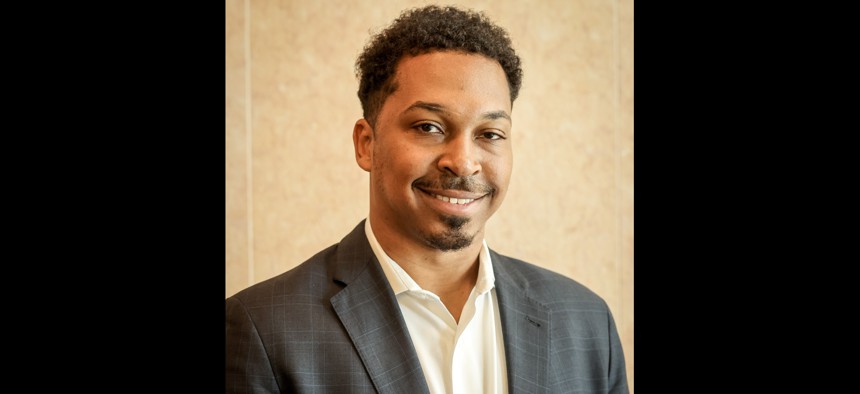
Assembly Member Jordan Wright was recently elected president of the Manhattan Young Democrats. Rita Thompson


Assembly Member Jordan Wright, son of Manhattan Democratic Party boss Keith Wright, wants to build political power for young people.
At age 29, he was elected to represent Harlem, succeeding longtime Assembly Member Inez Dickens in Assembly District 70 last year. Politics was nothing new to Wright. He’d grown up surrounded by Harlem’s powerful Black political leaders, watching his father’s own political legacy unfold as well as that of other members of Harlem’s old guard and heard stories of his grandfather state Supreme Court Justice Bruce Wright’s efforts to make the judicial system more just. And in 2023, Wright managed the campaign of Exonerated Five member Yusef Salaam, successfully helping him get elected to the City Council and then becoming his chief of staff.
Now, capping off his first year as an elected official himself, Wright is looking beyond Albany, hoping to use his youth and political acuity to engage young New Yorkers. City & State caught up with Wright to discuss his first year as a lawmaker, his vision for Manhattan Young Democrats as the political club’s incoming president and why he initially endorsed former Gov. Andrew Cuomo in the Democratic primary over Mayor-elect Zohran Mamdani. This interview has been edited for length and clarity.
You were recently elected president of the Manhattan Young Democrats. What inspired you to run?
I’ve walked around as the youngest elected official who lives in Manhattan since I assumed the seat of Assembly member for the 70th District, and I saw a unique opportunity to step into a leadership position for young people – a newly active group in this political space. I’m also inspired by folks who are elected officials and county leaders like (Rep.) Greg Meeks, someone who I’ve known for a very long time who is doing the work. I’ve always said I want to stand on the shoulders of those who came before me.
What power do the Manhattan Young Democrats currently have? How do you want to change that? What’s your vision for the organization?
I think like anything else it is what you make of it: You’ve got to do the work. The No. 1 thing is raising money, recruiting volunteers and growing membership. Membership is crucially important because we have to corral all those young people who voted and got involved in politics during the most recent New York City mayoral primary.
Right now, we have over 300 members, but many many young folks voted in this election who felt like they were talked to for the first time. I’d like every young voter to join their local political club – not just Manhattan Young Democrats – because I think that’s how you really see how the democratic process plays out.
What do you think the relationship should look like between Manhattan Young Democrats and the Manhattan Democratic Party, which is led by your father, Keith Wright?
I think it should be a very healthy relationship. The same goes for the other boroughs’ young Democratic organizations and whichever county party they are aligned with. It should be one where they can work with each other and they can have a symbiotic relationship.
Once you take office, both Manhattan Democratic county organizations will be led by a Wright. Have you talked about succeeding your father at the head of Manhattan Democratic Party? Does this help position you for that?
I think what this helps me do is to further the young people’s involvement in the borough and the county. I really haven’t had any other thoughts.
Young voters played such a huge role in the mayoral election, turning out in droves and helping propel New York City Mayor-elect Zohran Mamdani to victory. How can other elected officials replicate this?
I think that young people were spoken to in a way that they really hadn’t been before. And I think it’s really important to meet people where they are. That’s the most important lesson that anyone can take from this. Whether it be winning the internet, whether it be certain shows folks are watching – it could be nothing more than short-form content. I think it’s key for any elected official that wishes to tap the young demographic to use that blueprint.
Besides Mamdani, who do you think has done a good job of that?
(Rep.) Alexandria Ocasio-Cortez has done a good job, during the COVID-19 pandemic they were doing Twitch streaming and a number of things like that. Her and Zohran really have done a fantastic job tapping the younger demographic. My colleague in the Assembly, Charles Fall, has recently tried his hand at a couple short-form content videos that I found to be super entertaining.
What about reaching young men in particular?
Some of the best conversations I had this past election were with young folks who talked about “Oh I don’t want to vote. I think it’s unnecessary. They’re all more of the same.” And I was able to talk to some of the folks who had told me that they voted for President (Donald) Trump and got to really educate them as to why that vote might not have been everything they thought it would be in the sense of, “Oh, Donald Trump put money in my pocket. Donald Trump, he’s speaking for me and no one else is.” I was happy to talk to young voters and I look forward to continuing to do it. Like I said, it’s important to meet people where they are. That’s the best way to talk to anybody.
Can you share an example of meeting people where they are that you’ve recently implemented?
Yes, the Manhattan Young Democrats’ Blue Party back in October is one example – our tagline for that was “putting the party back in party.” That was a big moment. And then it was also key that whenever I’m walking the district, visiting poll sites, stopping folks who look like me – young men from Harlem – as they are out walking with their grandmothers or other family members.
Often as I did so, I’d hear their grandmothers or their mothers say they were going to take their child to vote and that I should talk to them, tell them why they should vote and why it’s so important.
How important do you think social media is now as a campaign tool?
It’s key. Social media is definitely here to stay in terms of campaigning strategy, but nothing beats old-fashioned knocking on doors. Nothing beats an old-fashioned subway stop. Nothing beats an old-fashioned standing in front of the supermarket and talking to people as they’re getting groceries on their way home from work.
Like many other elected officials, you initially endorsed former Gov. Andrew Cuomo in the Democratic primary, but after Mamdani’s victory, you began backing him. Would you do things differently if you could go back?
This is what I can say to that. The Wrights and the Cuomos’ history goes way back beyond the year when I was born. … When it came time for the primary endorsements, I had a number of long talks with the former governor and I made the decision I made, I endorsed him. Primary day happened. When they had a round two in the general election, I decided to endorse my colleague in the New York Assembly, Zohran Mamdani, who I’ve always had a good relationship with. I remember he was doing a train stop on 125th Street and I was going to get some Wingstop and I happened to see him by the trains. We shared an embrace. We hugged and I wished him a good race. I think that keeping good relationships is important all throughout this government that we’re operating together as a team to ensure that the affordability agenda the mayor wants to put forward happens.
So you wouldn’t do things differently?
I don’t know that I would do things differently. I did what I did and you know, that’s where it goes.
Did you want to back Mamdani initially, but couldn’t due to pressure?
I wouldn’t say I was met with any pressure. No, I would say the decision was made by me. There’s a number of deep, deep, deep ties with the Wrights and the Cuomos. I’ll share one story. When my father was state party chair and he was driving me up to Syracuse University, where I attended, I remember Gov. Cuomo gave a call to him and we had a conversation about the city of Syracuse, what was coming up for me, the impending weather and so on.
But like I said, I’m very happy to have endorsed the mayor-elect and I think it’s a very exciting thing for the future.
One more on Mamdani: After you decided to endorse him in the general election, it seemed like you were a very gung-ho, vocal supporter. Why did you take this approach rather than play it more down the middle?
In for a dime, in for a dollar. That’s kind of my tagline when it comes to working with anyone in this space. I think that it’s key for everyone to know where I stand as a Harlem elected official.
What do you think will be the most pressing topics in Albany for this year’s legislative session?
We have a new mayor, so obviously there’s going to be a number of things that we have to look for to see how it’s going to go forward. Gov. Kathy Hochul has spoken about universal child care. I’m sure there’s a number of things that she’s going to try to get through given this is an election year for the governor.
I have some bills that I’d like to try to get through as well. This is my second year of my freshman term, and I look forward to doing a lot of great things. For example, we were impacted by the Legionnaires’ outbreak in my district, and I have a couple of measures addressing that. I have a bill that I’m sponsoring with Sen. (Cordell) Cleare and I’m also co-sponsoring a couple of bills with the housing chair, Sen. Linda Rosenthal, that I’m looking forward to getting through as well. Those are two of my top priorities to make sure we don’t have an outbreak like that again in our community – or at least to mitigate any future ones as much as possible.
Any other key bills that you are looking forward to pushing or introducing?
I have one bill that I’m going to try to get through regarding the Sports Wagering Act as I’m on the Racing, Gaming and Wagering Committee. It has to do with the funding of them and where the profits go for sports programming. I’m doing that with Sen. (Jamaal) Bailey.