

DSA
Bernie Sanders spawned unnumbered socialists. NYC-DSA co-chair Gustavo Gordillo was one of them.
A class on “radical Latin American cinema,” climate change concerns and a populist presidential campaign were the recipe that formed the influential New York City leftist.
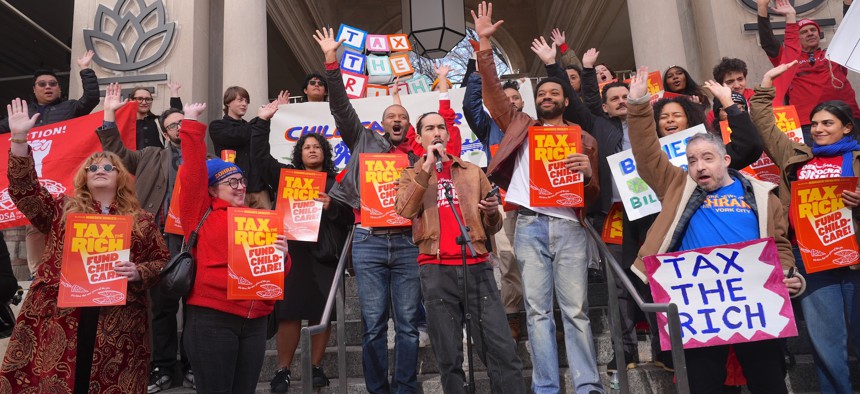
Gustavo Gordillo speaks at a Tax the Rich rally in Union Square on Nov. 16. Selcuk Acar/Anadolu via Getty Images


There is no 2025 Zohran Mamdani without 2016 Bernie Sanders. And there may not be a Gustavo Gordillo without Bernie either.
Gordillo, one of two co-chairs of the New York City chapter of the Democratic Socialists of America, emigrated from Peru with his family when he was a child and grew up outside Miami. His interest in politics and socialism in Latin America primarily sprouted as an academic exercise at first. “I didn’t think that there could ever be a mass base or a mass movement for that kind of politics in the United States,” he said. Then, like it did for Mamdani, Rep. Alexandria Ocasio-Cortez and many others who would go on to call themselves socialists, the Sanders campaign changed what he thought was possible. For Gordillo, who had moved to New York City after college in 2013 to work in the art world, theory and academia gradually turned to practice. He went from taking a class on radical Latin American cinema in college to joining the DSA in President Donald Trump’s first year in office, working on the successful campaign to pass the Build Public Renewables Act and trying – with varying degrees of success – to elect DSA candidates to the state Legislature. “It was through running those campaigns that we built up the infrastructure that we needed for a citywide race,” Gordillo says, looking back on some of the losses.
Gordillo had been working at an art gallery, but changed careers. “The people who were funding the industry were the same people that we were fighting in DSA,” Gordillo said. “So I left eventually.” He became a union electrician. He was drawn to the job after realizing through his work on climate politics that it’s the building trades workers who will implement that policy.
With Mamdani in City Hall, the DSA has never held this much political power, or had such a rapt audience. That puts Gordillo and fellow co-chair Grace Mausser under an increasingly bright spotlight. As co-chairs, the two essentially hold a second full-time, and unpaid, job, responsible for the big-picture work of undertaking major electoral and legislative campaigns, and the smaller details of deciding when to organize a rapid response around breaking news.
“There are always going to be people questioning projects that we take on. There is always going to be some amount of risk,” said Julie Swoope, secretary of the NYC-DSA steering committee, which is the chapter’s highest leadership body. “I think Gustavo is particularly talented at pushing through some of those difficult conversations.” Take, for example, the controversial decision to put up a candidate for mayor in late 2024. “It was a pretty big swing to take at that time,” Swoope said. “Gustavo was one of the early supporters of it and had pretty high confidence in the value of doing it for DSA.”
Josh Goodman, a DSA member who works for the New York City Department of Sanitation but spoke to City & State in his personal capacity, said he has been impressed with Gordillo and Mausser’s ability to “motivate the side of the New York City chapter that actually wants to accomplish things, as opposed to the people who are like playing pretend.”
Nearly a decade into his work with the DSA, Gordillo is co-leading a chapter with a swelling membership of 13,500. He has moved well beyond socialism as an academic pursuit. “Gustavo could quote theory all day long,” Goodman said. “But he doesn’t, because he’s there as an organizer to welcome you in.”
NEXT STORY: This week’s biggest Winners & Losers