

Interviews & Profiles
Lucy Lang on protecting ‘the fabric of democracy’ as state inspector general
New Yorkers may not have heard of her office, but as it marks 40 years, she says they can feel the impact.
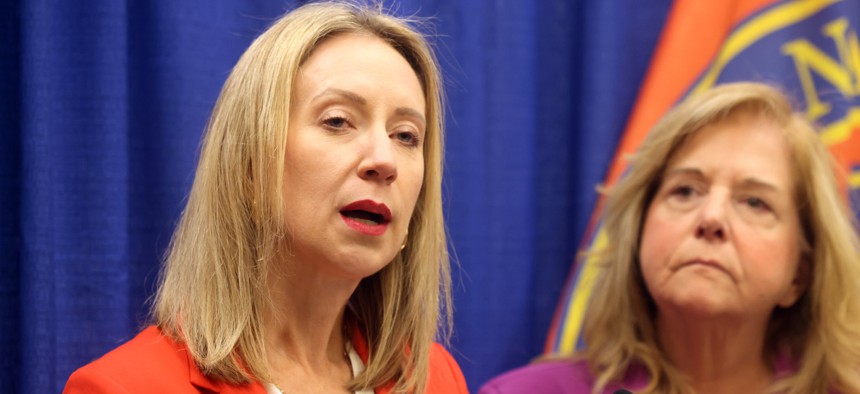
State Inspector General Lucy Lang Howard Schnapp/Newsday RM via Getty Images


The New York Office of the Inspector General is a government watchdog with jurisdiction across executive-branch agencies and public authorities, including oversight of several big-ticket infrastructure projects. Created by Gov. Mario Cuomo in a 1986 executive order, the office hit its 40th anniversary this year, at a time when public trust in government is fragile, and the very idea of independent oversight is threatened nationwide. Inspector General Lucy Lang, a former Manhattan assistant district attorney and criminal justice reform advocate, was appointed by Gov. Kathy Hochul in 2021 and believes that while the work in her office is often unglamorous, it “helps hold together the fabric of democracy.” City & State spoke with the state IG about her tenure, her oversight of New York prisons and her office’s impact. This interview has been edited for length and clarity.
There have been many changes since you began at the Office of the Inspector General. What are your priorities for the rest of your tenure?
Our job is not just to ferret out fraud and corruption, but also to do what we can to protect the programs that serve the most vulnerable New Yorkers. The way that we intend to do that in this year and beyond is by bringing the public in through the work of public integrity by really talking to communities, specific organizations, and a diverse range of New Yorkers about how the government serves them and how it can serve them better. To that end, we are embarking on a major statewide initiative over the course of the next year where we expect to be speaking extensively with civic groups and with schools. In addition, we’ll be speaking, as we always have, with the state employees who are directly under our jurisdiction.
You also have also emphasized this need for transparency and communication to New Yorkers. How are you measuring whether your efforts actually build trust?
We are working on developing networks to better understand our impact. One of the challenging things about it is that they are sometimes measured in terms of dollars saved or where fraud or waste or abuse started out. Our view is that is too limited of an approach to the metrics of success. Sometimes the metrics about success are that an investigation was conducted and discovered there was no wrongdoing, and that means that the agency or the program is operating with integrity. So that can be a very difficult thing to measure, but we are thinking about academic partnerships that may enable us to do a more comprehensive measurement around the impact we're having.
One area that we do track very carefully are the number of complaints that come in throughout the state. We continue to get them from a range of sources, including people who work in state government and people who avail themselves of the resources of state government. We have found that our outreach efforts are successful in illuminating to us areas where we should be directing increased investigative resources.
There was controversy with your predecessor, former state Inspector General Letizia Tagliafierro, whose eventual resignation was linked to an improper investigation of the Cuomo administration. How do you approach being a watchdog, not just for agencies, but also for the governor's office?
From the first conversation that I had about the prospect of becoming inspector general, it was very clear that I would only take the job if I had the independence required to do it effectively and consistently. I have been really fortunate, as compared to some of my peers across the country, in that I do not experience pressure to deliver on particular things. I have never felt weaponized politically, and one of the core reasons for that is structural. As compared to some of my predecessors, I don't sit in the governor's cabinet, so I don't sit alongside the commissioners who oversee the agencies I'm charged with investigating.
The Department of Corrections and Community Supervision (DOCCS) has experienced turbulence over the last year and a half, such as through strikes and rising violence. How are you handling oversight of DOCCS?
Having spent many years as an educator in New York state prisons, the first prison that I visited as inspector general was Attica. I bring to this job a deep awareness that the turmoil in DOCCS is not new. It has extended across generations. It is a generational project to fix it. I believe that my generation can be a tremendous part of the solution. It is going to require thinking humanely about a system in a way that is rehabilitative and holistic and will ultimately return New Yorkers to our communities better than when they were deprived of their liberty.
How can the average New Yorker feel the concrete reforms that your office is making?
I think about everything from our oversight of the state workers’ compensation system to our more specific investigations into individual allegations, so they can take very different forms. But New Yorkers should rest assured that where, for example, an employer does not have workers’ compensation insurance and is putting workers at risk, we stand ready to investigate. We make sure that people are held accountable for failures to protect New York-based workers as a nationwide leader in the area of labor law and workers’ compensation.