

Interviews & Profiles
NYC’s outgoing Cultural Affairs Commish Laurie Cumbo focused on Black cultural institutions
In a Q&A, she reflected on the ups and downs of Eric Adams’ one term and said she saw her role as a way to undo historic wrongs by lifting up African diaspora art.
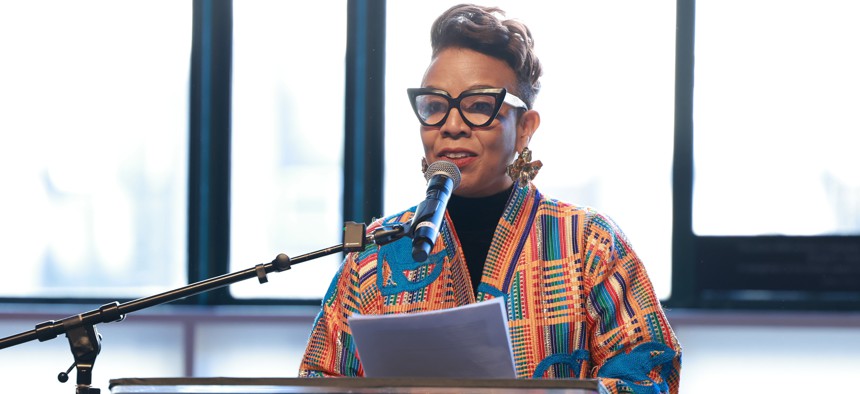
Outgoing Commissioner of Cultural Affairs Laurie Cumbo Jason Mendez/Getty Images for Brooklyn Academy Of Music

When Laurie Cumbo was appointed as commissioner of cultural affairs in March 2022 by former Mayor Eric Adams, she was already an influential player in the New York City arts scene. She founded the Museum of Contemporary African Diasporan Art, and served on the cultural affairs committee during her time as a New York City Council member.
The New York City Department of Cultural Affairs had a budget of $300 million this fiscal year, the highest ever. It distributes much of that in grants to hundreds of nonprofit cultural organizations, from zoos to museums to performing arts centers. It also supports capital projects for cultural institutions and supports city-owned institutions like the Metropolitan Museum of Art. Cumbo sees her legacy in the context of empowering Black cultural institutions.
Cumbo is one of the few Adams appointees who stayed on from start to finish in an administration that saw significant turnover. Cumbo embraced all aspects of the role, serving as the queen of the Mermaid Parade and getting engaged on the Met Gala carpet. With Mayor Zohran Mamdani’s appointment of Powerhouse Arts Vice President Diya Vij to replace her, Cumbo is now reflecting on her four years in the role. Her last day will be sometime this month.
She spoke with City & State, reflecting on her legacy and the future of culture in the city. This interview has been edited for length and clarity.
Reflecting on your time as the Commissioner of Cultural Affairs: What is your proudest accomplishment?
As an African American woman, I understand that the damage that, or rather the atrocity of the transatlantic slave trade, slavery, segregation, Jim Crow, all of these things were designed to strip Africans of their cultural identity. This is an extraordinary opportunity to be able to assist Black people, to be able to reconnect to their culture through the ability to fund, create, renovate, expand and support cultural institutions of the African diaspora throughout New York City.
My appointment essentially opened up the doors of opportunity for all marginalized people. And it was really an opportunity to show that a Black woman, a Black working mom, could create substantial opportunities for all people. And so through this position, I was able to provide support and funding for organizations from the Frick to the Met to the Museum of Natural History to institutions like Creative Outlet Dance Theater, to the Hip Hop Museum, like to be able to show that in this role and position, I had the ability to support all people in a way that everyone could see themselves reflected in the cultural landscape of New York City.
You remained a part of the Adams’ administration from start to finish, why did you stay after Adams’ indictment and what was your reaction when it happened?
I’m more committed to the work (than) I am committed to any particular person. I was committed, really, to the desire for the creation of cultural equity. My goal and my focus was on cultural equity. It was, how do we bring art and culture to the most underserved communities.
It was more of a focus on the ability to do the work. This is not a job for me. This is part of an ancestral movement where I believe ancestrally, I was tasked with the responsibility of reconnecting my people to their culture and their heritage. I really was just focused on my ancestral calling of delivering cultural equity to underserved communities that had gone underresourced, underfunded for so long.
What are your thoughts on how Eric Adams was treated by the justice system and the media while facing indictment?
It wasn't really my focus. It wasn't really where I was putting my attention. I mean, I'm a born and bred native New Yorker, four generations in. I remember the excitement around David Dinkins being elected mayor. And I remember the energy and the excitement that was around that. I remember, like singing in my shower the Tribe Called Quest song, where he drops that lyric: “Mr. Dinkins, would you please be my mayor? You'll be doing us a really big favor.” Unfortunately, Mayor Dinkins was only elected for one term. So I knew that that reality was ever-looming, would Eric Adams be given the support to have a second term in office? So I felt like I always knew that, you know, there's always going to be a power structure that, you know, in a country that was based off of a genocide, a country based that, you have to know that there are going to be a movement of people who are not going to want to see a Black mayor in office for one term or two, so that's something you always have to contend with. But as far as, what did I think about in terms of how he was treated and that sort of thing, I honestly didn't follow it that closely because I was really so involved in achieving the things that I wanted to achieve, because I knew we only had a very short period of time to do so.
During your tenure, you faced challenges such as a pro-Palestine protest occurring at the Brooklyn Museum, the subsequent vandalism outside of the director’s home, and protests against Drag Queen Story Hour where demonstrators alleged grooming. How should the city respond to these culture wars and work toward promoting unity during contentious times?
That is certainly a question for the next administration and the next commissioner to answer. I feel that the position that we took as an administration was that cultural spaces have to be safe spaces. They have to be safe spaces where organizations can take leaps, they can take risks, they can bring people together around opposing viewpoints. I feel like that's fundamental to our democracy, and so we have to continue to do all that we can in order to provide that safe space.
What are your thoughts on the Mamdani administration, and do you have any advice for the next commissioner of cultural affairs?
I would say that I'm excited for the Mandani administration and what new energy, new voices, new ideas they're going to bring to the table. There's a history that is part of New York City, and I think it's really important in every administration to always understand the fights and the struggles that got us here, and to honor it and to make it a part of the vision of the new era.
What can the Mamdani administration do to bolster and spotlight arts in New York City?
I think it would be incredible to be able to expand the Public Artists in Residence program. One of the projects or things that I've always worked on is how do we expand that program so that it's part of every agency. I also think that another exciting way would be to continue to expand on the She Built program where we're putting a monument of a woman in every borough in New York City. The first one is going to be Shirley Chisholm, that's going to be coming online in the next few months. And then Billie Holiday will be next. This will be an exciting opportunity to continue to expand the she builds program so that there are more sculptures, public art projects reflective of the contributions of women in New York City.