

Zohran Mamdani
Mamdani on Trump, AI, Menin and what can be accomplished in 100 days
The mayor has the job approval of half of New Yorkers, and he claims he never uses ChatGPT.
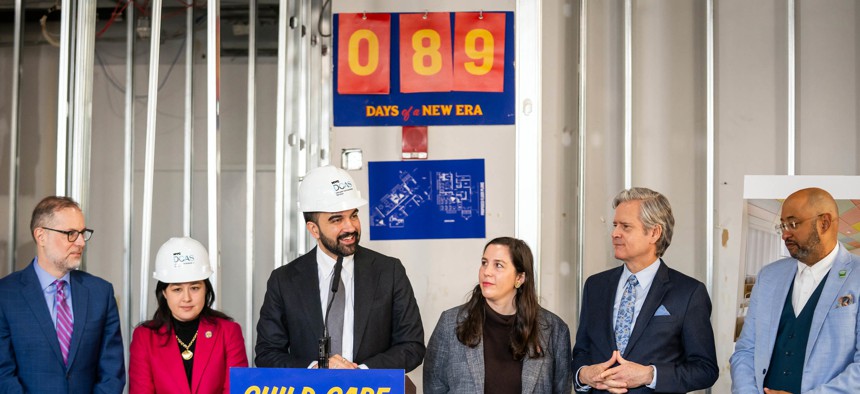
The mayor’s been counting the days. Ed Reed/Mayoral Photography Office


New York City Mayor Zohran Mamdani has totally bought into the somewhat arbitrary but beloved-by-media “first 100 days” benchmark to evaluate a new leader’s progress. A 34-year-old who had been in office just five years, he came into City Hall with something to prove. And he wanted to prove it quickly. Ideally within the first three months, one week and three days.
As City & State reported, his transition team was seeking ways his administration could make an impact specifically in the first 100 days. Since Day 1, he’s traveled from one press conference to another with an oversized calendar. On Sunday, he’s forgoing a staid “State of the City” address for a rally-style celebration at the Knockdown Center in Queens.
City & State sat down with the mayor at City Hall on April 8 – or Day 98 – to discuss this highly scrutinized period, including how he dealt with a record-breaking winter, how he wields his political clout, how he uses AI (not at all), and the feedback New Yorkers have given him as he reaches 100 days.
This interview has been edited for length and clarity.
The new Marist poll released today found that 48% of New Yorkers approve of the job you’re doing as mayor. That’s lower than former Mayor Eric Adams’ 61% approval rating during the same period and roughly on par with Bill de Blasio’s. Are you happy with 48%?
I leave it to New Yorkers to make their judgments. I know what it is my responsibility to do, which is that we work as hard as we can to deliver for as many New Yorkers as we can. The city sets the pace, New Yorkers do it as well. Now it's the job of city government to actually catch up.
Does 48% match what you’re hearing in the streets?
I think it’s important to be outside and actually speak to New Yorkers themselves. What I've heard from New Yorkers is that what we've focused on over the course of this last 90 or so days – delivering $1.2 billion in funding for a path to universal child care, getting more than $30 million in settlements with bad landlords, a Department of Consumer and Worker Development that has secured more than $9 million in settlements for workers and small businesses. These are things that have tangible impacts in people's lives. We also know that we can never pat ourselves on the back – there is always more work to be done. A lot of it is that if we want to win the faith of New Yorkers with the most transformational ideas, we have to deliver on the very things that they've seen unaddressed for weeks, months and years.
What has been your best single day out of these 100? What has been your worst?
I’ll get through the recency bias, and I’ll say my best day was day eight of our administration, when we secured the agreement with Gov. Kathy Hochul of $1.2 billion that would allow us to not only add 1,000 additional seats to universal 3K but also to roll out universal 2K for the first time in city history. It will save thousands of families more than $20,000 a year.
The recency bias is because it was lovely to be at the zoo today, and I’ve never seen a red panda in my life. I also never seen a porcupine or an otter, which was a lot of fun, although I had recently watched “Zootopia 2.”
The hardest day, it’s hard to pick which one exactly, but one of them, I would say, (was) the lead up to the second storm. We are a city that hasn’t had as tough of a winter as we faced this year in a long time, and it is also a time where we have to ensure that we’re prepared, not just for the storm itself, but what it comes after, and ensuring that we’re able to deliver on everything that New Yorkers need and keep them safe at the same time.
Was it the deaths in the cold leading up to the second storm that you’re referring to, or just that another storm was coming?
I think it was that we were facing the first blizzard in more than a decade after having seen the kind of snowfall we hadn’t seen in years already.
At this point we know that it’s impossible to close Rikers Island and replace it with the borough-based jails by 2027. What is the deadline you are holding your administration to?
We are looking to move as quickly as possible. Part of the reason that we can't even give a date is that the last few years have been characterized by an incredible amount of inaction. Frankly, towards that end, just a few days ago, we opened a facility at Bellevue Hospital that had been ready to be opened 15 months prior, but had been left dormant. That is just one example of the many steps required to close Rikers Island.
What I can say is that for the first time in a long time, New Yorkers can rest assured that we are a city government that is deeply committed to actually closing Rikers. I am incredibly proud of DOC Commissioner Stanley Richards who has been doing everything he can to work with partners at every level to ensure that we're ready for that.
You became mayor during a time of technological transformation. Artificial intelligence may upend our economy and our social structure. Do you plan to set rules for how city government should use AI? Do you plan to do anything like the governor’s new commission to study how to both harness AI and protect workers?
AI will continue to be a focus for our administration because of the far reaching ramifications and impacts that not only it can have, but it already is having. We are working with our New York City public school system in putting out AI guidelines. That is just one example of what our admin will be doing. And there are things that AI allows the administration to do that it couldn’t do prior.
There’s also a level of job loss that we’re already seeing, not just in the city, but also across the country, and a scale of potential job loss that would have an immense impact on people’s lives across the city.
One of your mentors, Sen. Bernie Sanders, wrote recently that AI could exacerbate income inequality and erode democracy. I see you’ll be at a rally with him this weekend that appears to touch on that topic. Do you share his concerns about the sort of deep upending that AI could cause?
I do share a lot of those concerns, as well as the environmental impacts of these
data centers.
Do you use AI?
No.
None?
Not to my knowledge. I just mean that sometimes they put it into apps.
But you’re not on ChatGPT or Claude or something.
No.
Has your relationship with City Council Speaker Julie Menin suffered after last week’s budget response debate? Have the two of you spoken individually since then?
We just saw each other this morning at (the National Action Network Convention). Both of us are very much committed to fulfilling our legal obligation of putting the city on a balanced budget by the end of this process.
We will have disagreements. We've had them prior. We'll continue to have them, but I always want to ensure that it's a relationship where that conversation is one of substance. The critique that I shared was a substantive critique of that proposal. I think that's important given my responsibility to be honest with New Yorkers, especially given the stakes of this budget crisis and the scale of it.
Your relationship with President Trump has surprised a lot of people. On the campaign trail, you said that your administration would be “Trump’s worst nightmare.” But it’s been a lot more warm and publicly cordial, from what we’ve seen. I think you’ve suggested that the approach has helped with things like securing the release of ICE detainees and potentially funding for housing at Sunnyside Yard. Why do you think he is so receptive to you and open to working with you?
I think the president and I have a number of disagreements, both publicly and privately. And yet, what we share in common is a deep love for this city. The conversations that we’ve had have always circled that point of agreement. Even when I put forward the proposal to build more housing in a single development than the city has seen since the early 1970s, it wasn’t the introduction of the idea to the president. This was something that he was deeply familiar with, being a New Yorker himself and someone who has developed quite a bit of housing across the city. And I said on the course of the campaign that amidst the disagreements that I had with the president, that I would always look to work with him if there was a point of agreement. And we’ve seen various points of those agreements, whether it be initially about the scale of the affordability crisis or now about the importance of building in New York City. And that is something I will pursue, while always being honest.
In that second meeting, for example, before I spoke about Sunnyside Yards, I brought up my continued opposition to ICE raids, my characterization of them as cruel and inhumane and doing nothing to serve the interest of public safety.
Gov. Hochul has also carved out an interesting working relationship with him. Did you seek her insight or talk to her about how to approach that difficult balance?
I spoke with a number of people in advance of the first meeting. The governor was one of those that I spoke to.
Beyond Speaker Menin, who we understand you have a standing weekly meeting with, we’re curious who outside of your administration do you have similar standing meetings with?
The governor is someone that I speak to regularly, and part of that is a reflection of the partnership that we've built. I wish it wasn't so remarkable that there's a partnership between the mayor and the governor, but given recent history, it isn't something that we've seen much of. I’m also in regular touch with many elected officials across our city. Beyond that, I would say Sen. Bernie Sanders, who is a mentor of mine, and someone that I look to for advice, for reflection. He's also someone that has not just served as a senator or a presidential candidate, but also as a mayor.
What about DSA? Do you have a standing conversation with them?
I do speak regularly with DSA members and with a number of organizers across our city.
You’ve chosen to use your political influence in interesting ways: to back Claire Valdez and Brad Lander. To not back Chi Ossé or Antonio Delgado. Sometimes that has meant going against progressive allies. How do you think about when to use that political power or not? What’s your ultimate goal in building political power in the city and state?
It’s to deliver for working class New Yorkers. Capital is something to use so that you can actually transform the lives of those who have long lost faith in government’s ability to meet their needs. I’m incredibly excited about the three candidates, one of whom is now an elected official that I’ve endorsed. (Editor’s note: Mamdani turns to his press team and questions whether he’s allowed to talk about political matters in a government building.)
Your predecessor certainly did.
I guess if you’re asking me, that’s fine. (Laughs) My predecessor is not a great indication … Diana (Moreno), I was so excited to support and now to see her as the Assembly member in my old neighborhood. And Claire and Brad, to me, are such great illustrations of Democrats who know not just what to oppose, but also what to fight for. And I think that that fight is one that’s needed at every level of government – city, state, federal – and I’ve been excited by these campaigns.
The New York Times called you a “ruthless operator.” Would you say that you are ruthless?
(Laughs) I think I’m quite straightforward.
One of the things that’s been notable during your tenure is that you’ve really brought New York City influencers into the fold, recognizing that in many ways they have more reach than traditional media. Where are you getting your news?
I get my news – now I have a.m. clips and p.m. clips that I will read of many different outlets. I'll also look through Twitter to go beyond those traditional outlets. I would say that that's a general indication, and that I’m very lucky to have a press team that makes sure that we are forever informed.
Do you watch any influencer content?
(Laughs) I’ll sometimes watch a few videos before I go to bed. There's a comedian named Neel who does an impersonation of me. I saw a video of him last night as me at a record store.
You brought Ramadan to the halls of power in a way that New Yorkers have never really had an opportunity to see before. This was incredibly meaningful to so many people, and it also drew some Islamophobic backlash. How did it feel to bring your spirituality to the forefront in such a public way?
In many ways, I'm just being myself. I know that for many, that is a first for them, to see what it looks like to be a part of Ramadan. One part of what I want this job to be is to celebrate each and every New Yorker's ability to live their life to the fullest expression of themselves. That's not exclusive to Ramadan. It also means now in Passover, I've had the pleasure of attending a number of Seders and hosting one at Gracie Mansion. It's meant on Easter, getting to celebrate with Christian New Yorkers at church. It’s knowing what it means that each and every person in the city is not just safe or tolerated or protected, but also celebrated.
In these 100 days, have you gotten a closer look at the NYPD’s surveillance system? It’s a really broad category, but you’ve shared concerns about police surveillance in the past. Having a firsthand look, have those concerns been mitigated, or do they continue? And how do you think the NYPD has generally done so far?
I think the NYPD has done a very good job at delivering safety for New Yorkers. Over the course of these three months, we’ve seen a record low of murders. We’ve seen a joint record low of shootings. We’ve seen a decline in burglary, a decline in all major crimes. … I’m in regular communication with my police commissioner, and as part of that, have a number of conversations around the work of the NYPD, the focus of the NYPD, and ensuring that it is a job that is done that delivers on the outcome of public safety, and I do believe that that is what they’re doing.
And is police surveillance a concern for you?
I've been open about my critiques of the gang database, for example. Those are longstanding critiques that I’ve had. A few months ago, the NYPD implemented reforms as per a city Department of Investigation recommendation. And those are the reforms that we are now seeing and are part of the conversation that we’re having.
NEXT STORY: Publisher’s Note: We’re nominated for a Webby!