

Interviews & Profiles
Zohran Mamdani: Muslim, Hindu, African, South Asian, New Yorker
How the mayor is navigating his identity - and how fellow desi New Yorkers feel about it.
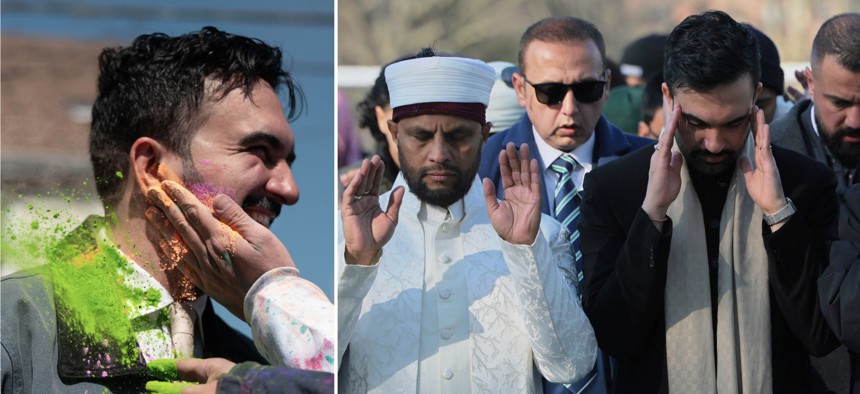
A Muslim mayor with a Hindu background, Zohran Mamdani has embraced different aspects of his identity as mayor of New York City. Michael Appleton, Kara McCurdy/Mayoral Photography Office

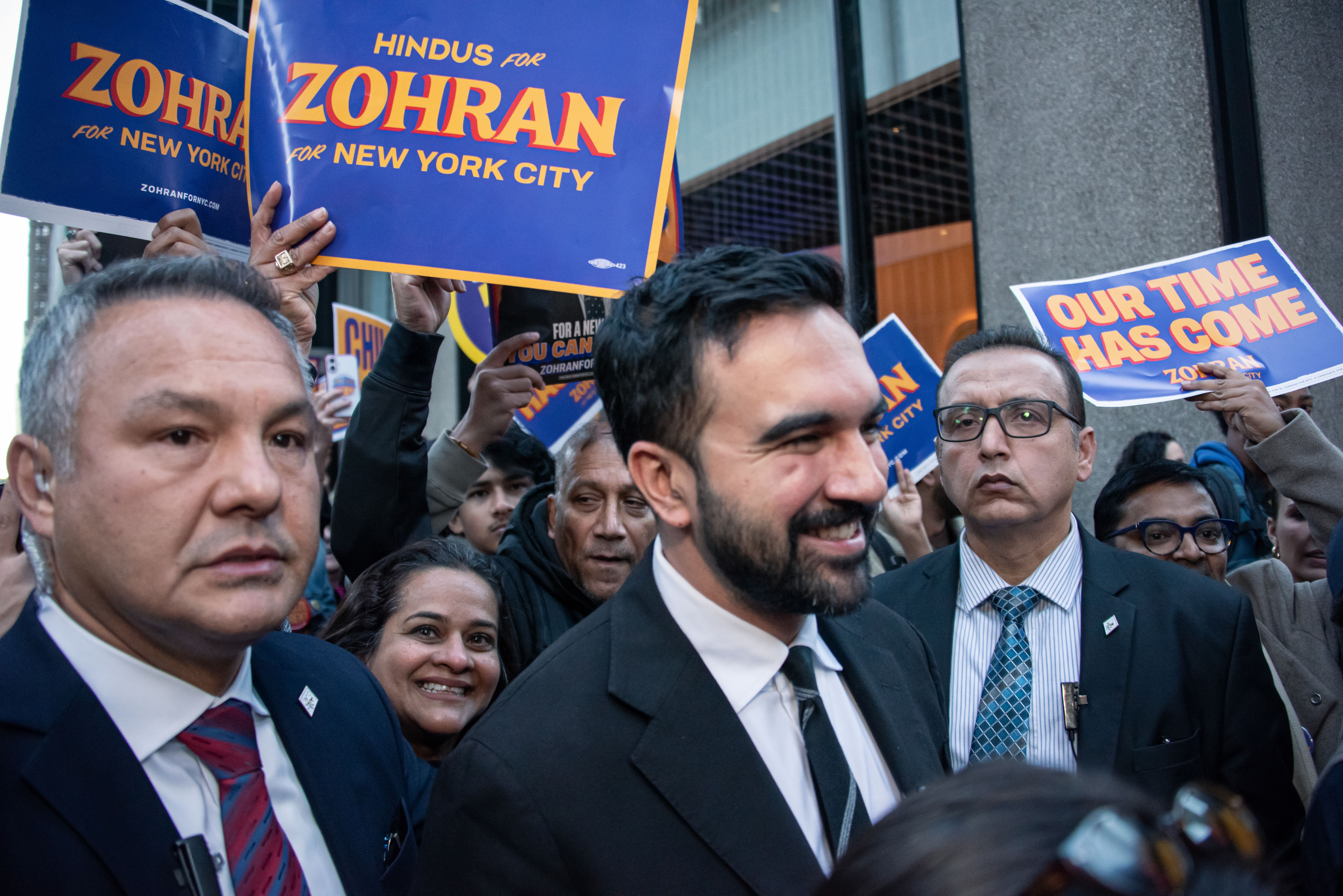
One year ago, on the night of May 4, 2025, when candidate Zohran Mamdani was barely polling in double digits against then front-runner former Gov. Andrew Cuomo, his first major rally at Brooklyn Steel leaned heavily into his South Asian background. Without mentioning it by name (perhaps a hard-won lesson from Kamala Harris’ freshly failed presidential campaign), Mamdani’s South Asian identity boomed from the pre-show music on the loudspeakers, beamed from the kurta he wore in the banner image on his website and radiated from his desi supporters at the concert venue. South Asians emceed (Kal Penn), performed (Ali Sethi) and filled the stage and crowd, signaling an unmistakable, joyful declaration of Mamdani’s roots. It was an early indication of the strength of a substantially overlooked voting bloc that would turn out in historic, unprecedented numbers to help elect New York’s first Muslim, South Asian mayor.
Despite his historic win, however, Mamdani is not universally beloved among his community. Just before the primary, a section of Hindu New Yorkers had initiated a late-in-the-day campaign to oppose Mamdani, based on his critical comments on the Indian Prime Minister Narendra Modi. Mamdani, who had opposed Modi’s exclusionary policies against Indian Muslims as an Assembly member, had earlier emphasized at a mayoral forum organized by New York Focus and Hell Gate that he would not host a press conference alongside Modi if he were to visit New York, and called him a “war criminal” for his role in the 2002 Gujarat riots, in which more a thousand people – a majority of them Muslim – were killed.
A handful of Hindu Americans, some of whom lived on Long Island or in New Jersey and were unable to vote in the mayoral election, had banded together to form Indian Americans for Cuomo. The group flew a banner behind a plane going up the Hudson that read “Save NYC from Global Intifada. Reject Mamdani.” Cuomo, but also Mayor Eric Adams and Republican nominee Curtis Sliwa, saw the opening in the run up to the general election. Each mayoral candidate visited several Hindu temples and attended multiple religious events, hoping to make the most of the opposition Mamdani faced from a vocal Hindu minority.
Yet, there was one mitigating aspect of his identity that not only neutralized some of the resistance from Hindu New Yorkers but also helped ease Mamdani’s access into spaces where he otherwise might not have been easily welcomed: his own Hindu background.
The inner sanctums of many Hindu temples – including ones owned by Bochasanwasi Shri Akshar Purushottam Swaminarayan Sanstha, or BAPS, an influential Hindu sect from the state of Gujarat that is known to share close ties with Modi – are barred for entry from all except priests and, in rare circumstances, VIPs. It’s hard to imagine most Muslims being allowed in. But I watched as Mamdani, on October 5 at the Ganesh temple in Queens, was not only invited to offer prayers but also let just inside the outer layer of the inner sanctum, at some distance from where the idol was situated. The priest performed a prayer ceremony for him, tied the ritualistic sacred thread on his wrist, and asked him to touch the idol’s feet to ask for blessings for a successful campaign, as the rest of the group stood back behind an iron chain, which had been lifted to let Mamdani in.
Lower-caste Dalits like myself who are born in Hindu families are often wary about visiting Hindu temples, where we frequently are made to feel unwelcome, particularly those owned by BAPS, the Flushing outpost of which Mamdani had visited the same day. BAPS was accused of exploiting Dalit Indian workers to build a temple in New Jersey though a federal investigation was dropped and no charges were brought. In fact, the first time I visited a Hindu temple, after more than a decade of living in New York City, was when I started following the Mamdani campaign in its early days, last year. Curious to understand and document the growing power of South Asian New Yorkers through a South Asian candidate, I consistently noticed the absence of Dalit New Yorkers from that broad coalition. After writing the book “Coming Out as Dalit,” which was published in the U.S. in 2024, and being involved in policy around caste legislation in New York state (which Mamdani supported as an Assembly member), it became crucial for me to unpack how his rise would reflect on the community from which he received his earliest support. What I discovered was a complex and nuanced portrait of New York’s first South Asian mayor, whose choices speak volumes about the growing power of South Asians in New York.

Where he came from …
Mamdani was born to a Ugandan academic with Gujarati Indian roots, Mahmood Mamdani, and India born-and-raised filmmaker, Mira Nair. Mamdani identifies as Muslim – the religion of his father – but also grew up with a Hindu background, through his mother’s religion, an identity which he addressed sparingly while campaigning and rarely since becoming mayor. Mamdani didn’t respond to an interview request for this story.
Mamdani’s mixed religious heritage is an illustration of the syncretic faith traditions that are common across South Asia, especially in India. Although, Hindu-Muslim unions have come under attack, particularly since the election of the Modi government in 2014, families like Mamdani’s belong to a rich history of multifaith upbringing where both Hindu and Muslim traditions are observed, including festivals, food and religious customs. Nair, whose movies frequently feature postcolonial themes, has discussed her own Punjabi Hindu family as “not particularly religious,” and her son’s Muslim-Hindu upbringing as never being a source of tension. The focus from his parents was on acquiring “knowledge.” “He had to study the world. He had to read. He had to write,” Nair told Vulture.
Mahmood Mamdani, an anthropologist and postcolonial studies scholar, is known for extensively writing on issues of Muslim identity, including the book “Good Muslim, Bad Muslim,” which regained popularity during and after Mamdani’s campaign. The Columbia University professor has emphasized his son as “the first African mayor of New York of South Asian descent,” regardless of Zohran Mamdani himself leaning more on his South Asian roots and identity during the campaign. Yet, his decision to identify as Muslim over Hindu appears linked to his father’s lifelong anticolonial scholarship over the question of identity, whether it is around Indian Ugandans, whom the elder Mamdani firmly establishes as Africans of Indian descent (perhaps indicative of why a teenage Zohran checked African American as well as Asian on his Columbia application), or whether it be his father’s Muslim background, which Mahmood Mamdani has repeatedly foregrounded as a political identity, particularly in the wake of the heightened media attention after 9/11.
Mahmood Mamdani opens “Good Muslim, Bad Muslim” with a dedication to “Zohran and his mates … and all the children everywhere who will inherit the world we make.” And he recalled reading “portions (from his academic work) that could be read to an 8-year-old without harm,” at his son’s request. The mayor was unquestionably inspired by his father’s scholarship and even changed his major to Africana Studies for his last two years as an undergraduate at Bowdoin College in Maine, The New York Times reported. So it’s rational that he would also choose his father’s political identity as his own.
Mamdani’s Hindu identity might even have been easier to lead with (as some South Asians in New York perplexingly expected him to do), given its existing political capital in the U.S., but he has clearly chosen otherwise. If anything, Mamdani’s decision to so promote his Muslim identity – which is also tied into his advocacy for Palestinians – is a brave political choice for someone who was running for citywide office in New York City. New York City has a large share of Muslim voters, and they supported him in record numbers, but that identity has come with bitter backlash, near-constant scrutiny and toxic Islamophobia as an ongoing undercurrent for nearly all his governing choices.
What is equally interesting is Mamdani’s relationship with the country of his parents’ origin, India. Mamdani has been repeatedly critical of Modi, and earned a sharp rebuke from the Indian government in January after he sent a handwritten note of solidarity to Umar Khalid, an Indian Muslim political prisoner, who has been in jail since 2020 without bail, over his alleged involvement in the communal clashes in India. And while Mamdani chooses to identify as “South Asian” instead of “Indian” (to the chagrin of some Indians online), he frequently draws on the country in his political decisions. In his election night speech, Mamdani also quoted from India’s first Prime Minister Jawaharlal Nehru’s address delivered on the eve of the country’s freedom from centuries of British rule. And last week, in response to a question around King Charles’ New York visit, Mamdani said that he would “encourage him to return the Koh-i-Noor diamond,” a rare 105.6 carat jewel, which was presented to Queen Victoria in the 1840s, when India was still under British rule, and which the Indian government has lobbied repeatedly for the United Kingdom to return. In making these careful choices, Mamdani displays rare acumen in sending pointed political messages to the Indian government, at the same time drawing from postcolonial legacies of (one of) his countries of origin.
Possessing both a Muslim identity and Hindu heritage also allows Mamdani to successfully walk the tightrope that bridges the often-bitter divides that separate the delicate South Asian coalition of Indian, Pakistani, Bangladeshi, Nepalese and Sri Lankan communities that share complicated political dynamics back in the subcontinent. Mamdani campaigned while fasting for Ramadan, hosted community iftar dinners, and frequently spoke at gatherings inside mosques following communal prayers. Yet, he also talked about growing up celebrating Hindu festivals like Diwali and the brother-sister celebration of Rakhi. Although Mamdani had appeared in several events inside Hindu temples during his time in the Assembly, he largely skipped visiting them during his primary campaign (with the exception of a low-key visit to a Nepalese temple in Ridgewood). On a rare string of visits to temples in October organized by Hindus for Zohran, Mamdani spoke about his mixed identity.
“I’m proud of my Hindu heritage, I’m proud to be someone who would be the first Muslim mayor of the city,” he said. “I’m proud to hold all of those things together, as we deliver a vision for the people of this city.” On Diwali, weeks before the November general election, Mamdani distributed sweets out of a restaurant in Jackson Heights, a time-tested tactic often employed by South Asian politicians.
That late-in-the-race acknowledgment of Hindu festivals gave the impression of pandering to a Hindu voter base. But Mamdani’s commitment to his multireligious identity was evident during his time as an Assembly member, when in 2023, he co-sponsored a bill to make Diwali a public school holiday. The bill was introduced by Assembly Member Jenifer Rajkumar, who was first elected to the Legislature on the same day as Mamdani in 2020 – making them both the first South Asian Assembly members in New York history.
Rajkumar, who bills herself as “the first Hindu American elected to New York State office,” stands in contrast to Mamdani, as someone who is more emphatic about her Hindu background and has publicly clashed with the mayor over their divergent approaches to Indian politics and the Modi government. Mamdani attended multiple protests against the Modi government’s policies since first getting elected in his western Queens district, while Rajkumar was endorsed by groups like American Hindu Coalition, and accepted donations from individuals with close ties to Modi – which led Mamdani to dub Rajkumar a “puppet of Hindu fascists.” Mamdani’s remarks on Modi, in turn, drew immediate backlash from Rajkumar, and later, a coalition of mostly right wing Hindu organizations signed a letter calling Mamdani “Hinduphobic” for his comments on both Modi and Rajkumar.
Mamdani and Rajkumar not only differ in their opinions on the Hindu right, but also around the issue of offering caste protections to New Yorkers. Mamdani was among the co-sponsors of an Assembly bill to add caste as a separate category of discrimination in state law, and he is broadly known to support anti-caste assertion. In contrast, Rajkumar isn’t a sponsor and has appeared at multiple events hosted by the Hindu American Foundation, which was among the lead opponents of a similar California bill that was vetoed in 2023. At an HAF event in November, as seen in videos obtained by City & State, Rajkumar discussed introducing a bill to remove all mentions of caste from school textbooks in New York – arguing that would unfairly single out Hindus.
As she seeks reelection to the Assembly, Rajkumar is facing a challenge from David Orkin, who unsuccessfully sued to get her off the ballot, accusing her of committing petition fraud, which she denied. Like Mamdani, Orkin is endorsed by the New York City chapter of the Democratic Socialists of America, and while the mayor hasn’t backed Orkin yet, he's widely expected to do so before the June 23 Democratic primary.
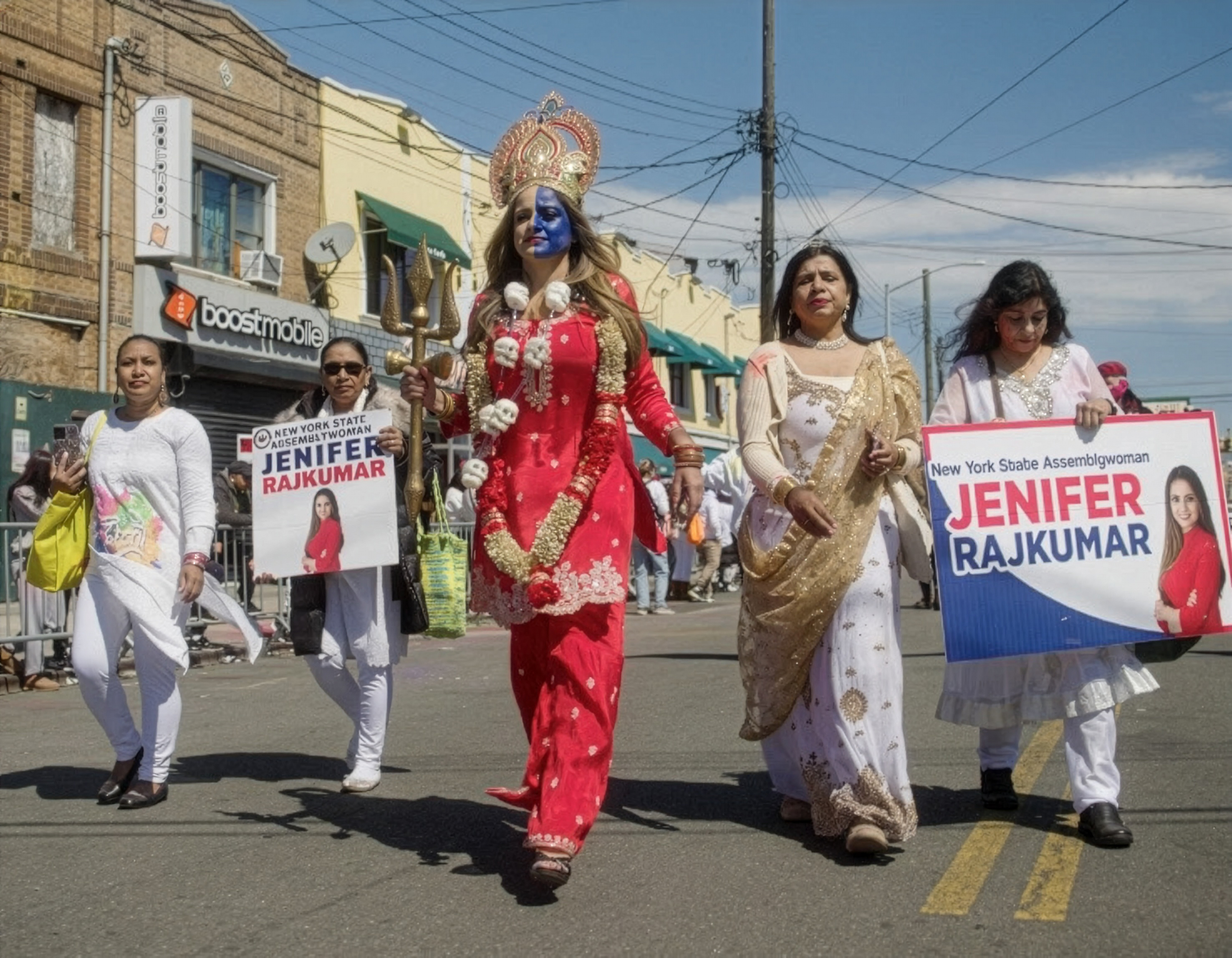
Both Mamdani and Rajkumar recently appeared at the Phagwah, or Holi celebration parade in Richmond Hill, organized by Indo-Caribbean New Yorkers. Mamdani stood on the mayoral float, dusted in bright colors, and Rajkumar arrived with half her face covered in blue paint, with a golden crown on her head and dressed, quite literally, in the image of a Hindu goddess.
“I was there, dressed as the Goddess Kali, with my cohort of strong Indian women. But I did say hello to the mayor, and we shook hands,” she told City & State. “Just a hello. And we marched together for a bit.”
… Where he’s going
After four months in office, Mamdani’s governance has yielded mixed responses among the South Asian communities who simultaneously burst into political prominence with the election of the city’s first South Asian origin mayor. More than 87% of South Asian voters cast a ballot for Mamdani, and South Asian turnout increased to 43% in 2025 from just 15% in 2021, according to Board of Elections data analyzed by South Asian political organization DRUM Beats. Mamdani stacked not just his transition team but also the current mayoral admin with desis, including Ali Najmi, the chair of the Mayor’s Advisory Committee for the Judiciary, and former DRUM Beats Political Director Jagpreet Singh who’s now a top aide in the Office of Mass Engagement.
Mamdani’s early announcements, like increasing funding to expand free child care, reaching a settlement giving $5 million in worker restitution and penalties for delivery workers (many of whom are Bangladeshi and Pakistani) and citywide rental ripoff hearings have earned Mamdani favorable points among the community. Other moves like floating the idea of raising property taxes, which would disproportionately impact Black and brown homeowners (meant as a bargaining chip to get Gov. Kathy Hochul to agree with his “tax the rich” agenda in an election year) have proven unwelcome. Several people who spoke with City & State, including many of Mamdani campaign’s early supporters, revealed discomfort with his willingness to introduce a policy idea that they believed would hurt South Asian communities.
However, some, like Kazi Fouzia, a community activist and one of the many “Bangladeshi aunties” Mamdani shouted out in his primary night victory speech for campaigning tirelessly for him, are also willing to give him a longer rope. “Zohran said he will only increase the property taxes if he is not able to tax the rich. But people think ‘oh you’re increasing our taxes’. His promises are always misunderstood,” she told City & State. Fouzia explained that even during the campaign, many South Asian New Yorkers were worried that his “freeze the rent” policy would hurt working class landlords.
But it was one incident in particular that tested Mamdani’s overlapping identities and his new role as mayor. This January, Jabez Chakraborty, a 22-year-old Bangladeshi New Yorker experiencing a mental health episode was shot by cops while holding a knife inside his home. His family had dialed 911 to request an ambulance, but two NYPD officers showed up instead. Mamdani’s initial response thanking the first responders drew immediate ire from some South Asian New Yorkers.
“Why is the Mayor applauding officers who recklessly almost killed our son in front of us?” read a statement from DRUM, whose affiliate DRUM Beats had been among the Mamdani campaign’s earliest supporters. Even as Mamdani later met with the family and visited Chakraborty in the hospital – he survived the shooting and has since been charged by Queens District Attorney Melinda Katz for attempted assault and criminal possession of a weapon – and promised the release of body camera footage from the police officers, it was a clear and dissonant break between his South Asian supporters and the mayor, one that had happened quite early in his term.
“We were quite disappointed in the original statement, and after trying to engage and not getting (a response), and publicly pushing back, then we got responsiveness,” DRUM Executive Director Fahd Ahmed told City & State. Ahmed added that since their public statement, the Mamdani administration has been “spectacular” in their follow-up on the case and the needs of the family. “At least, we feel like we’re being meaningfully engaged and not just sort of being written out.”
After all, the shooting opened up old tensions among some South Asian New Yorkers and the NYPD. The scene reflected the death of 19-year-old Bangladeshi New Yorker Win Rozario in 2024, who NYPD officers shot and killed holding scissors while experiencing a mental health crisis in his home. And some South Asians were upset by the mayor’s decision to retain Jessica Tisch as the NYPD commissioner, who started her career in its controversial intelligence division known for mass surveilling Muslim New Yorkers post 9/11. Under Adams and Tisch, NYPD’s Strategic Response Group frequently targeted pro-Palestinian protestors with heavy-handed and frequently violent force, including students on campuses across the city.
Some more left-leaning New Yorkers are talking about pressuring the mayor to pick a new police commissioner.
“(One) option is us as a community putting forward a candidate (for commissioner) that we think would be superior and more viable and more attentive to communities and (enforce) consequences for police officers who brutalize innocent people,” legal services lawyer and former Mamdani campaign volunteer Shivani Parikh told City & State.
Meanwhile, Council Member Shahana Hanif, who was also the first Muslim and Bangladeshi woman elected to office in New York City, cautioned that Muslims can’t just rely on representation, but need solidarity amidst rising Islamophobia.
“Islamophobia changes its face, and as more of us get into elected positions, needing the support of our colleagues to push back against that rhetoric will become very important,” Hanif told City & State. She expressed her discomfort with declaring Mamdani as “the leader of South Asian representation”, adding that South Asian visibility in arts, academia and activism can be equally credited for generating this current moment.
One of the first things the council did in the Mamdani era was overriding Adams’ veto of a bill meant to protect Uber and Lyft drivers from unfair dismissal. The bill was sponsored by the Indian American City Council Member Shekar Krishnan who, in Jackson Heights, represents the largest population of taxi drivers in New York.
Krishnan stressed that a Muslim mayor of New York City sends a “poignant” message to Muslim New Yorkers, echoing Hanif’s call to end Islamophobia. “But that does not mean that accountability ends,” Krishnan told City and State about the discontent among community members around the police shootings.
Several South Asians echoed Krishnan, like tech worker Faiza Shireen who feels “cautiously optimistic” about the mayor. “There is a movement that is outside of this candidate, and I want to make sure that we are holding true to that movement, rather than building a cultural personality,” she said.
“The real work comes back to empowering us as the people of New York,” says Durga Sreenivasan, an organizer who worked on Mamdani’s campaign recruiting volunteers. “How do we get enough funding for lawyers for those kidnapped by ICE? How will racial equity define the city’s budget?” Sreenivasan told City & State. “In order to stay hopeful, it’s imperative that we keep asking questions.”
Many other South Asian New Yorkers were more generous in their assessment, including community organizer Harpreet Singh Toor, who had campaigned for Cuomo. “Even though I did not support him, I personally pray for his success,” Toor said of Mamdani. “If he fails, then our next generations will get a setback to aspire for that office, and that’s why it’s paramount that he should succeed.” As a Sikh New Yorker, often singled out for his faith, Toor also hasn't liked the Islamophobic reactions to Mamdani. “They are saying that he’s the Muslim mayor of New York City,” Toor said. “Nobody said Christian Eric Adams or Jewish (Michael) Bloomberg or Christian Rudy Giuliani.”
But even off the campaign trail, Mamdani has continued to promote his South Asian identities. He dropped by the NYPD’s Sikh Heritage Day Celebration on April 30, introducing himself to the crowd at police headquarters as first Punjabi mayor of New York. And he’s continued to underscore his Muslim identity, hosting public Ramadan celebrations across the city and iftar dinners almost every day during the holy month.
Supporters like Indo-Guyanese political organizer Tej Budhram appreciate it. “A lot of things that might seem symbolic have actual power,” he told City & State. But when there was such fearmongering about Mamdani’s identity during and after the campaign, Budhram finds it powerful that he’s simply doing his job as mayor.
“The biggest impact of the Mamdani mayoralty has been showing that a Muslim in government doesn’t mean anything really – in the sense of like, nothing has changed,” he said. “He’s governing as well as any other mayor – miles better than other mayors.”
Yashica Dutt is an award-winning author of “Coming Out as Dalit” and a political journalist based in Brooklyn.
Corrections: This story has been updated to provide detail about Mamdani’s visit to Ganesh Temple in Queens and to add that no charges were brought following the federal investigation into BAPS. This story has also been updated to clarify that Shivani Parikh is considering supporting a new candidate for police commissioner.
NEXT STORY: City’s first ‘close Rikers czar’ starts this month