

Interviews & Profiles
Maurice Brown thinks Syracuse is ready for democratic socialism
An interview with the Onondaga County legislator hoping to end Assembly Member Bill Magnarelli’s nearly three-decade tenure.
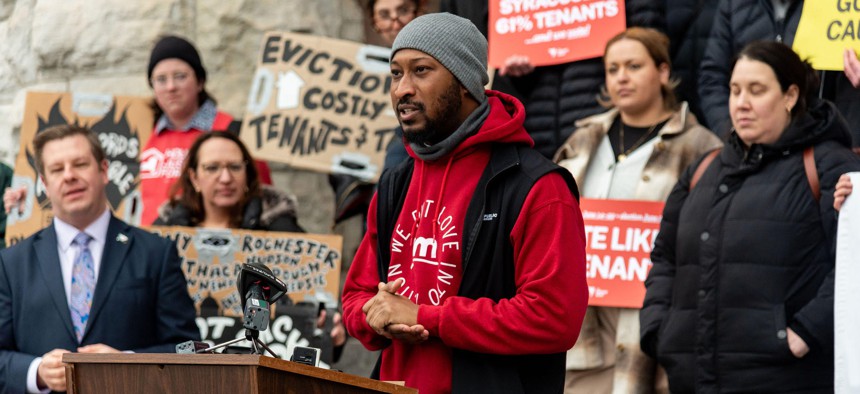
Maurice Brown is running for Assembly in Syracuse. Ciara Feltham of Ciara Studios


Maurice “Mo” Brown did not dream of a career in politics – instead, the 34-year-old spent most of his life chasing a career as a stand-up comedian as he performed sets poking fun at his time in the Army Reserve, applying to work at Taco Bell and his job in construction.
That changed in 2015, though, when Brown volunteered for U.S. Sen. Bernie Sanders’ presidential campaign after being inspired by his messaging on income inequality. He hosted rallies and town halls for the campaign, and then worked with the Working Families Party in Syracuse before serving as a member of New York Progressive Action Network’s board of directors for nine years. In January 2024, he was elected to serve as the county legislator for the 15th district of Onondaga County, encompassing much of the southern side of Syracuse. Now, Brown is posing a primary challenge against incumbent Bill Magnarelli for Assembly District 129 – with Sanders and the DSA endorsing his run.
Since entering politics, Brown says life isn’t as funny anymore. Admittedly, there’s not much comedic material to extract from lead levels in drinking water and the potential environmental impacts of the Micron project. But there are plenty of similarities between stand-up and politics.
“In some situations, they're the same,” Brown told City & State. “As a stand-up comedian, you look at life and you try and find the humor in it. Whereas an elected official, you look at life and you try and find how to make it better.”
City & State spoke with Brown last week about why he chose to challenge Magnarelli, their upcoming debate and his support for increased statewide taxes on the rich. This interview has been edited for length and clarity.
What key issues in your district pushed you to pursue elected office in the Assembly, as opposed to remaining in your current role as county legislator?
A lot of the work you do at the county level is paid for at the state level. The one that came to a head last July was childcare, where we had to stop taking childcare (assistance funding applications) because of the state. Fundamentally, I think we should have universal childcare, so that was the biggest issue that pushed me into the race. Another one that you really can’t pursue on the county level is the data center moratorium, and up until yesterday my opponent was unsure on the data center moratorium, which is such a big issue statewide. (Editor’s note: Magnarelli is a co-sponsor of the latest data center moratorium legislation, which was introduced June 1.) I live in Central New York – Skaneateles Lake and the Finger Lakes define our region. If we don’t pass a moratorium and if we build any data centers the way they’ve been building them right now, it would be an existential threat to the city of Syracuse, and I think it’s so important that I ran for state Assembly on those two things.
Your primary race is one of several throughout the state that sees an establishment incumbent being challenged by a progressive. Within this larger trend that we’re seeing throughout the state, why did you specifically decide to primary Magnarelli?
Initially, when I was considering getting into the race in November, the thought was that Magnarelli was going to retire. He hadn’t said anything, but there were rumors that he and a good amount of the older Assembly members were thinking about retiring. It was more just exploring an Assembly run, but once he decided he was in the race the reasons I would run remained the same. He’s not in favor of good cause eviction. He wasn’t in favor of a data (center) moratorium until yesterday. It wasn’t necessarily that I was running against him – I just want an Assembly member that is willing to fight for the things that I see as important. He hasn’t been that person, and I don't think he’s going to be after 28 years.
Magnarelli has gone unchallenged for much of his 28-year tenure in the Assembly. What has been particularly challenging about trying to upend nearly three decades of a status quo of leadership in the district?
Entrenched power yields nothing without a demand. That’s just life. The powers that be have definitely formed against our campaign, and we thought they would, but I view what we’ve already done as a win. He’s been a notoriously unresponsive Assembly member, and now he’s picking up calls that he’s never done before, like on the data center moratorium. He’s been absent on that, he’s been absent on the community grid conversation. We’re tearing down a big highway in the city of Syracuse that once divided us, and he was not in favor of the teardown. Since he didn’t get his way, he hasn’t been helping the project at all, and I’m told now he is engaging in those conversations. If he had been doing these things all along, I could have happily just bowed out, but it seems like he needs that pressure in order to do his job – so it’s my job to provide that pressure.
You two will debate two times this week. How do you intend to differentiate yourself from him policy-wise as you present yourself to voters?
The biggest difference between us is our tactics: he likes to play the background. I think that you need to be the leader in certain conversations. He’s been in favor of the New York Health Act; I’m going to be a leader on the New York Health Act. He’s not really a leader, he’s more of a gatekeeper. Right now we need people who are going to vocally oppose what ICE is doing, who are going to stand up and fight. People want fighters right now. I think he’s had good service and maybe he can still fight in the ways I think he needs to, but he hasn’t been a fighter for the first 28 years so I’m not expecting him to become one now.
A big part of your campaign has centered on housing affordability and transit, and your support for taxing the rich to get those funds is a major difference between you and Magnarelli.
With all of the things we say we support, you really can’t do them unless you’re going to tax the rich unless you’re in favor of cutting something else. Previously it was Assembly Member Demond Meeks’ bill that was going to pretty much change the tax bracket for those who make above $500,000 a year. If you’re making $500,000 in a year, you can afford to give a little more. We’re calling on those people to step up right now, and we’re seeing in places they have been asked that they’re not leaving the state – the second homes tax was implemented in New York City, and we’ve not seen this mass exodus. It takes courage to stand up to these really powerful, really wealthy people, and I’ve not seen my Assembly member display that courage, and right now we need that.
NEXT STORY: This week’s biggest Winners & Losers