

Personality
Harry Nespoli reflects on the evolution of the labor movement
The former head of the Municipal Labor Committee talks about working with Mike Bloomberg and Jessica Tisch.
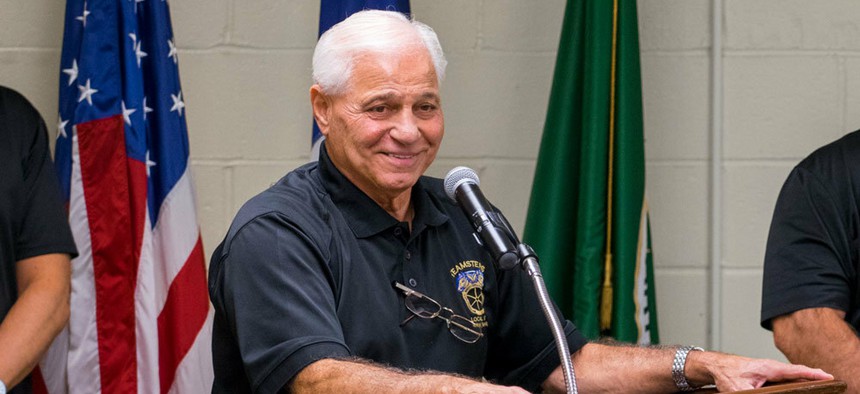
Harry Nespoli, who led the Municipal Labor Committee, retired last year after five decades with the New York City Department of Sanitation. Courtesy Teamsters Joint Council 16



Harry Nespoli retired last year after decades as one of the top union leaders in New York City. A five-decade veteran of the city Sanitation Department, Nespoli retired as president of the Uniformed Sanitationmen’s Association and as chair of the Municipal Labor Committee. In a Q&A, Nespoli talked about how New York City’s labor movement has changed over the past two decades and how the city needs to address affordability issues affecting municipal workers. This interview has been edited for length and clarity.
How has the labor movement in New York evolved over the past 20 years?
Well, there’s more pressure on unions, only because of the cost of living in the city. So that means that the concern of all the unions in the labor movement is to satisfy the members the best they possibly can. With the cost of what’s going on in the city right now compared to what it was years ago, I mean, congestion pricing, everything costs money now, and I think that the labor movement is doing a very good job of representing their members, and it seems like a lot of unions are getting frustrated with their members not getting a big enough raise to keep up with what the cost for New Yorkers is.
How would you rate the New York City mayors that you worked with?
Probably the one that really kind of knew what the unions were looking for in the beginning was (Mike) Bloomberg. He’s a businessman. I went to the City Council to speak in favor of getting an extra term for Bloomberg because 9/11 was there, and the city was really in shambles as far as money was concerned. Who do you want at the helm? You want somebody that doesn’t know how to do business? No, and he won. He got the term.
Since you stepped down there has not been a permanent chair of the Municipal Labor Committee. Do you think this is hindering the committee work?
The MLC is very, very powerful, and the people that are on the board are able to turn around and run the MLC because they’re together. And when they’re together, that’s when that’s dangerous for the city of New York, because if you slap one around, the other one’s looking at you. So, I know they had the runoff and they didn’t get the third or whatever, but I think there’s something they’re still working on now, and I think it’s going to be resolved, and it’ll be a single person on top. But again, that’s a board, and the board rules there.
You had a chance to work closely with Jessica Tisch when she was sanitation commissioner. How would you rate her work at both the city’s Sanitation Department and the Police Department?
Whenever she wanted to speak, I was there. Whenever I wanted to speak to her, she was there. She is very, very creative. She’s not a pushover, and she asks you a question, she knows the answer already. She’s a very, very intelligent person and she comes to work and she works. And anytime I wanted her, anytime I called her, she was involved. Anytime I had a gripe about something, she sat down and she waited and she voiced her opinion, and she gave me her answer to it. That’s all I could ask for, is somebody that is willing to listen and willing to weigh the problem and to come up with something together. I’ll tell you one thing, she’s doing a hell of a job as commissioner of the Police Department. And, you know, it’s a tough job. Tisch is a hell of a worker. She ain’t scared of work.
What do you think Jessica Tisch’s political future is?
I think that I think she has a great future ahead of her politically, no matter which way she goes, because she’s there, and she shows up. She was always there in sanitation, always. I think that she has a great future as long as she wants to continue doing it.
How has the Department of Sanitation evolved over time?
It’s doing great. It really is. From the time when I loaded the truck in 1970 when I was hired to the time that I retired last year, it’s progressed along excellently. You got some good union leaders in there now, and you got some great management leaders there. And we’ve always had an open door policy that we can work it out as long as we get to a meeting. The department never turned me down, no matter who the commissioner was, and I never turned the department down. I always, no matter who the labor relations (commissioner was), Jim Hanley and Renee Campion. But when you reached across the table, you shook a hand, you knew you had a deal. That was it. Renee, when Renee gave her word, she kept her word. And whatever was across the table, she always remembered, and I always remembered too.
How do you view the entire debate and fights over Medicare Advantage? What are your thoughts looking back on that?
I thought the program was put together well, I really did. But, the members didn’t want it, some retirees didn’t want it, and you got to let it go sometimes.
And speaking of the state, how do you think Gov. Kathy Hochul is doing?
She’s doing the best she possibly can do, but it’s politics, and now it has changed. And you don’t know until you count the ballots. Every time I talk to her, she sounds positive, she sounds good, and she’s been around. Everybody likes to change, change, change, but you know what? Sometimes change isn’t good.
NEXT STORY: Meet the brains behind the State Fair