

Politics
John Samuelsen is (predictably) not happy about the horse carriage ban
An interview with the union leader on what he plans to do next about the apparent deal to ban the industry from New York City.
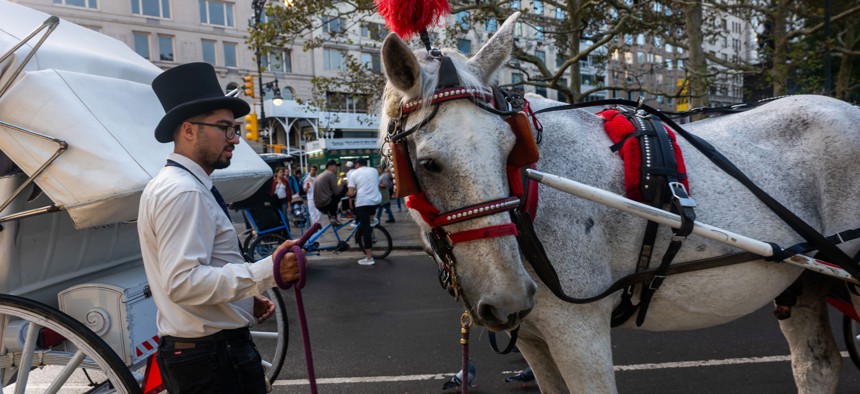
The horse carriage industry is likely coming to end in New York City after a deal was recently struck. Spencer Platt/Getty Images



New York City’s decades-long (or longer) debate over horse-drawn carriages appears to be finally coming to a close. The New York City Council plans to vote on a bill next week to ban the industry, with support from Mayor Zohran Mamdani. The advancement comes after the death of 18-year-old tourist Romanch Mahajan during a ride over the summer, when a horse bolted and Mahajan jumped from the carriage to help his mother, who had been thrown off.
After years of deadlock, with labor consistently opposing efforts to ban horse-drawn carriages, there’s not a lot of leverage left for the carriage drivers and the union that represents them to put up a fight over the industry’s impending end. But there’s still plenty of room for fighting words from Transport Workers Union International President John Samuelsen. The union blasted the agreement to advance the ban, saying the workforce protections weren’t strong enough in the amended legislation, calling resources like career counseling “weak” and criticizing the lack of a requirement for the city to compensate carriage owners.
City & State caught up with the union president for an interview about his discussions with Mamdani and Menin amid this apparent loss. Samuelsen, not known for keeping his feelings about politicians close to his vest, shared stronger criticism of Menin than he did of Mamdani, though both are supportive of the ban.
“Speaker Menin was clear that the transition away from horse carriages in Central Park must include meaningful protections for the workers,” Menin spokesperson Jack Lobel said in a statement. “Through thoughtful conversations with labor and other stakeholders, the council developed a framework to ensure better economic opportunities for these New Yorkers. As the administration implements the plan, Speaker Menin’s office will remain engaged in the transition process, including through a new joint working group that she has invited TWU and the administration to join.”
At a press conference on Wednesday, Mamdani said his administration is committed to protecting the workers and owners in the industry. “We want to ensure that this is a resolution that also comes with a measure of a just transition for those who have earned their livelihood from this kind of work,” he said. This interview has been edited for length and clarity.
New York City Mayor Zohran Mamdani had a part in bringing this to the finish line, saying that the horse carriage industry is coming to an end. Have you talked with him about this recently?
I did. I talked to him yesterday and expressed my dissatisfaction with his going along with what began with a Julie Menin-contrived bill that is predicated upon a fictitious public safety emergency, just ridiculous public safety emergency, and I expressed that to him. There are differences between him and Julie Menin in this. He’s consistently held the position that he’s against the use of these horses in the carriage industry. Julie Menin has supported us in the carriage industry all along, and then used this tragedy and exploited the grief of a family that suffered this tragic loss to create this fiction that the horses are dangerous.
So even though the mayor has been more consistently against what your position is, you don’t hold him as responsible for what’s happening now?
He’s not the one who drove the bill forward. I believe that he should not be going along with this contrived notion that somehow the Central Park carriages are dangerous, which is what Julie Menin predicated this bill upon. You know, think about that for a second. The e-bikes are mowing people down across New York City, and they remain unaddressed. Yet there’s a lot of chatter about it in this professional political class in New York City. And I conveyed that to Zohran. … I don’t think Zohran believes the horses are a public danger. I think he has a morally held belief that the horses shouldn’t be doing what they’re doing, and I do believe that that’s different than Julie.
The speaker has a package of bills on e-bikes. It hasn’t moved forward yet, but there has been a hearing on that.
Doesn’t matter. How come she didn’t fast-track the clearly more dangerous problem to New York City, the way that she did with clearly not a public safety problem in New York City?
Do you feel like this hurts your relationship with the mayor moving forward? Can you still work together?
I think the mayor also has a heartfelt desire to ensure that workers in the industry land on their feet. I don’t think any of that is visible in the bill that Julie put forward. There’s a bunch of what trade unionists would call “supposals” in the bill. There’s no guarantees, there are supposals. There’s nothing concrete written into the bill. There’s no guarantee of compensation for individuals, business owners, that invested their life savings into horses and medallions. There’s nothing – there’s garbage in the bill. So she is throwing it all into the lap of the mayor.
The speaker has a few years left of her leadership of the City Council. Outside of this particular issue, do you feel like there’s any capacity for TWU to work with – and for yourself to work with – the speaker on other issues? Or are the bridges burned?
Business is business. To the extent that the TWU has to do business in New York City, we have to do business in New York City. In terms of a professional trust in anything that Julie Menin says – no union should ever trust anything that Julie Menin says.
You said the bill throws a lot in the mayor’s lap to pick up these proposals. What role do you intend to have in figuring out what comes next? What’s your next move in this fight?
My desire is to see the workers themselves have a voice in their destiny. I don’t think that a track worker should be having conversations when the conversations begin about what a transition into a new livelihood looks like, if it gets to that point – and it certainly appears it’s going to. I think those conversations should be had with worker leaders themselves and the mayor’s office.
So you want the TWU Local 100 and the worker committees of carriage drivers and medallion owners to be leading that role, not yourself?
Yeah, absolutely.
NEXT STORY: Want to be the BOO-klyn Democratic Party chair?