

20th Anniversary
How Charlie Rangel won over Al Sharpton
The Rev. Al Sharpton remembers the pioneering Lion of Lenox Avenue.
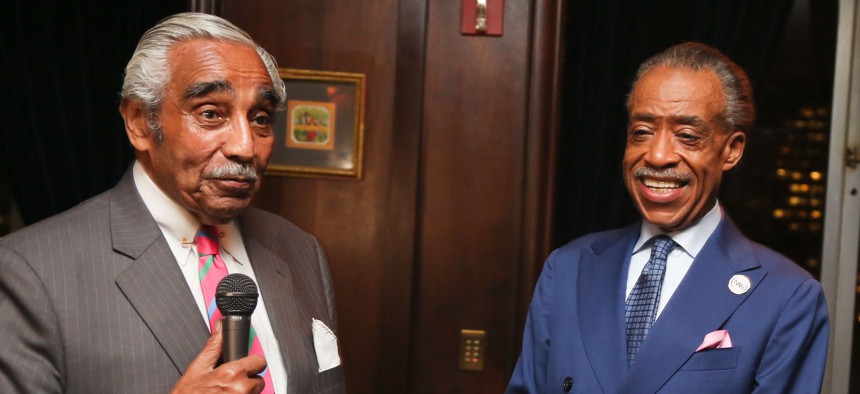
The late Rep. Charles Rangel and the Rev. Al Sharpton at Sharpton’s birthday party in 2013. Johnny Nunez/WireImage



Charlie Rangel is one of New York’s 20 most influential politicians of the past 20 years. See the full list.
The late Rep. Charlie Rangel liked to say that he “never had a bad day” after a Korean War battle in which he led men out of a harrowing skirmish with Chinese troops while wounded.
It wasn’t just a catchphrase lent to the title of his memoir spanning the pioneering Harlem Democrat’s life, 46-year tenure in Congress and ascent to chairing the powerful House Ways and Means Committee, becoming the first Black member to do so.
The motto was a “contagious” philosophy, said civil rights leader the Rev. Al Sharpton. “We had a mentality of ‘don’t cry in your milk, keep going.’ And we got that from Charlie,” Sharpton said of Rangel, who died in 2025 at 94 years old.
Born more than 20 years after him – in Brooklyn, not Harlem – Sharpton was not a direct contemporary of Rangel’s. Unlike Rangel, Sharpton wasn’t a member of Harlem’s Gang of Four. When he moved his National Action Network to Harlem, Sharpton was seen by some as part of the new guard. But the two would come to work toward a shared vision – one they viewed through different glasses, as Sharpton puts it.
Sharpton reflected on Rangel’s legacy in an interview with City & State. Here is Sharpton, in his own words, on the “Lion of Lenox Avenue.” The responses have been edited for length and clarity.
On his first impressions of Rangel …
I was a teenager that had been an ardent fan of (Rep.) Adam Clayton Powell (Jr.). When Adam Clayton Powell ran the last time, in 1970, I would come up from Brooklyn and help volunteer. I was too young to vote. Rangel won the primary, and I was heartbroken. … By 1971, the Rev. Jesse Jackson had started (the civil rights organization Operation) PUSH, and (through that) I became very friendly with (Manhattan) Borough President Percy Sutton, who was close to Charlie Rangel. They used to tease me, “We reconverted Adam’s boy.” … (Rangel) surprised me because he was not the establishment, backroom kind of politician that I thought was opposing Adam. He was active. He would talk to me about how he marched in Selma and that he agreed with our activism. And so we became more and more friendly, and by the time we got to the ’80s, many of the cases I’d fight – whether it was Bernhard Goetz, whether it was Howard Beach – he would call me. He’d be right there.
On going to jail together …
As a result of the police killing of Amadou Diallo, I had started daily sit-ins at 1 Police Plaza. We’d go get arrested like (at) the vigils with the South African Embassy in Washington, D.C, (in the ’80s). We’re three or four days in, I’m at this prefight luncheon (at Madison Square Garden with Don King). Charlie Rangel’s there as a guest of Don King, as I was. And Charlie looks at me and said, “Reverend, I’m hearing that you’ve got people going to jail every day about this Diallo thing.” I said, “Yes, I am.” And he said, “What time do you go?” I said, “10 o’clock.” He said, “I’ll be there in the morning.” … About half an hour later, I go into the men’s room and former Mayor David Dinkins is in the men’s room. He said, “Charlie’s going tomorrow morning?” I said, “Yeah.” He said, “I’m coming.” I really didn’t believe either one of them. I told my publicist at that time, Rachel Noerdlinger, I said, “You can put out we’re going to have Congressman Rangel, but I don’t believe Dinkins.” (The next morning) about five minutes to 10, Rangel’s car pulls up and he and Dinkins got out and went and took a knee in front of 1 Police Plaza and went to jail with me. That’s the kind of guy Charlie Rangel was. And this was when he was at the height of his power.
On Rangel’s influence in Harlem and in Washington, D.C. …
He was one of the most powerful people in Washington. When (President Bill) Clinton was in, and we wanted to get things done, he’d get us a hearing. And he would tell Bill Clinton, “You’ve got to talk to Sharpton,” which he did. Clinton and I developed a rapport because of Charlie. Charlie got Clinton to move his post-presidential office to Harlem, 125th Street. Charlie Rangel did that. Ironically a lot of what Adam pioneered in Congress – the war on poverty, healthcare and all – Charlie maintained. If Adam Clayton Powell was the Moses of New York politics, Charlie Rangel was the Joshua. Adam brought us across the Red Sea, where we were not any longer in the bondage of Tammany Hall. But we weren’t in the Promised Land yet, we needed a Joshua. Charlie Rangel brought us across the Jordan by getting us a Black mayor and a Black state comptroller and a Black attorney general. That all came from the era and work of Charlie Rangel.
On Rangel’s physical legacy and those who follow in his mold …
When you look at the development, urban development up in Harlem, that’s directly Charlie Rangel. Cultural institutions, directly Charlie Rangel. He got the funding, he put it through. And I think when you look at a lot of the criminal justice reform, that was Charlie Rangel.
Those of us that were a generation behind him, the ones that I see is (Rep.) Gregory Meeks is absolutely a student of Charlie Rangel and is in that tradition. He and (Rep.) Yvette Clarke, I think, would be the ones that would come to mind.
On Rangel’s optimism …
No matter what happened, whether it was the election of Mayor Rudy Giuliani in 1993 – which broke a lot of our hearts because it was Dinkins’ reelection (campaign) – or later in life where we saw the election of Donald Trump – we were apoplectic about him beating Hillary (Clinton) – Charlie Rangel was always the guy that we’d meet at Sylvia’s or somewhere the day after. “Let me tell you what we’re going to do.” He was always the one with, “Let’s move on.” He’s the only guy that I know that wouldn’t mourn any defeat. He was the guy that says, “All right, let’s pick up the pieces, we’ll make this work.”
On whether that optimism fell with the ethics charges he was found guilty of in Congress …
I think he felt, in many ways, individuals in Congress betrayed him, because he felt that what they came with was not credible. So I think it was more of a personal disappointment in some of the Congress. But it didn’t shake his mission at all.
On the reported rivalry between him and Rangel …
It was a political (thing), taking different sides, but he and I always talked. He understood. First, he didn’t endorse me for mayor, and I understood. I said, “You’ve got institutions here. You’ve got to do what you got to do.” Nobody thought I’d get the vote I ended up getting.
And then when he ran (for reelection in 2014), I told him that I would not do anything to hurt him, but one of my board members, the Rev. (Michael) Walrond, was in the race, and I could not endorse against Rev. Walrond, so I’ll just stay out of it. And he said, “I understand that.” He said, “Well, I’m coming to the rallies and all.” And he did. So it was not a rivalry.
I think that we had not different visions, (but) I think that we were looking at them through different glasses. So you could see the same thing, but he would see more of the old guard, and I would see people like Rev. Walrond and others that should come on.
On Rangel’s humor …
In the middle of a tense moment, he’d find a way to say something that’ll make you laugh. We were fighting something. I think Giuliani or somebody. No, we were fighting about stop-and-frisk, and I was angry about something with (then-Mayor Michael) Bloomberg. And Charlie Rangel came by the Saturday rally, and I said, “You know, Bloomberg is not a bad guy. Why can’t he get that this is crazy?” And Charlie looked at me and says, “Well, I think you need to really explain it in policy terms. And by the way, since you got a TV show, I see you’ve got a new suit on today.” … He’d rib you all the time. In the middle of you and your passion, he’d bring you back down. He was excellent at that.
On what Rangel would say to today’s progressives and left-wing movement …
He’d say, “What are you going to deliver across the board?” That it should not be just some well-educated kids that have a trust fund. But “What are you going to do about the people in the projects? What are you going to do about the people in the Rangel Houses?” He would be with them on the issues, but he would challenge them on broadening and organizing.
On Rangel in retirement and the old guard growing older …
Maybe one or two Saturdays a month, he’d come by our Saturday rally. I remember I honored Rev. Jackson, who was my mentor, and Charlie came in on a cane. And I looked at that stage that night and saw Rev. Jackson in a wheelchair and Charlie on a cane. And it really hit me that this era is slowly moving away. And he would come. We’d be live on radio on Saturday morning. My emcees would say, “You’ve got three minutes, you’ve got four minutes.” And I’d always say, “Charlie can talk as long as he wants. It doesn't matter.”
NEXT STORY: This week’s biggest Winners & Losers