

Interviews & Profiles
Meet the brains behind the State Fair
State Fair Director Julie LaFave works all year to make the annual tradition happen.
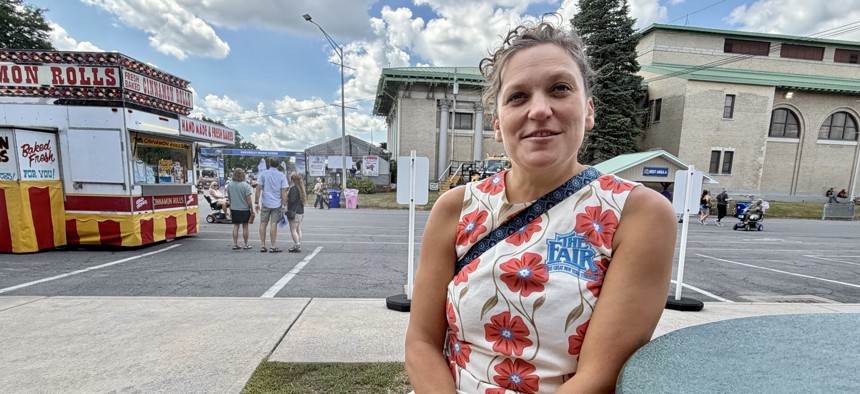
This is State Fair Director Julie LaFave’s third year running the show. Kate Lisa / City & State New York


The Great New York State Fair has been a summer tradition since before the Civil War, and the agricultural spectacle continues to delight over 1 million visitors in Syracuse for nearly two weeks each August. The 13-day fair – which runs from Aug. 26 through Sept. 7 – features hundreds of events, a wide variety of food, farm and cultural exhibits, including the 58th annual butter sculpture.
The fair has grown a whole lot bigger, and looks a bit different, than the first one in 1841, but state Fair Director Julie LaFave said many of its iconic traditions – like the 25-cent milk bar, famed butter sculpture and low ticket prices – aren’t going anywhere, at least as long as she’s in charge. She spoke with City & State on opening day about maintaining those traditions and some things she’d like to expand in the coming years to ensure the fair keeps up with the 21st century.
This interview has been edited for length and clarity.
You’ve been director how many years?
This is my fourth year being here, but it’s my third in charge.
I’m sure you’ve been coming many years before that.
Yeah, I didn’t grow up here, but I moved here about 20 years ago. So yeah, it was always a staple in my summer.
Where were you originally?
Michigan, but I moved around the country a bit – did that thing in my 20s and moved around – and then settled here.
What made you say, “I want to get involved in leading this event”?
I have 20 years in public service, and being a civil servant or in public service has always been something I really enjoy. My first 20 years of my career were in parks and recreation. I knew that I wanted to do that, and I also found a love of running large events and the logistics. I love the logistics of an event. I go to events on my own, and I look to see where they place trash cans, or I look to see the lines that people (are in), and it’s a very similar career to parks and recreation. You can run a large community festival. It’s all relatable, scalable.
What differentiates planning for the New York State Fair from another event?
We put so much emphasis on highlighting what is great about New York state, not just New York state, but New York state agriculture growers, producers, everybody who comes here and does business here, the small businesses, we highlight the animals, we highlight the farmers. It is the best of New York on display for 13 days.
Do you have a favorite part of the fair of all those days?
When I started, they told me it’s going to take me three fairs before I see everything, and I can confirm that that is true. If you look (at) how many buildings there are, there’s 375 acres. I want to get to know as many of the people who come year after year, in addition to the people who come for the first time, and to do that takes time. But I try my best over 13 days to walk through every building to say “hi” to at least one person in each booth, meet one of our animal owners, and it’s not something that can be accomplished in 13 days. Think about going to a city; you can’t walk every street, and you can’t walk every street in 13 days.
How many people do we have coming in? Is it still growing?
It is still growing. I think there’s a few things to keep in mind. I think a successful player is not always dictated by that attendance number, but people are always interested in that attendance number. I think 1 million mark is where everybody thinks that that’s a successful fair. There’s a lot of factors that people don’t take into consideration. The weather can impact things. Even if it’s raining, it doesn’t mean people don’t have a good time here. We have all of these buildings. We have a lot of places for people to take cover and to still explore.
You’ve seen everything now – so now what do you take into every year?
Now we’ve made some good assessments. We’ve made some good observations. We are careful to not touch those nostalgic things, but now we really put a lot of practice into keeping things fresh and new and adding what’s new that we can, and we compare with other fairs around the country too.
What are the nostalgic things that are never going anywhere?
Guarantee is a strong word, but I feel like it’s a guarantee that the milk will always be 25 cents, the potato will always be $1. I don’t know that the admission price will always be the same, but I think it’s a good guarantee. We remain the cheapest state fair in the country, and I think it’s always been important to this governor, and I think previous governors, as well. We want New Yorkers to come and experience that, and part of that is the price tag, as well. … We’re still cheaper than it was pre-pandemic to get in.
How is that possible?
I think of the State Fair almost (like) state parks or your local park. They don’t exist to make money. They exist to provide a service. They exist for their residents or their customers or their clients to get out and experience something. You don’t go to the state park to walk through the forest for them to make a profit. We want you to come to the state fair to experience New York, and we don’t want it to cost you a lot.
What do you want to change now that you’re finally solidly in this role?
We always want to attract new vendors. Arts and crafts changes. That’s a good example. So it was the Art and Home Center, now it’s the Creative Art Center. But you know, it’s not just needlework anymore. We still have needlework, but there’s new types of crafts out there. So everything we have is a competition. So this year, we have a fine art competition. We have a cookie decorating competition for America 250 this year. So we see what’s happening in the world, or in the fair world, and this year is America 250. So we’ve added new elements to match that. Next year, we’ll see what it is. In two years from now, it’ll be the 100th anniversary of the Haudenosaunee village here, and it’ll be the 100th anniversary of our ag museum here. So those two years, I imagine, will be trying something new to celebrate both of those occasions.
I have to ask you: What’s your favorite food here?
The best answer I always give to this, which I think frustrates people, is it’s like picking a favorite child. You can’t. I have two dogs, I can’t pick a favorite dog. I have five kids, I can’t pick a favorite one. But what I will guarantee everybody is that over 13 days I don’t repeat a meal. And this year, more than ever, I think our new options, our vendors have gone really wild with some of the concoctions that they’ve created.
Which ones are really exciting?
Actually, we have honey puffs with chocolate. We have deep fried ribs that came last year. Cool. There's a new crepe stand. There's new Greek food. I mean, the newest thing the last few years is sprinkling Hot Cheeto dust on things, or even Fruity Pebbles. Things like that. We have now a very large chocolate fountain. The Dubai chocolate’s big here. And then there’s the favorites, the sausages, the cheese dogs – I like a deep-fried pickle. I do like that.
How about struggling farmers? The governor talked about them a lot here at the fair. Is there anything the fair is doing to help them or educate people about their struggles?
We’re not as involved as our greater department because the fair is a part of (the state) Department of Agriculture and Markets. So on a much broader scale, the department I’m an employee of is doing a lot of work to help those farmers. Here at the state fair, we keep the entry levels low. For instance, in our dairy barn, we have a few rotations. We’re providing lunch to all of them – one of them was today. So it’s a small little gesture, but it’s a nice gesture. … I think it’s 400 lunches today, and we’re going to be doing that again throughout the fair. It’s called the rotation when one set of animals comes out and the next one comes in. When the next rotation comes in, we’re going to do that as well, and we’re looking at ways we can further appreciate them in future fairs.
Walking around with the governor too, you really see how politics – of course, they’re present, but they disappear a lot. Do you see politics come into the fair at all during the 13 days?
The fair is a lot of things to a lot of people. For some people, their memory is coming and showing their goat when they were 5 years old, and now they’re here with their grandkids. For some people, it's just they want to come here and just enjoy the music. I do think, for the most part, we see that set aside, and people just come here and find what makes them happy and discover new things. But you know, we do see a lot of it out of here, not included in these walls. There are certain vendors who are on either side, and we don't get involved in that. We don't vet vendors based on what their beliefs are or what side of an aisle they may be on, and you'll see vendors who are maybe selling products that quote unquote, from one party or another, but I don't think it's overwhelming, and I don't think it's prevalent here.
Anything else that you want people to know?
One of the things that in this administration I’m most proud of us doing is really expanding the accessibility of the fair. ADA has been around for a long time. We did not have our first sensory day or our first sensory space until three fairs ago. So this is the third fair, and every year we’ve expanded on it. So I’m very proud that three years ago we had one sensory room. Now, three years later, we have three sensory spaces. We now have the nation's first fully accessible restroom with an attendant, which has an adult changing table that goes up and down, which has a sink that goes up and down, adjustable. I’m really proud that we can offer these things because the fair may not have been accessible for people before. We have sign language interpreters at every concert. For our grounds entertainment acts, one of the shows a day will have sign language services. We also have sign language people on site at all times. So I’m proud that we’re making it truly accessible, because New Yorkers are everything.