

Interviews & Profiles
The Metropolitan Opera needs money
A Q&A with Peter Gelb, general manager of what “may be the most important performing arts company in this country.”
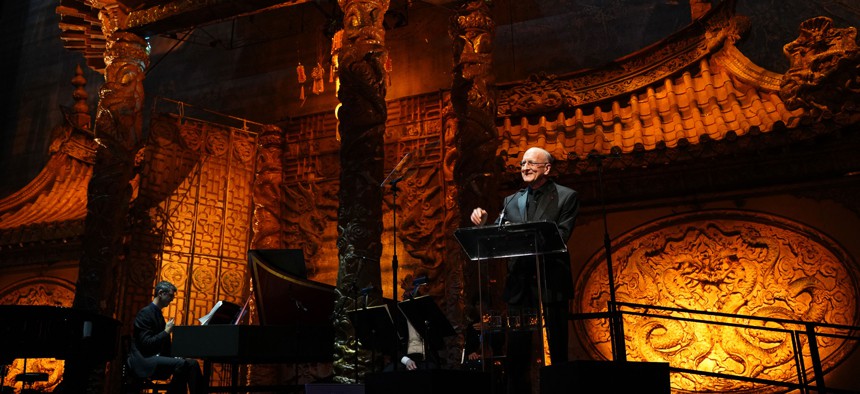
Peter Gelb speaks at the On Stage At The Met Gala at the Metropolitan Opera on May 20, 2024. Jared Siskin/Patrick McMullan via Getty Images


In the news business, sometimes the most worthwhile interviews are not the ones you went looking for but the ones that find you. Such was the case in October at City Hall, where I ran into former Rep. Carolyn Maloney and Peter Gelb, the general manager of the Metropolitan Opera who, as luck would have it, were on their way in to visit with New York City Council Speaker Julie Menin in hopes of securing support for the opera.
For more years than I want to admit as a reporter, I’ve made my way to the same gray metal desk in the radio room at City Hall, but I once was a 12-year-old classical ballet student who got to dance at the Metropolitan Opera House at Lincoln Center with the Royal Ballet and Bolshoi Ballet companies in the spring of 1968.
Maloney is an opera lover too, who told me she joined Gelb to lobby for the opera because she believes it’s important for culture to be preserved and endure. “The arts are important for the soul and for the economy,” she said.
Gelb talked to City & State about the Met’s new partnership with Mayor Zohran Mamdani, the opera’s massive impact on the city’s economy and how art can promote global cohesion. This interview has been edited for length and clarity.
We kind of met randomly. So, Mr. Gelb, why are you here today?
I’m here with Congresswoman Maloney because we’re hoping to find additional sources of funding from the city. The Met may be the most important performing arts company in this country, but it’s also the most expensive. We face great challenges.
This season, we launched a free ticket program with Mayor Mamdani to provide underserved New Yorkers with 70,000 free tickets. We want to make New York more affordable and give more people the chance to enjoy opera at the Met. Imagine the biggest Broadway musical and multiply it by 20: We have a 100-piece orchestra and hundreds of people onstage in the chorus. We present classic operas, from Puccini’s “La Bohème” to new works, including an adaptation of George Saunders’ novel “Lincoln in the Bardo.”
Do you still have a dance company?
The Met’s original dance company, led by George Balanchine, disbanded when he left to create the New York City Ballet. We still include dance in our productions, but we don’t have an official company. We audition dancers for each piece, and hundreds of dancers work at the Met each season in different styles, depending on the choreographer.
We work with many brilliant choreographers, including Brazilian choreographer Deborah Colker, who created the choreography for our Frida Kahlo opera last spring, and Brooklyn-based choreographer Annie-B Parson, who choreographed our new opera “The Hours.”
Sticking with labor, how many unions are represented there, and how important is the Met to the performing arts economy?
The Met has an enormous economic impact. We have 3,000 to 4,000 people working at the Met on any given day. We’re the largest performing arts company in the country, if not the world, and 15 unions represent a large part of our workforce and costs.
The people who work at the Met are among the highest paid of any opera company in the world. We need a path forward that sustains both our artistic excellence and our finances.
How large is the Met’s annual budget?
It’s about $340 million a year, and ticket sales cover only about a third of that. We need new sources of funding. We have generous donors, but we launched a campaign called “Make the Met Forever” to broaden our fundraising appeal. The Met is an invaluable cultural asset, and it can survive only with everyone’s support.
We also give back to the city. We bring public school students from all five boroughs to rehearsals, and our free ticket program is called “Opera for All.” We want to share opera’s beauty and emotional impact with the broadest possible public.
We’ve heard a lot about cuts to the National Endowment for the Arts and seen the difficult circumstances at the Kennedy Center. What impact does the federal government’s move away from traditional support for the professional arts have?
The National Endowment for the Arts and the Corporation for Public Broadcasting have served important purposes, and both have lost their funding. The Met is indirectly affected by cuts to public broadcasting because PBS carries our programs. Each year, we broadcast eight or 10 operas in movie theaters around the world, and they’re eventually shown on PBS.
PBS President (and CEO) Paula Kerger understands the importance of opera and continues to support us as best she can. The NEA’s main purpose was less to help the Met than to support smaller companies across the country. Its loss has been devastating for small theater and performing arts companies. For the Met, it represented a very small portion of our funding.
The impact is on the young musician or composer writing the next opera. It’s our seed corn that’s in jeopardy.
Absolutely. The Met is doing more than any other opera company to support new operas, composers and librettists. We’ve been averaging three Met premieres each season. I believe the future of the art form depends on new works that expand the repertory with stories people can relate to today.
The classics will always be there, but opera also needs new work. We have a special program to develop it. Not every piece will end up on the Met stage, but we work to encourage and support young composers and librettists, partly to make up for the loss of NEA funding.
When I was 12, I had the good fortune of performing when (arts impresario) Sol Hurok brought the Bolshoi Ballet and the Royal Ballet to New York City. It transformed my life. Performing alongside Russian dancer (Rudolf) Nureyev and (English ballerina Margot) Fonteyn gave me a sense of global connection – the idea of art as love. Can you talk about opera and the arts’ importance to global cohesion and understanding?
Absolutely. My first job, when I was 17, was working for Sol Hurok as an assistant in the mailroom. So while you were dancing, I was probably stamping envelopes for ticket holders. I remember Nureyev and Fonteyn coming with the Royal Ballet.
An example of the Met’s importance in the world today is “The Mothers of Kherson,” a Ukrainian war opera we commissioned. It had its world premiere in Warsaw, Poland, last week. It tells the true story of women in occupied Ukrainian cities who went on rescue missions to save children kidnapped by the Russians.
After Vladimir Putin and Maria Lvova-Belova were accused of war crimes, Lvova-Belova said at a Kremlin press conference that Ukrainian parents who believed their children were in the wrong hands could come and get them. It was a hollow invitation: Parents would have to cross enemy lines to search for their children.
Some Ukrainian mothers undertook those rescue missions while their husbands were fighting on the front lines. More than 20,000 children remain unaccounted for, though several thousand have been rescued and returned to Ukraine.
“The Mothers of Kherson” is an example of art bearing witness to human events. From Picasso’s “Guernica” to “Schindler’s List” and the documentary about Mariupol that won an Academy Award (“20 Days in Mariupol”), art has a role to play in bearing witness to what is happening in the world.
Since the invasion began, the Met has stood out as a leading arts institution defending Ukraine. We helped create the Ukrainian Freedom Orchestra, which tours every summer. When news broke of a U.S. deal with Putin over oil, we played the Ukrainian national anthem to show our audience that we stand in solidarity with Ukraine.
Bob Hennelly is general manager and City Hall reporter at WBAI Pacifica Radio.
NEXT STORY: City & State Games: Match that Mustache