

Policy
Hochul’s year-end vetoes and signatures
Gov. Kathy Hochul has just one bill that remains up in the air as 2026 approaches.
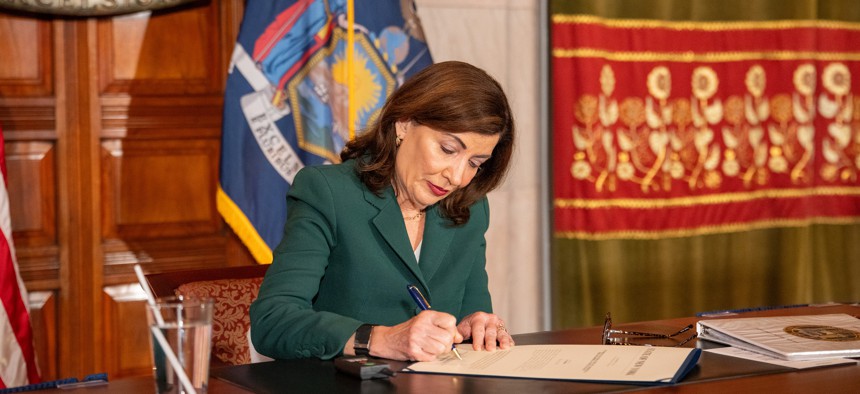
Gov. Kathy Hochul signs a bill into law on June 27, 2025. Aidin Bharti/Office of Governor Kathy Hochul


Lawmakers and political observers can enjoy the holidays with ease this year, as Gov. Hochul has already taken action on all but one of the 856 bills the state Legislature passed in 2025. She got through the last major tranche on Friday, leaving just a somewhat obscure measure relating to Western New York judicial districts up in the air.
Last week was an eventful one for major and controversial legislation. It kicked off with the governor’s decision to support a slightly amended version of the Medical Aid in Dying Act, as first reported by City & State. The bill wasn’t one of the more than 100 she had recently called up, so her announcement came as something of a surprise. But unlike most bills that Hochul agrees to sign with changes, the version passed this year will technically receive a veto (likely a pocket veto at the start of the new year) and she will sign a brand-new version with the agreed-upon changes once the Legislature passes it early next year.
Then Friday came around – the deadline for nearly all of the bills on her desk – and news of the fate of many of the most high-profile bills trickled out throughout the day. Hochul has 10 days, minus Sundays, to act on legislation formally delivered to her desk. On Friday, Hochul signed new AI regulations, a measure to increase consumer protections and a large prison reform omnibus bill, among other legislation. Most came with major or minor tweaks after negotiations with lawmakers.
Hochul has signed 713 bills and vetoed 140, not including line items from the budget. Legislators also passed a state constitutional amendment that doesn’t go to the governor. Vetoes are often contentious, with negotiations playing out behind the scenes to reach a compromise before the governor takes action on a bill. Sometimes, they work out through chapter amendments lawmakers agree to make. Other times, the discussions still end with a veto.
This list was last updated on Dec. 22.
PENDING BILLS
Upstate judicial redistricting
This may not be congressional reapportionment, but that doesn’t make it any less thorny. In a bid to create a more representative bench, this bill would create three new judicial districts in the Fourth Judicial Department and tweak the three that already exist there. Monroe, Erie and Onondaga Counties – home to the region’s largest and most diverse cities and towns – would each get their own districts. Currently, urban and rural areas share courts in a way that lawmakers say dilutes representation for communities of color. Republicans allege that the measure is simply meant to decrease conservative influence in the courts. Hochul on Monday told reporters that she and legislators are discussing potential “complications” with the measure regarding the typical once-a-decade timing of redistricting.
SIGNED BILLS
Medical Aid in Dying
Easily the most controversial bill passed this year, the Medical Aid in Dying Act would allow certain terminally ill New Yorkers with an estimated six months or less to live to end their own lives with the assistance of a doctor. Advocates for the measure have been among the most dogged lobbyists in Albany for the past several years, achieving their first victory when it passed both chambers this year. But the measure has its detractors, including religious groups and some disability rights and doctors’ groups, as well as those who just have moral qualms about suicide. Ultimately, Hochul and lawmakers came to agreement to include additional safeguards into the bill in exchange for her signature. Those included requiring patients to record their request for life-ending drugs and limiting the option to only New York residents. “We're not talking about ending life early, but about ending dying early,” Hochul said at a press conference on the measure. The law will also go into effect six months after Hochul signs it, rather than immediately, to give the state Department of Health to issue necessary regulations. Legislators will pass a new version of the bill early next year with the various changes, including the new effective date.
Prison reform omnibus bill
Amid outrage over the beating death of Robert Brooks at Marcy Correctional Facility by corrections officers and a weeks-long strike by corrections officers earlier this year, discussions about prison reform took center stage. Passed at the end of the legislative session, this omnibus reform bill consists of 10 different measures, including expanded oversight and transparency measures. The bill was the result of a two-way agreement between Assembly and state Senate leaders and does not include any parole or sentencing reform measures that criminal justice reform advocates had pushed for. Hochul signed the measure with some changes. “I strongly support efforts to increase safety of everyone in confinement facilities as well as accountability for staff, and I know the legislature is passionately committed to ensuring the safety of our prison system, a commitment that only became stronger after the horrific murder of Messiah Nantwi,” the governor wrote in an approval message. Hochul said that parts of the bill were "impractical and unworkable,” and that a requirement that cameras be added to corrections vehicles came about through negotiations. Legislators who pushed for the measure and criminal justice reform advocates largely applauded the compromise.
Shield law 2.0
The state previously passed laws to protect access to gender-affirming and reproductive health care by shielding health professionals who provide it to out-of-state patients where such care may be illegal. According to a bill memo from the sponsors, the laws need updating to “better respond to the new threats and tactics” that conservative states have deployed since 2022 and 2023 and may deploy in the future. Earlier this year, for example, the U.S. Supreme Court upheld a law in Tennessee banning gender-affirming care for minors. Hochul agreed to sign the bill after lawmakers agreed to changes in order to fix “technical inconsistencies” in the measure, and to change the timeframe given to health care providers to answer requests for health care information, according to an approval message.
FAIR Business Practices Act
Pushed for by state Attorney General Letitia James and former Federal Trade Commission head Lina Khan, the Fostering Affordability and Integrity through Reasonable Business Practices Act aims to crack down on “abusive or unfair” business practices. That would expand current protections against “deceptive” business practices and permit the attorney general to take action against businesses that engage in such practices. Supporters of the legislation say the measure is particularly needed now, as the Trump administration has promised regulatory rollbacks that would make it harder to hold bad actors accountable at the federal level. Hochul agreed to sign the legislation with a few changes to prevent the new law from overriding existing case law around the “consumer-oriented standard,” and to clarify that the private right to action only applies to deceptive practices, not unfair or abusive ones. Even with the tweaks, James and the bill’s sponsors celebrated the signature. “At a time when the federal government is abandoning working people and raising the cost of living, this law will help us stop companies from taking advantage of New Yorkers,” James said in a statement.
NY HEAT (lite)
State Democratic lawmakers have received criticism from environmental advocates in recent years for failing to advance a number of high-profile environmental and climate bills, even as New York struggles to hit greenhouse gas reduction and electrification benchmarks set in law. The NY HEAT Act has been a major priority for environmental activists, but legislators only managed to reach a compromise at the end of the legislative session this year for an extremely scaled down version of the bill, which would only repeal a rule that currently gives gas companies a subsidy for new gas hookups within 100 feet of an existing hookup. Both the original NY HEAT Act and a different pared down version would have done much more, including ending or amending the state’s obligation to serve. Hochul signed the bill on Friday with the agreement that it would go into effect in a year, rather than immediately. “Kathy Hochul just gave New Yorkers a $600 million Christmas present by signing our bill to repeal the 100-foot rule,” sponsor state Sen. Liz Krueger said in a statement. “This is a massive win for New York’s gas customers, and for clean air and a livable climate.”
RAISE Act
Hochul signed into law new artificial intelligence regulations approved by lawmakers, the strongest in the nation – just not quite as strong as legislators wanted. The Responsible AI Safety and Education Act will require the largest companies developing AI models to include safety precautions against misuse of the technology, including the creation of bioweapons or automated crime. After initially proposing a total rewrite of the bill that would have made it a nearly exact copy of a weaker California law, Hochul managed to get lawmakers to agree to using the West Coast law as a base, but with some changes to strengthen it. It doesn’t go as far as the sponsors and AI safety advocates wanted, but it still goes beyond what California enacted – creating some national harmony between measures while still advancing the ball to ensure that the current rules act as a floor rather than a ceiling.
VETOED BILLS
Keep Police Radio Public Act
State Senate Deputy Majority Leader Michael Gianaris managed to pass this bill last year in the state Senate, and Assembly Member Karines Reyes got it over the finish line this year in her own chamber. The legislation would prevent law enforcement agencies in the state from encrypting their radio communications without ensuring that other emergency service workers and journalists still have access. It’s meant to ensure a degree of continued transparency when it comes to reporting on police activities and to provide crucial real-time information to emergency services outside law enforcement. Hochul said in a veto memo that while transparency is a “worthy goal,” it could not “come at the expense of public safety.” She cited a series of issues with the bill, including the cost to local police departments to implement it, the bill’s apparent requirement to make the dispatches of undercover officers public and the technological feasibility for departments across the entire state to comply.
New York Health Information Privacy Act
One of a package of bills pushed for by the Bipartisan Pro-Choice Legislative Caucus to protect access to reproductive health care, the measure would regulate the collection and selling of health information by third-party organizations. There are currently few, if any, protections for consumers who may have their health data used without their knowledge. A memo from the bill’s sponsors specifically mentioned a recent case in which a period tracking app sold data to an anti-abortion group. Under the proposed law, any app or website would need to receive affirmative consent from a user before saving and retaining their health information data. In a veto memo, Hochul said that the legislation as written is too broad, “creating potentially significant uncertainty about the information subject to regulation and compliance challenges.” The veto came after the tech industry lobbied intensely against the measure due to its far-reaching implications on what data could wind up protected.
Freedom to Read Act
In response to an increasing number of school districts in conservative areas and GOP-led states banning or limiting access to certain books for children – particularly those involving same-sex couples, gender identity and unsavory parts of U.S. history – state lawmakers passed the Freedom to Read Act. Although it’s less of an issue in New York, the legislation is meant to ensure that access to reading materials won’t be curtailed by potentially conservative school boards. According to the bill language, it would empower library staff to create the “widest array of developmentally appropriate materials” as is feasible. Hochul wrote in a veto memo that school librarians already have a considerable degree of control over what their libraries contain, and they currently cannot restrict access to books just because school officials disagree with their content. She also said the state previously issued guidance about curating widely representative materials, so Hochul expressed concern the bill “will do more to confuse than to clarify” the obligations of librarians.
Grieving Families Act
For the fourth year in a row, Hochul rejected a bid to update New York’s ancient wrongful death law to permit family members to sue for emotional damages. For nearly 200 years, surviving family members have only been able to seek damages in a wrongful death case related to fiscal matters like lost wages, not for emotional distress. But Hochul has expressed concerns the past three times she rejected the bill, which she reiterated again this time. “For the fourth year in a row, the Legislature has passed a bill that continues to pose significant risks to consumers, without many of the changes I expressed openness to in previous communications,” she wrote in a veto memo. Those include worries over increased financial burdens on hospitals and potential insurance cost increases for New Yorkers. Legislators have introduced a series of changes to the bill to address some of the reasons the governor gave for rejecting it, but none have been enough to satisfy Hochul. The sponsors this year didn’t introduce more changes, which makes the fresh veto unsurprising.
NYC ballot questions
In a bid to curtail some powers of the New York City mayor, state lawmakers passed legislation that would prevent a mayor from bumping City Council-derived referendums from the ballot in favor of referendums that originated with the mayor’s office. Mayor Eric Adams employed that power this year much to the chagrin of Council leaders, who went to Albany in search of relief. In a veto memo, Hochul said she supported “enhancing democratic decision-making by local governments,” but cited the fact that the bill would not be limited to New York City but would impact every city, which have their own specific needs. She also argued that the bill could “undermine the efficacy of existing charter revision processes” and make things more confusing for voters if proposed revisions from multiple places all appeared on the same ballot.
Freedom of Information request timelines
One of the seven bills sponsored by state Sen. James Skoufis and vetoed by Hochul, this legislation sought to improve the FOIL process by establishing maximum deadlines for state agencies to respond to requests. Over the course of three years, the current deadline of 180 days would be shortened to 60 days. In her veto memo, Hochul said she supports increasing transparency but called the bill as passed “unworkable.” The governor said the bill set "arbitrary" deadlines and failed to provide additional resources to agencies so they can fulfill FOIL requests more quickly.
Grocery delivery pricing
Another Skoufis bill vetoed by Hochul would have required grocery stores and other food retailers to include the price differences between items bought in-store and those purchased online for delivery. The proposal would not have prevented stores from marking up prices online, but it would have required them to disclose that markup to consumers. Hochul said in her veto message that providing real-time price comparisons to online delivery services would be “operationally challenging” for stores.
Contraception insurance coverage
If you guessed that Skoufis sponsored this legislation, too, you’d be correct. The bill aimed to make birth control more accessible by requiring insurance companies to reimburse pharmacists who dispense it without a specific doctor’s prescription. A 2023 law gave pharmacists the ability to provide oral contraceptives in this manner so that people can access them even without seeing their doctor. State law already requires insurance companies to cover birth control, but pharmacists don’t get reimbursed for their expanded authority, which could potentially limit the number who utilize it. Hochul vetoed the measure, writing in a memo that updating billing systems would be costly for insurance companies. She also expressed concern that increased costs to insurers from new charges from pharmacy benefit managers would get passed onto consumers.