

Energy & Environment
Climate change is eating away at NYC bridges
Meanwhile, the cost of preventing a disaster continues to rise.
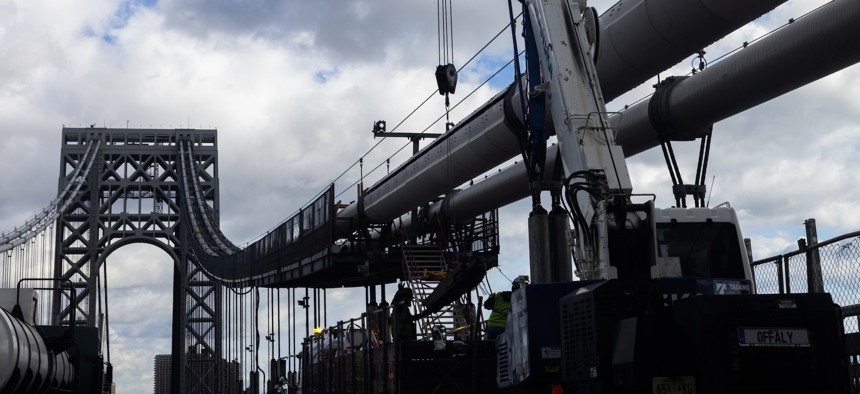
Repair work on the George Washington Bridge. The Port Authority is nearing the end of a $2 billion dollar renovation to the bridge. Jeffrey Basinger


The Third Avenue Bridge in the Bronx isn’t on the list of New York’s most deficient bridges, having undergone a complete rebuild in 2005 after a $118 million investment, according to the New York City Department of Transportation. It’s a swing bridge, which spins around a central axis like a carousel, creating a space through which taller boats can pass.
Yet in the summer of 2024, a heat wave expanded the steel of the bridge so much that it got stuck in the open position, jamming traffic for hours while the New York City Fire Department hosed down the expanded joints.
As New York is increasingly battered by heat waves, flooding, sea level rise and other effects of climate change, its infrastructure as well as its people will face new kinds of threats. Videos of subway stations spouting rivers of water after heavy rainfall have brought to people’s attention the vulnerability of low-lying infrastructure, but bridges are vulnerable as well.
The good news is that because of tight regulations and mandatory biennial inspections, bridge collapses should be unlikely, according to Maria Lehman, a seasoned infrastructure engineer and interim executive director of the American Society of Civil Engineers. “Of all the infrastructure classes, the one that I lose the least sleep over is bridges,” said Lehman.
However, this monitoring system was put in place for normal conditions, said Paul Chinowsky, professor emeritus in engineering at the University of Colorado. Chinowsky said municipal agencies may not be able to keep funding necessary bridge repairs as climate change intensifies the wear and tear on bridges and strains the city budget. New York City’s necessary bridge repairs already exceed $19 billion, according to a 2024 analysis by the state comptroller’s office.
Making things more complicated, the city’s bridges are overseen by a number of agencies: the state Department of Transportation, the Metropolitan Transportation Authority, the Port Authority of New York and New Jersey and the city Department of Parks and Recreation.
“I think of it like whack-a-mole,” Chinowsky said. “It starts slow. But the climate's making it go faster and faster, and eventually you can't keep up with it.”
Changes in heat and storm patterns can crack concrete, and heavy storms and flooding may cause “scour,” essentially erosion around bridge piers which weakens the supports. The changing climate causes an increased need for inspections, which typically cost between $4,500 and $10,000, according to the U.S. Department of Transportation, and bridge repair costs are expensive and vary wildly. Bridge closures due to road work also cause traffic delays and detours.
“People take bridges for granted,” Chinowsky said. “And the public needs to understand this is going to cost money,” whether in the form of tolls or taxes.
New York’s “deficient” bridges and the reality of bridge lifespans
New York state ranks fifth nationally in the number of “deficient” bridges, with 10% of all bridges in need of repairs, according to the American Road and Transportation Builders Association. New York City has an 8% deficiency rating, but has more bridges ranked “poor” or “fair,” than “good.”
The average age of bridges in New York City is around 70 years old, much more than the intended design life of 30 to 50 years, said Lehman, who has been part of the national Infrastructure Report Card published by American Society of Civil Engineers since its inception in 1998. The latest report, from 2022, gave New York state a C- grade for bridges. Actual bridge lifespans may be even shorter, given that they were calculated under conditions that predate climate change.
In 2024, the MTA produced a “Climate Resilience Roadmap” with ten infrastructure goals. Bridges were last on the list.
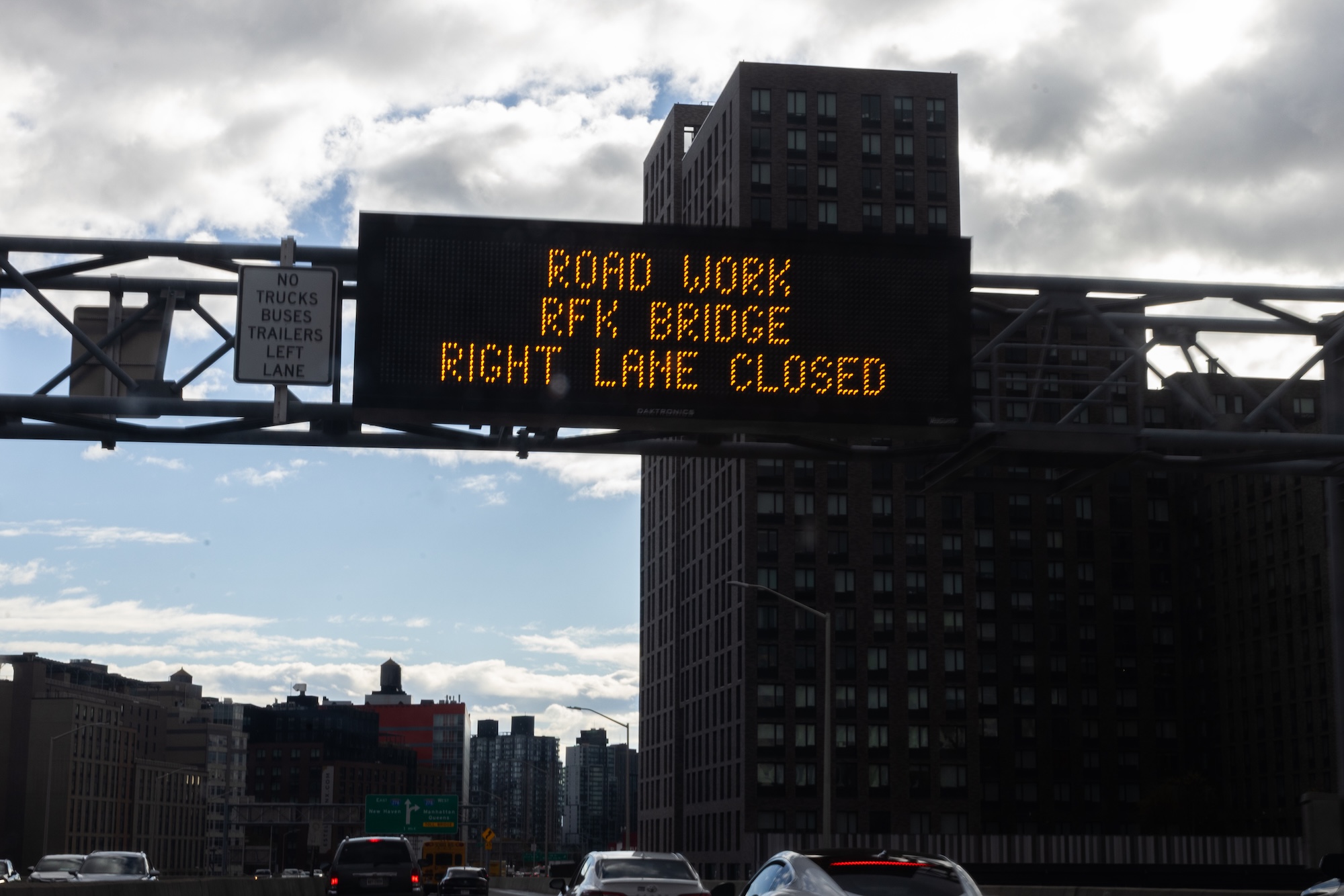
To address heat and wind impacts on bridges, the MTA’s plans include piloting materials to reduce heat-induced expansion of bridge joints, and finding ways to monitor extreme wind. The focus of their plan is “primarily on the four suspension bridges where there is the risk of instability due to high wind events” according to the roadmap document. Those include the Verrazzano Bridge between Brooklyn and Staten Island, the Whitestone and Throggs Neck bridges between Queens and the Bronx, and the Robert F. Kennedy bridge connecting Queens, Manhattan and the Bronx. The other three MTA controlled bridges are Cross-Bay Veterans Memorial in the Rockaways, the Henry Hudson at the top of Manhattan, and Marine Parkway-Gil Hodges Memorial bridge at the entrance to Jamaica Bay.
Repairs are currently needed on 821 bridges in the five boroughs, mostly small overpasses over local roads, not bridges that cross large bodies of water. According to the American Road and Transportation Builders Association, 74 bridges in New York City are considered structurally deficient.
A national transportation research nonprofit, Trip, also collects data on bridges. Their 2025 report on New York City bridges shows another troubling factor for managing bridge longevity. The cost of repairs has increased 46% in just the last three years.
Large bridges tend to get the most attention, and for good reason. They can hold hundreds or thousands of vehicles at a time and are critical to nationwide interstate routes. The Port Authority has been rebuilding the George Washington Bridge, one of the largest and most expensive-to-maintain bridges in New York City, at a cost of $2 billion.
“We basically rebuilt almost the entire George Washington Bridge in place,” said Melissa Targett, the Port Authority’s chief of resilience and sustainable design. Throughout the reconstruction, called “Restoring the George,” the bridge maintained 24/7 operations. The MTA, meanwhile, invested $3 billion in comprehensive capital programs across its seven major bridges from 2000 to 2024.
"Our objective is to try to extend the life of our bridges to the greatest extent possible," said John Hinge, assistant facility engineer at MTA Bridges and Tunnels. On all its suspension bridges, the agency has replaced original concrete decks with lighter, stiffer steel "orthotropic" decks which utilize a system of long, closely spaced beams like ribs, rather than traditional grid-like steel reinforcement. These updates include the Verrazzano and RFK, improving aerodynamic performance and reducing weight on cables and suspender ropes – which helps reduce the impacts of storms.
For some bridge decks, the MTA has added a specialized asphalt mix called Rosphalt, which is more flexible and ultimately extends the life of the bridge. And the MTA has elevated some of its bridge electrical components above FEMA's 500-year flood elevation, a resilience measure partially born out of lessons from Superstorm Sandy.
Even the CCTV systems in bridge control rooms have been affected by climate change. Because of increased heat, the MTA had to add air conditioning near some of their security cameras which were overheating in the summer.
"If you're not building resilient infrastructure, you're wasting money, because you're going to have to rebuild it," Lehman said. "People need to let their elected officials know that it matters to them and to their neighbors and to their friends and to their family."
The subjectivity of bridge inspections
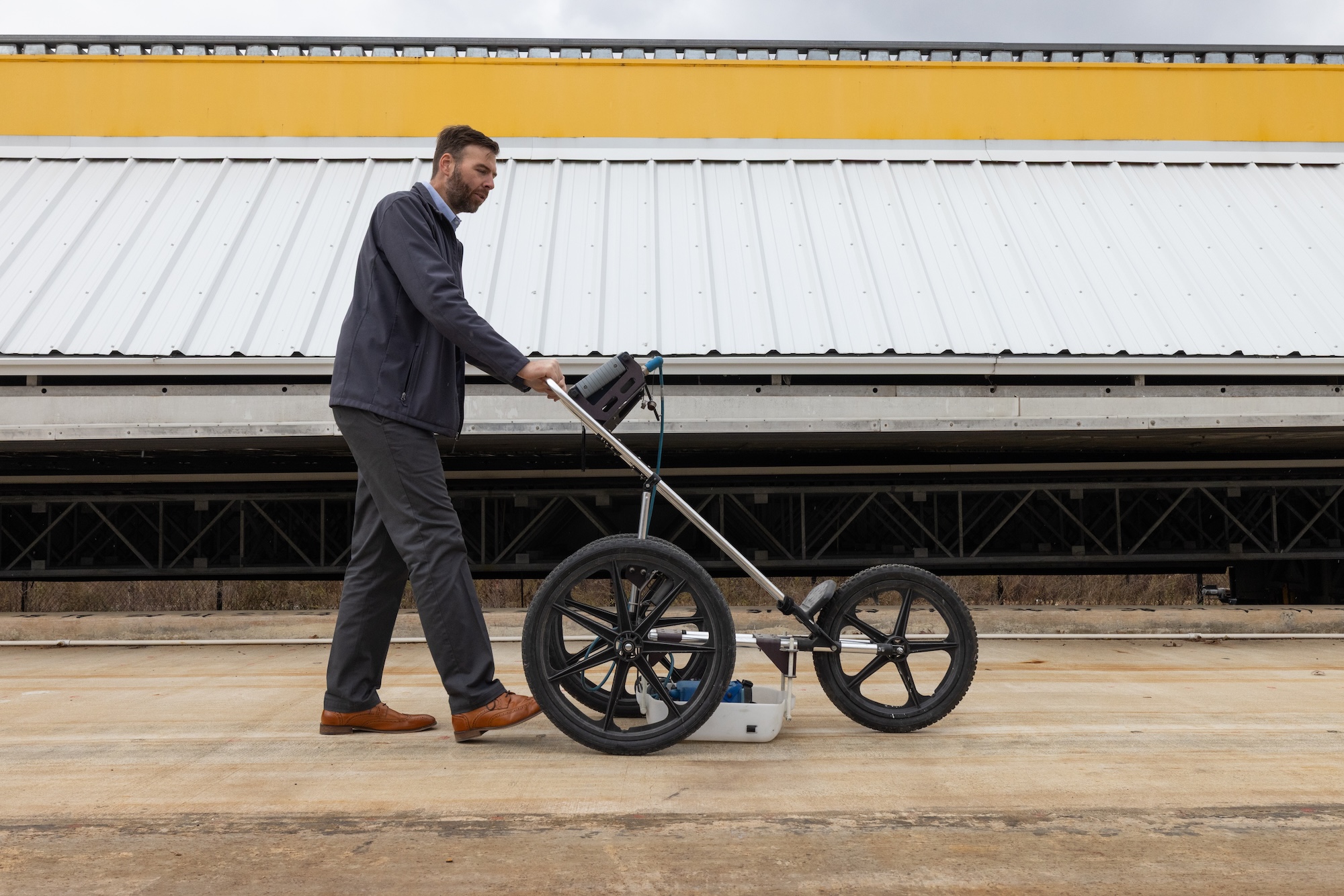
John Braley, a research professor at Rutgers University, pushes a stout, wheeled cart over a concrete bridge. The device collects data using sonar, echoing down into the thick structure which was embedded with small sensors under the surface and along the bridge’s steel beams.
“Bridges used to be tested by dragging a train chain across the surface, and there's a pitch when it goes over a hollow area,” Braley said. But inspections like that have an element of subjectivity that can change from one inspector to another, and may miss internal issues not obvious by sight or sound.
Braley’s device is called “The Beast” and is housed at Rutger’s Center for Advanced Infrastructure and Transportation. He collects data on the non-destructive test methods, from strain gauges to radar, to better assess the condition of bridges and the effectiveness of the testing methods themselves.
Novel concrete mixtures in his experiments and more reliable inspection methods are “all about longevity,” he said. “I think with climate change, it's become that much more obvious that we can't afford to waste our resources,” he said. Braley imagines a scenario where agencies can “send a drone or an autonomous thing across a bridge in a few minutes and get this sort of data.”
The George Washington Bridge recently piloted a drone visual inspection program, according to representatives from the Port Authority. The program was successful and moved into standard procedure.
Bridge authorities and engineers remain confident in regular visual inspections. But, because of the climate’s increasing rate of bridge degradation, Chinowsky believes a tragedy is inevitable because “we can’t keep up with the demand.”
And if a storm causes a washout, a bridge collapse resulting in injuries or deaths, “you're going to get a lot of finger pointing,” Chinowsky said.
This story was published in partnership with the Craig Newmark School of Journalism.
NEXT STORY: 'Sooner rather than later:' Stewart-Cousins is ready to pass immigrant protections