

Heard Around Town
Good government watchdogs want COIB to restrict electioneering
After two recent rounds of ballot proposals, the advocates are yelling at the refs.
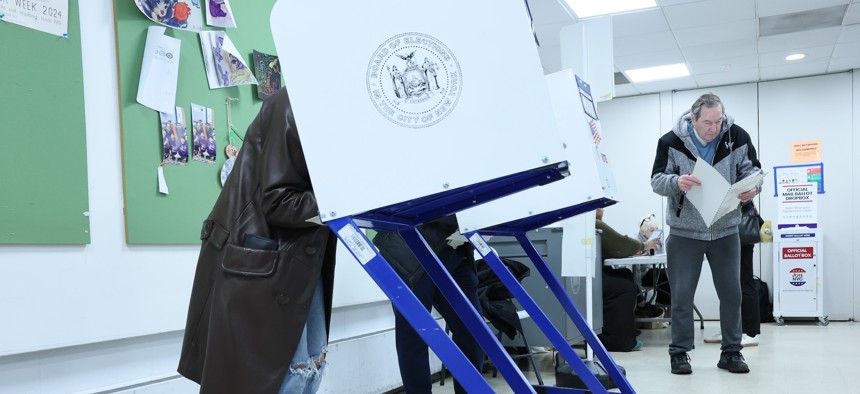
Voters considered six ballot proposals in November. Michael M. Santiago/Getty Images


Several good government groups are urging the New York City Conflicts of Interest Board to come up with new, clear rules banning the use of city time and resources for electioneering on ballot questions.
Citizens Union sent a letter, shared exclusively with City & State, to the independent oversight agency Monday afternoon. Good government groups Reinvent Albany and New York Public Interest Research Group also signed on.
The city’s governing document known as the City Charter has a longstanding prohibition that bans elected officials and public servants from using government funds, time or resources for political activity – including public communication “designed to urge the public to … support or oppose a particular referendum question.” COIB’s interpretation and enforcement of that provision has been called into question over the last few years as the City Council and the Adams administration battled over two sets of ballot proposal questions, first in the lead up to the November 2024 election and then again one year later.
The letter in particular hones in on the public education campaigns centered on three controversial housing-related proposals that unfolded late last year. The City Council spent more than $1.5 million on mailers opposing the proposals, which were sent on official City Council letterhead and included phrases like “your power could be taken away” and “your neighborhood essentials are at stake this election.” Meanwhile, the mayor’s Charter Revision Commission that crafted the measures spent roughly $3.2 million on digital ads and a TV campaign featuring city officials voicing the importance of building more affordable housing. While these communications didn’t explicitly tell voters to vote for or against the proposals, they were clearly designed to urge them to vote one way or another, according to the letter. The City Council said at the time that COIB had signed off on the mailers.
“We are seeing substantial sums, millions of dollars of taxpayer funding, that is being used to influence how voters think about ballot measures. The City Charter is really clear on this, which is why this whole issue has been so frustrating,” said Grace Rauh, executive director of Citizens Union. “The problem is getting bigger, not smaller, and frankly we feel that if it isn’t addressed now, this has a real danger of becoming standard practice in future elections.”
Two other commissions – one called by the City Council and another called by former Mayor Eric Adams on the last day of his tenure – could move to put new proposals on the ballot later this year. To avoid future issues, the letter calls on COIB to develop clear rules defining prohibited “political activity” using city time, resources and funds ahead of the 2026 general election. That should also include guidance barring advocacy in support of or in opposition to ballot proposals even if it doesn’t explicitly tell New Yorkers to vote yes or vote no. Those rules should be made public so everyone is on the same page, Rauh said.
“The Conflicts of Interest Board does need to act. This is all fresh in everyone's minds, and we need clarity. Clearly elected and government officials need guidance on what is permissible,” Rauh said. “We want them to act regardless of the state of these charter commissions, but the fact that we have two … does create added urgency.”
COIB’s next board meeting is scheduled for Friday. Carolyn Lisa Miller, the agency’s executive director, declined to comment on the letter. “When and what is discussed at board meetings is a determination made by the board,” she said in an email. “If the board decides to hold an open meeting, notice will be provided in accordance with City rules.”
NEXT STORY: Who’s going to pay for AC in New York City?