

Energy & Environment
Blue highways could change how goods are transported throughout NYC
Already central to the city’s food access infrastructure, Hunts Point could play a key role.
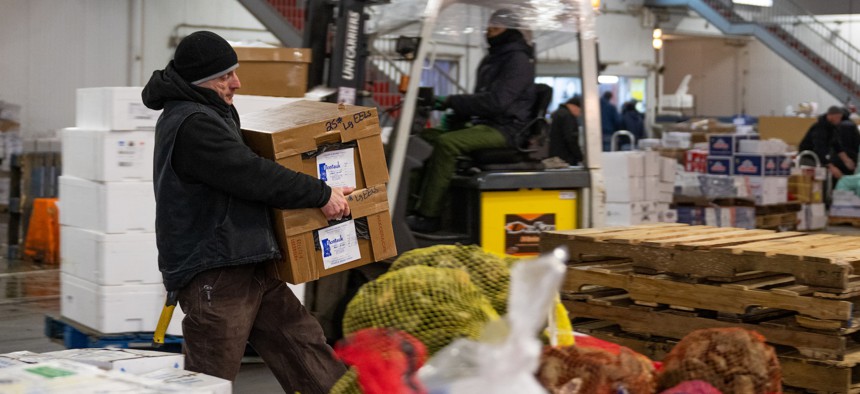
Millions of pounds of food make their way through Hunts Point and Fulton Fish Market. Alexi Rosenfeld/Getty Images


In November, a prison barge on the East River that for three decades housed 800 overflow inmates from Rikers Island was finally towed away. The hulk had sat empty since November 2023 but continued to loom over Hunts Point Market in the Bronx, the thriving food center where each day some 7 million pounds of fruits and vegetables, 2 million pounds of meat, and a million pounds of fish arrive to feed a hungry city.
City officials hope the departure of the prison barge will usher in a new era, one where barges begin plying the East River again, carrying some of this fish, produce and meat from Hunts Point to other points around the city for daily distribution using what they’re calling “blue highways.”
The new Blue Highways pilot program, a public-private partnership being overseen by the New York City Economic Development Corp. and the city’s Department of Transportation, will replace trucks with diesel-powered barges, creating an alternative for moving food around the city. According to the Blue Highways Action Plan released by the EDC, if the pilot is successful, the plan is to expand citywide. The EDC has identified more than 25 potential sites.
Hunts Point could become a big hub for the Blue Highways program. Eventually, it will be home to two terminals, one of which is already in the pilot phase. While that pilot – a smaller pilot within the Blue Highways program run by Bronx-based urban freight company Con Agg Global – is not the only Blue Highway pilot already off the ground, it will be a key one, given Hunts Point’s significant role in the city’s food access system.
Currently, some 15,000 trucks arrive daily from around North America to Hunts Point Market, carrying mangoes from Brazil, blueberries from Peru, Japanese wagyu beef, lamb from Colorado, halibut from Montauk and other products. Once the food gets to Hunts Point, local trucks pick it up and fan out to all five boroughs, delivering it to the city’s supermarkets, bodegas and restaurants. Hunts Point Market provides 45% of the city’s fish, 25% of its fresh produce and 35% of its meat.
The trucks that keep the city of more than 8 million people fed exacerbate air pollution surrounding Hunts Point, which has the highest asthma rate for public school children of any New York City neighborhood. “Asthma attacks are the No. 1 reason that kids miss school at PS 48, the local elementary school,” said Assembly Member Amanda Septimo, whose district includes Hunts Point. “The blue highway cuts directly at that.” For Rafael Salamanca, who, until Jan. 1, represented Hunts Point in the City Council, it’s personal. “I’m an asthmatic. My son’s an asthmatic,” he said. “I have to walk around with my asthma pump. I have a nebulizer in my car just in case my son … gets an asthma attack.”
Moving food by truck also poses a potential weakness in the city’s food access system. Located on a floodplain between the Bronx and East rivers, Hunts Point is low-lying and vulnerable to flooding. As climate change melts distant glaciers, leading to sea-level rise, flooding will increase, threatening food access for ordinary New Yorkers, including the schools, food banks and soup kitchens that serve the city’s most vulnerable. And the heavy cloudburst rains that are becoming more common have stranded trucks on flooded highways like the Long Island Expressway. Flooding at Hunts Point could have serious effects on the city’s supply chain.
Thaddeus Pawlowski, a research scholar at the Center for Resilient Cities and Landscapes at Columbia University, said having multiple ways of moving food around the city is a kind of insurance plan. If one route fails, there’s backup. “We have a lot of highways that are near the water and flood very easily,” he said. “The blue highway would reduce that vulnerability.”
Pawlowski acknowledged that a possible down side of the Blue Highway Program is the potential disturbance of the aquatic ecosystem, but was not too concerned. “I think that there must be some danger with that, especially from oil spills and oil slicks,” Pawlowski said. “But the environmental benefits I think would be far outweighed. I don’t see that as a major danger.”
Transporting food by water used to be the norm. Before moving to Hunts Point in 2006, the Fulton Fish Market was in lower Manhattan at the South Street Seaport, where until the 1950s, fishmongers would unload the fish right off arriving boats. Then came global trade agreements and the creation of the interstate highway system.
Barges have been used for a decade or more in other parts of the world. The supermarket chain Franprix has used barges on the Seine in Paris since 2012. In December 2022, to manage an uptick in online orders during the COVID-19 pandemic, Ikea began using mobile container boats on the Seine. The last-mile delivery in Paris is done by electric trucks. This initiative has removed 18,000 trucks from city streets since December 2022, according to Emilie Carpels, sustainability manager for Ikea France. Transporting goods all over New York City by water is not a totally new idea, either. As mayor, Mike Bloomberg pushed for improved utilization of the city’s waterways, and highlighted its value in terms of transporting goods. The Adams administration issued a request for expressions of interest for the Blue Highways program in 2023.
At Hunts Point, the Con Agg Global pilot is projected to take 1,000 trucks per month off city roads and represent a massive gain in efficiency, according to Paul Granito, CEO of Con Agg Global. A barge can carry nearly 2,000 tons of material, the equivalent of 50 truckloads. This won’t make much of a dent in the 15,000 trucks that go through Hunts Point every day, but “pilot projects are important for sponsoring long-term change,” Pawlowski said. “You can’t go from trucks to boats overnight.”
Eventually, a permanent Con Agg Blue Highways facility – as opposed to the current temporary one installed for the pilot program – will work in tandem with a larger, EDC-run one called the Hunts Point Marine Terminal, which is slated for a 2030 opening. That terminal will receive food shipments at Hunts Point from around the world; the Con Agg facility will send food and other goods out from Hunts Point and throughout the rest of the city using e-bikes, small electric trucks and the like, according to an EDC spokesperson. It will function as what EDC refers to as a microfreight terminal.
The Con Agg pilot program, which the EDC is assisting with, began in earnest in October with proof-of-concept trips in which gravel, crushed stone and other construction materials were moved to Hunts Point south along the Hudson River from Albany on diesel-powered barges. (Those trips have been somewhat infrequent, though, as concrete can’t be produced in cold weather, per Nicole Ackerina, Fulton Fish Market CEO. But the EDC said another one took place on Feb. 11.)
Next, the plan is to move food from Hunts Point to other newly rejuvenated sites on the East River. Barges would move fish from Fulton Fish Market and other food from the Hunts Point food distribution center throughout the city, the EDC spokesperson said. Though unlike other future Blue Highway sites, the Con Agg facility will continue to shepherd aggregate material throughout the city, not just food and other goods.
For now, Fulton Fish Market and Con Agg Global are hoping to get more food industry clients involved. But attracting clients interested in seeing food moved by barge has been challenging, said Ackerina. Moving construction material is one thing. Transporting fresh, easily spoiled delicacies like fish, meat and produce is another. The program needs to show that the products will be adequately safeguarded from point A to point B. “For a while, people were like, ‘We will believe you when we see it,’” Ackerina said.
On Dec. 17, Con Agg did a test run in partnership with nonprofit organization Empire Clean Cities – this time with food. A vessel traveled from the Fulton Fish Market, where fishmongers from Blue Ribbon Fish Company loaded it with fish to go to the Tin Building at South Street Seaport, where e-bikes were ready to deliver the fish to area restaurants and stores.
South Street Seaport is an ideal neighborhood for the Blue Highway program. The area experiences a lot of congestion and already has a landing. Downtown Skyport, a heliport, would grow into the first Blue Highway microfreight terminal and handle last-mile delivery. EDC plans to open the terminal at the end of 2027.
That last-mile delivery is one of the benefits of blue highways: They can help get food to less accessible areas faster, using either smaller electric trucks or e-bikes. For example, to get from Hunts Point to Staten Island, trucks must traverse the Bronx, Manhattan and Brooklyn, about 30 miles, passing over three toll bridges that often get backed up with traffic, a trip that can take up to two hours. Large trucks are often either not allowed or face congestion on major city highways like the Belt Parkway, so they end up on small neighborhood streets.
Other than the Con Agg Global pilot project, EDC also launched a successful pilot between the Atlantic Basin terminal in Red Hook and Pier 79, and is the first of its kind to continuously operate five days a week. That pilot, a joint effort by the Department of Transportation, DutchX, EDC and NY Waterway, carries 300 to 400 parcels per day from a ferry onto five electric cargo bikes, according to the EDC.
Looking ahead, EDC wants to scale up the pilot at Pier 79 and run the same operation between Atlantic Basin and Pier 11. That site would be temporary, though, and the clientele would shift over to Downtown Skyport upon its completion.
NEXT STORY: Mamdani to Hochul: Raise taxes or else…