

Policy
Mamdani has a lot of explaining to do on his ‘Department of Community Safety’
The New York City mayor isn’t alone in wanting the NYPD to respond to fewer mental health calls, but how he plans to make that happen is still an open question.
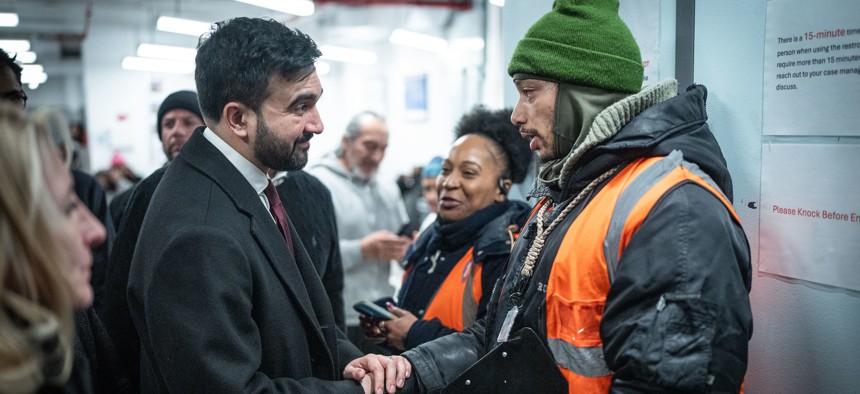
Mayor Zohran Mamdani visits a drop-in heating center during a frigid cold snap. Michael Appleton/Mayoral Photography Office


Mayor Zohran Mamdani said this week that the launch of his so-called Department of Community Safety would be hastened following the police shooting of Jabez Chakraborty last month. The 22-year-old man’s family said they called 911 requesting an ambulance because he was in emotional distress. But police responded to the scene and shot Chakraborty multiple times after he pulled a kitchen knife and advanced toward officers, body camera footage released Tuesday shows. On Monday, Mamdani visited Chakraborty in the hospital, where he’s on a ventilator.
“This situation underscores just how urgently we need a different and more effective mental health response system,” Mamdani said at an unrelated press conference Tuesday.
The Department of Community Safety was a central campaign promise to strengthen the city’s existing crisis and preventative services, sending social workers to the scene of a mental health crisis rather than cops. The administration has already begun hiring people to develop it under First Deputy Mayor Dean Fuleihan, though it’s unclear how many people or in what specific roles. Legislation to establish the department is advancing through the City Council. But incidents like the Chakraborty shooting highlight how Mamdani’s language on the department has evolved – as well as questions the Mamdani administration has yet to answer about how mental health response would work under the new department.
“It’s not entirely clear actually, what this department would be or what it’s trying to do,” Elizabeth Glazer, founder of the publication Vital City and the former director of the Office of Criminal Justice under Mayor Bill de Blasio, told City & State last month.
Asked how the city would respond under his vision if, like in Chakraborty’s case, a weapon was not mentioned during the initial 911 call but was drawn after responders arrived, Mamdani didn’t appear to have an answer yet. “A lot of this is exactly the focus of the conversations that we’re having internally in developing out this Department of Community Safety,” Mamdani said Tuesday.
Revisiting campaign proposals
So far, most of the information we have about the department comes from a 17-page whitepaper released during Mamdani’s campaign to give the then-candidate a way to take the offensive on public safety. The brainchild of his closest adviser Elle Bisgaard-Church, its mission is broad: It aims to expand, reform and better coordinate programs designed to prevent gun violence, homelessness, mental health crises and more while greatly diminishing police involvement in mental health crisis response. Existing offices including the Office of Gun Violence Prevention, the Office for the Prevention of Hate Crimes and the Office of Community Mental Health would all be included under the agency. But the element that Mamdani most frequently discussed on the campaign trail was overhauling and expanding a non-police response program known as B-HEARD, which deploys teams of paramedics and Health + Hospitals mental health workers to 911 mental health calls where operators don’t identify violence or imminent harm.
The campaign estimated that the new department’s budget would reach $1.1 billion, with roughly $455 million of that requiring new funding.
“When you look at what seem to be all the different components of the department, it’s a whole array of different things. It’s alternatives to incarceration, re-entry, it’s the Cure Violence (program), it’s hate crimes,” Glazer said. “In some ways, it’s sort of like a department of nonprofits.”
It is not clear how much of what’s in the whitepaper will remain in the administration’s final vision for the department. The whitepaper, for example, suggests ending joint response teams of police and mental health workers. While “co-response” is sometimes used colloquially, there are also specific “Co-Response teams” operated by the NYPD and health department that respond to some 311 and 988 calls. Those shrunk under budget cuts in the last administration.) One bullet point in Mamdani’s proposal reads: “end co-response teams to hand calls off to crisis and outreach teams that are better positioned to address people’s needs.”
The former senior adviser on severe mental illness to Mayor Eric Adams called that the “single most disturbing sentence” in the platform. In a Vital City article from November, Brian Stettin wrote: “The NYPD will (as it must) always insist on sending police to a scene where a person is brandishing a weapon or screaming aggressively at passersby. If we ‘end co-response,’ we foreclose the possibility that police will have the benefit of clinical assistance in these situations.”
Mamdani’s recent language around co-response has indicated he’s no longer committed to ending it. He has now repeatedly said that police will respond when a call involves a weapon or the threat of violence. “I want to make clear that a person experiencing a mental health episode does not always have to be served first or exclusively by a police officer. It is important for us to have all of the options available,” he said Tuesday.
In his Vital City article, Stettin argued that the campaign’s DCS proposal will, despite good intentions, make the complicated system of mental health services even “patchier” than it currently is. The proposal says DCS will have outreach workers for people living on the street – efforts that Stettin argued will overlap with existing work by the Department of Homeless Services. Similarly, he noted that other mental health related work – like expanding clubhouses and deploying Community Mental Health Navigators in every neighborhood – belongs under the purview of the Department of Health and Mental Hygiene.
Establishing the department
Part of what makes it difficult to determine what this department will look like is that Mamdani has not committed to a path for creating it. Several observers said they believe City Council legislation would be legally necessary to create a new city department, but the administration says it is pursuing all options, which has led to speculation that they might choose to instead pursue a beefed up a version of an existing city office, such as the Mayor’s Office of Criminal Justice, which already houses programs mentioned in the campaign whitepaper like the Office for the Prevention of Hate Crimes and Alternatives to Incarceration. (City Hall spokesperson Dora Pekec has declined to comment on speculation about what other options for creating this department would look like.)
Meanwhile, the mayor has endorsed legislation from City Council Member Lincoln Restler that would grant broad authority to create the department, though it’s unclear if the administration is fixed on taking a legislative path as opposed to trying to create the department through executive action or even a charter revision commission. Politico reported Tuesday that the administration is considering executive orders.
Theoretically, the path could be multifaceted. The administration could take executive action, while also pushing for the legislation. “Legislation is necessary to ensure that the Department of Community Safety is a permanent part of the kind of safety landscape in New York City,” Restler said Tuesday. “But I encourage the administration to do everything in its power to move forward with advancing this urgent work.”
There are political benefits to creating the department through legislation rather than executive action. Having the council vote for a new department looks like a mandate, rather than a unilateral whim of a lefty mayor. The legislation addresses the new department in broad strokes, and cedes a lot of authority to the mayor’s office for how it would actually function: “The department shall assist in the coordination of operations among agencies and offices under the jurisdiction of the mayor that are involved in law enforcement, emergency response, crime prevention, victim services, social services, homeless services, mental health and public health,” the legislation reads. Notably, it would manage city contracts related to alternatives to incarceration and violence prevention, among other programs. Restler acknowledged that the bill language could change throughout the legislative process, but said its broadness is by design: “The legislation we drafted last year intends to give the Mamdani administration broad legal authority to create a permanent Department of Community Safety that achieves the vision that has been laid out on his campaign,” he told City & State last month.
But the legislation also includes some details that aren’t laid out in the campaign proposal. It includes, for example, a requirement that at least one 24/7 office be opened in each borough, tasked with what appears to be the central work of the department: outreach to vulnerable populations, conducting safety patrols with volunteers intended to prevent violence, participating in emergency response with law enforcement and EMS, and providing conflict mediation and deescalation “in circumstances that are not likely to result in immediate harm or danger to the public.”
Restler’s legislation has 22 listed co-sponsors in the City Council so far. Speaker Julie Menin (not currently a co-sponsor) agrees that police are overburdened. “Taking mental health calls out of their purview is something that would mean that we could make sure that NYPD officers are fighting crime, which has to be one of the main focuses,” she said last month.
NEXT STORY: New York lawmakers want to keep AI out of news