

Sponsored Content
Paving a better path for business growth
“What we do in 40 pages, they do in one page:” panelists at PPI event discussed improving New York’s economic competitiveness.
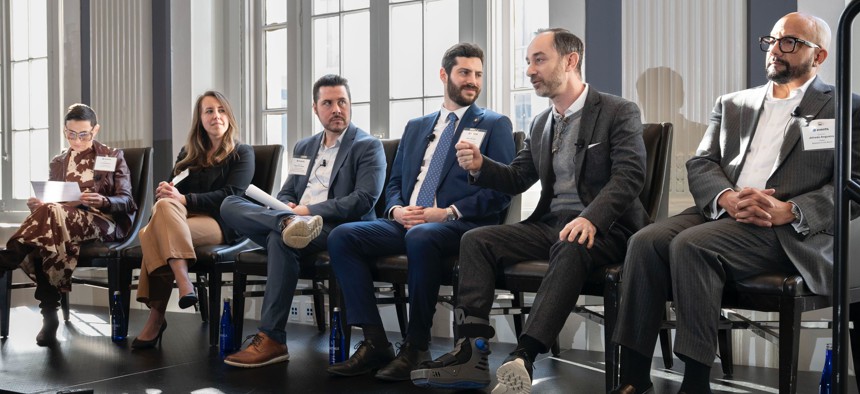
Panelists at PPI’s New York Business Blueprint event presented by City & State New York on Feb. 5, 2026 at the The Renaissance Albany Hotel. Mitch Wojnarowicz


The Public Policy Institute of New York State held a panel sponsored by City & State on Thursday in Albany addressing the roadblocks businesses face in order to succeed in New York state.
Heather Mulligan, president and CEO of the Business Council of New York, kicked off the event, explaining in her opening remarks how difficult New York rules and regulations can make it for business owners.
“It’s filled with questions. ‘Can you guarantee that you will have this outcome? That you will create this many jobs? And if you don't, by the way, we're going to take it back,’” she said about getting state grants. “Other states, what we do in 40 pages, they do in one page.”
Liz Benjamin, managing director of Marathon Strategies and former Capital Tonight host, moderated the five-member expert panel. The group discussed a recent report released by the Public Policy Institute highlighting the challenges of the state’s declining workforce as people age or move out and how New York’s economic decline impacts all business sectors.
NYC Hospitality Alliance Executive Director Andrew Rigie explained how stressful it can be for a business owner.
“You're constantly fearful of another fine, another inspection, some lawsuit that is basically cost-prohibitive to defend, so you're forced to settle. So there is this constant anxiety of running a small business,” he said. “I think entrepreneurs at large … believe in New York, they want to do great things, as they have done, but every single turn, they're hit with something else.”
The panel frequently spoke about how burdensome the state’s many regulations can be at a time when many other states are aggressively reducing them to spur growth.
Alfredo Angueira, who owns a restaurant in the Bronx, brought up the state’s flawed rollout of its recreational cannabis industry as an example of how difficult bureaucracy can make it for businesses to succeed.
“It's this new, innovative thing that New York decided to get into a few years ago. It made about $2.5 billion. It's been faced with lawsuit after lawsuit, misstep after misstep,” Angueira said. “And this was an industry that New York had from the beginning and had the opportunity to get right and did everything wrong.”
To combat regulatory problems, Assembly Member Alex Bores has partnered with the Business Council of New York State to push a bill that would use artificial intelligence to go through old statutes that possibly need to be removed to help businesses.
“We have a 60-page bill of a bunch of these nonsensical, sometimes dangerous, statutes that need to come off the books,” Bores said on the panel. “And that's big and that's complicated, but I think would really be a first step in moving in that direction.”
On the issue of artificial intelligence, Ryan Silva, executive director of the New York State Economic Development Council, said while New York is good on technology and innovation, there is also a growing concern about energy consumption from businesses.
“One of the things we hear from our members almost daily now is around energy and access to power that we're going to need if we want to accomplish our goals around artificial intelligence, quantum and manufacturing,” Silva said. “These are things that are not only challenges we're facing here in New York, but I think is a nationwide issue. ‘How do we have and provide access to that power, and the time to market to get access to that power, while making it affordable, while making it reliable?’”
Panelists were asked what they would like to see the state Legislature tackle this year before the session ends in June. National Federation of Independent Business’s New York State Director Ashley Ranslow suggested she actually wanted to slow things down.
“I think one of the things that small business owners will often say is that we don't need anything from lawmakers, right? ‘I'm not looking for a handout. I'm not looking for X, Y or Z.’ I just need them to get out of the way, right?” Ranslow said. “We've done a lot, a lot of different bills in a lot of different areas, the 24,000 that are introduced. Sometimes we move too fast in New York, and we need to take a pause and we really need to examine and look at whether it's the fiscal impact or the practical impact of legislation.”
NEXT STORY: DCAS is in for a Mamdani era shakeup