

New York State
SUNY, CUNY seek more state aid beyond proposed increases
The city and state’s public universities want a combined $3B this year for capital projects.
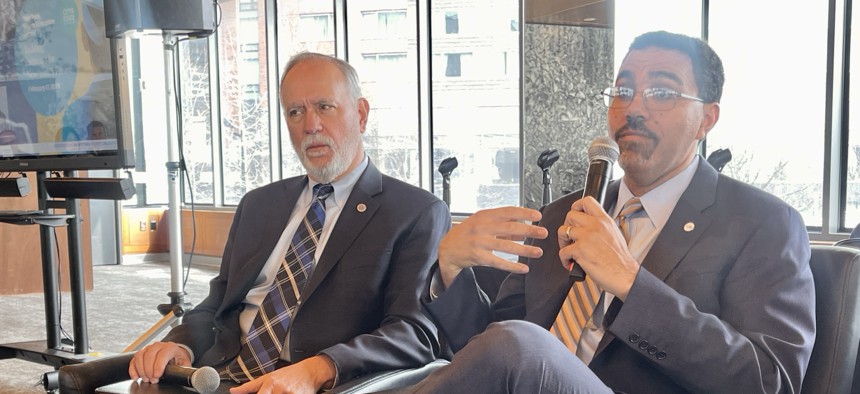
CUNY Chancellor Félix Matos Rodríguez and SUNY Chancellor John King joined forces for a fireside chat at City & State's Higher Education summit on Feb. 17, 2026. Kate Lisa/City & State


The leaders of New York’s public colleges and universities are asking the state Legislature to put more aid in the budget to support struggling campuses, including to complete delayed infrastructure projects and a backlog of maintenance work.
At City & State’s Higher Education Summit on Tuesday in Manhattan, City University of New York Chancellor Félix Matos Rodríguez and State University of New York Chancellor John King praised Gov. Kathy Hochul’s budget, which proposes to increase higher education funding. But they said the state Senate and Assembly should counter the governor’s proposal with more to better close the gap.
Hochul’s budget proposes $595 million for capital maintenance – up from $550 million last year – but the SUNY Board of Trustees is petitioning lawmakers for $1 billion and a five-year capital plan.
“We have $10 billion in deferred maintenance costs now. The challenge is that at $550 million a year, we're not able to make enough progress,” King told City & State after the panel. “When we start a project, we need to know we have all the cash to cover the project.”
Hochul’s budget does not propose tuition hikes and increases SUNY operating funds by $54 million, so SUNY does not expect atypical staff cuts or to close any campuses, King said.
He is supportive of Hochul’s proposal to expand the SUNY Reconnect program, which offers free tuition and covers the cost of fees, books and supplies for New Yorkers aged 25 to 55 without a degree who enroll in programs in high-demand fields, like nursing, green energy or advanced manufacturing. Hochul has proposed expanding the program to include emergency management, logistics and air traffic control, and expand eligibility to nursing students who already have a degree.
SUNY and CUNY have seen increased enrollment for the last three years, but Matos Rodríguez said CUNY campuses continue to face structural deficits after decades of disinvestment and pandemic-related losses.
CUNY, meanwhile, is seeking $2 billion in capital funds – especially to support community colleges. Two-year public colleges in the state rely on the municipality they are located in for half their funding, making financials especially tight. Hochul has proposed about $400 million in her budget.
"I always believe you signal to the people in the buildings when you're a public institution what you think about them by their condition. And we have a ways to go in making sure our campuses send that signal,” Matos Rodríguez said.
The education leaders also touched on immigration as the governor and Legislature negotiate a slate of immigration proposals. Both chancellors said they have not had U.S. Immigration & Customs Enforcement officers on campus, and SUNY and CUNY each have policies not to share information with ICE without a judicial warrant.
But President Donald Trump’s immigration agenda has still impacted some faculty members and staff. ICE separately detained two employees at SUNY Upstate Medical University with active asylum cases, deporting one to Ecuador, King said, and immigration agents detained a staff member at the University of Buffalo after accidentally crossing the Canadian border, who has since been released. And a Suffolk Community College student and her mother were detained while at home.
"Our understanding is ICE came to the building looking for someone else, but ended up detaining her and her mother,” King said.
SUNY has 64 campuses outside the five boroughs, but King said none have pushed back on the policy to not share information with ICE without a warrant.
"Generally, folks on our campuses, regardless of the area of the state, see our students working hard and doing the right thing to get an education so they can contribute to their family and the community,” he said. “When the focus was on someone who's maybe engaged in some horrible, violent crime, then I think there was a lot of consensus across the country about the need for the federal government to act. But that's not what's happening.”
This story has been updated to clarify that SUNY does not expect additional staff cuts in the upcoming year outside routine reviews of enrollment and academic needs, per a spokesperson.
NEXT STORY: Blue highways could change how goods are transported throughout NYC