

Policy
Updated state police tattoo policy could become law
The bill is advancing in the state Legislature, but State Police leaders and the union representing troopers disagree on its necessity.
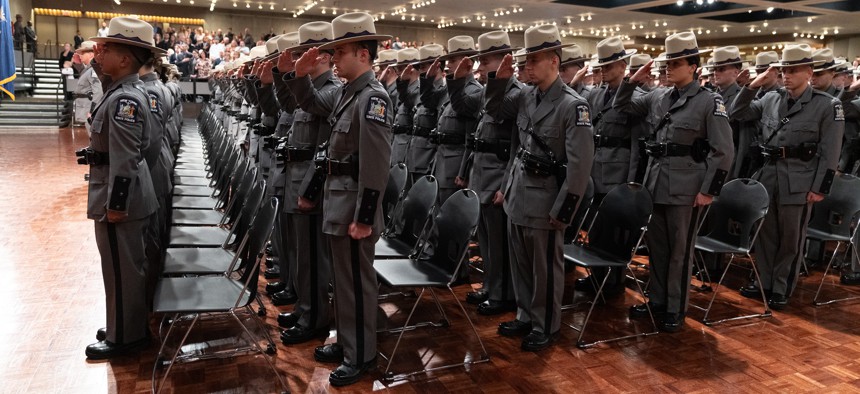
State Troopers graduate from the Basic School of the New York State Police Academy on Oct. 22, 2025. Aidin Bharti/Office of Governor Kathy Hochul


The head of the New York State Police and its union are at odds over a push to make a recently updated tattoo policy permanent.
State police revised an internal policy in 2022 allowing trooper candidates to have tattoos if they can be concealed under a long-sleeve shirt or business attire.
A bill cleared the Assembly last week to require all law enforcement agencies statewide to adopt a tattoo policy – preventing the updated rules from being overturned under different leadership.
“Internal policies can change at any time,” sponsor Assembly Member David Weprin said. “Placing clear guidelines in statute ensures stability, transparency and uniformity across all covered agencies.”
Hand, face and neck tattoos are still prohibited, except a ring tattoo on each hand. Assembly members passed the bill nearly unanimously. Weprin said it’s critical to codify the policy to aid police departments struggling to recruit and retain workers.
“Were this internal policy to be reversed, troopers that have since been hired with tattoos and troopers that have gotten tattoos since the change could be adversely affected,” Weprin added. “It’s important we protect our officers who sacrifice so much and that we respect their individuality and right to express themselves.”
But state Police Superintendent Steven James isn’t convinced the policy needs to be codified in state law and said the 2022 policy update has helped reverse the staffing shortage as intended – especially with hiring veterans.
“The way it is now, we’ve made strides significantly,” James told City & State after a budget hearing in Albany. “I guess every bit would help, but I don’t know that (codifying it) is necessary yet … I guess if we ever get to a point where we’re suffering, that might be an option. But right now, we’re good.”
But members of the New York State Troopers Police Benevolent Association continue to push for the change.
“We agree that allowing tattoos is an important recruitment and retention tool, and feel strongly that this policy must be codified in law to ensure that future Division leadership doesn’t return to the discriminatory anti-tattoo policies of the past,” Trooper Charles Murphy, president of New York State Troopers PBA, said in a statement. “We look forward to working with Division to ensure that the formalized tattoo policy created as a result of this bill, should it pass and be signed into law, is transparent, fair and clear for all existing troopers and future recruits.”
The measure has yet to clear the state Senate. Sponsor Sen. Michelle Hinchey will continue to push to pass the bill in the upper house this session.
“When law enforcement is looking for solutions to attract the most qualified applicants to their ranks, we should support them in that effort,” Hinchey said in a statement. “I was glad to work with the NYS Troopers PBA on this legislation, which will help with recruitment and retention efforts and provide stability by protecting against attempted policy changes in the future.”