

Policy
Council considers options after Mamdani vetoes buffer zone bill
The bill initially passed the City Council with 30 votes but 34 votes are needed to override the mayor’s veto.
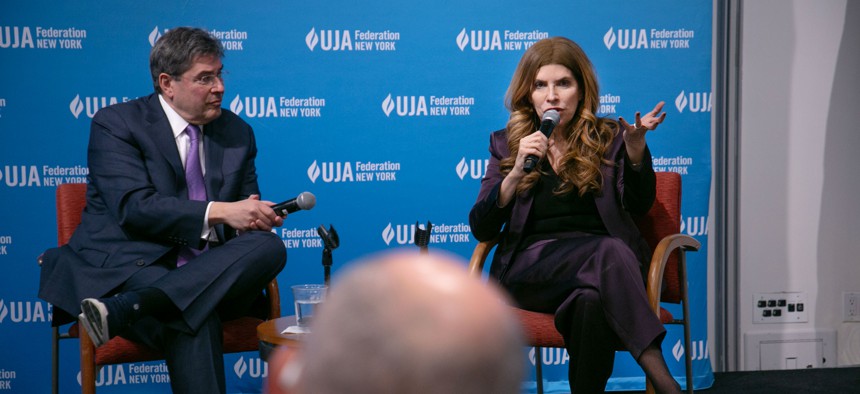
New York City Council Speaker Julie Menin speaks at a UJA-Federation of New York board meeting on Jan. 28, 2026 William Alatriste/NYC Council Media Unit



New York City Council Speaker Julie Menin and her allies are weighing their options after Mayor Zohran Mamdani said he would veto a controversial bill that would have required the police department to create and publicize plans to deploy security perimeters around educational facilities during protests.
Unlike the related “buffer zone” bill pertaining to houses of worship – which Mamdani said he’d let go into effect – 175-B didn’t pass with a veto-proof majority. Council members approved the legislation late last month by a 30-19 margin, four votes shy of the two-thirds majority needed to override a mayoral veto. That doesn’t necessarily mean the fight ends here. Several people familiar with Menin’s thinking said the speaker is contemplating whether to try and whip up enough votes to override the move, though they noted nothing has been decided yet. The New York Times was first to report on the mayor’s plan to veto the bill.
“While I appreciate that King Zohran will graciously allow one bill with a veto-proof majority to become law, his choice to veto a second bill may be forced to contend with democracy,” said one Democratic council member who supported both of the bills.
A spokesperson for the speaker’s office said that members will now discuss next steps.
Announcing his decision Friday morning, Mamdani said he’d reviewed both of the bills and come to different conclusions about them.
He said the bill pertaining to buffer zones outside houses of worship had initially raised serious First Amendment concerns, but the amended version of the bill “is narrower in scope and effect” and no longer “poses the same risks it once did.”
But the mayor said 175-B, the bill pertaining to buffer zones outside educational facilities, was “meaningfully different” from the other one and was “not a narrow public safety measure.” He pointed to the broad way in which 175-B defined an “educational institution” as well as what he described as the constitutional concerns it raises regarding New Yorkers’ right to protest.
“As the bill is written, everywhere from universities to museums to teaching hospitals could face restrictions,” Mamdani said in a statement. “This could impact workers protesting ICE, or college students demanding their school divest from fossil fuels or demonstrating in support of Palestinian rights.”
His rationale echoed the concerns that many of the bill’s critics have voiced in recent weeks. While much of the opposition – which includes civil rights groups, labor unions and some left-leaning politicians – have spoken out against both buffer zone measures over free speech concerns, the focus has increasingly been on the education version, which was sponsored by Council Member Eric Dinowitz. Menin herself sponsored the houses of worship version, though both were included in a package of bills known as the City Council’s “Five-Point Action Plan to Combat Antisemitism.” A spokesperson for the speaker’s office pointed out that the bills are essentially the same in bill language, scope and constitutionality – the only difference is the location.
Supporters of the buffer-zone bills, which were spurred by a protest outside a synagogue last fall, have argued that would protect students and worshipers in a way that would also bolster accountability over the NYPD’s protest protocols.
“I want students to be safe from harassment, from intimidation as they enter and exit school. With this veto, Mayor Mamdani does not want our students to be safe as they enter and exit schools,” Dinowitz said. “I want police transparency and with this veto, Mayor Mamdani does not want transparency.”
Mamdani’s veto, the first since he’s taken office, is likely to further heighten tensions between the two wings of City Hall. Menin, a moderate Democrat, has increasingly positioned herself as a counterweight to the mayor as budget discussions have intensified in recent weeks. Speaking at an unrelated event yesterday, the speaker passionately defended both of the buffer-zone bills, warning that a veto from the mayor would only lead to more divisiveness.
If Menin decides to pursue a veto override, that could also further strain tensions within the council’s own ranks. The vast majority of the council’s Progressive Caucus voted against the bill – so much so that it needed support from the body’s five Republican members to pass. Council Members Tiffany Cában, Shahana Hanif and Lincoln Restler recently spoke at a protest against the bills outside of City Hall in which they urged the mayor to veto 175-B. Now that Mamdani has done so, the City Council would need 34 votes to override it. It initially passed with 30 votes, with Council Member Gale Brewer abstaining from the vote.
There is currently one vacancy in the City Council, which will be filled in a special election on Tuesday. Mamdani and Menin are both backing rival candidates in that race with the speaker pitching her support behind Carl Wilson, the former chief of staff to the member who’d vacated the seat. A spokesperson for his campaign said he’d vote to override the veto if he wins the seat. Former gubernatorial aide Lindsey Boylan, who is Mamdani’s preferred candidate for that seat, and fellow candidates Layla Law-Gisiko and Leslie Boghosian Murphy all said they would vote against overriding the mayor’s veto.
If Wilson wins the special election and Brewer can be convinced to vote in favor of an override, then supporters of 175-B would only need to flip two “no” votes to override Mamdani’s veto. Brewer declined to comment at this time.