

Policy
A brief history of New York City’s neverending horse carriage controversy
Since Central Park first opened, no one has been able to agree whether horse-drawn carriages should be allowed to transport tourists around the city.
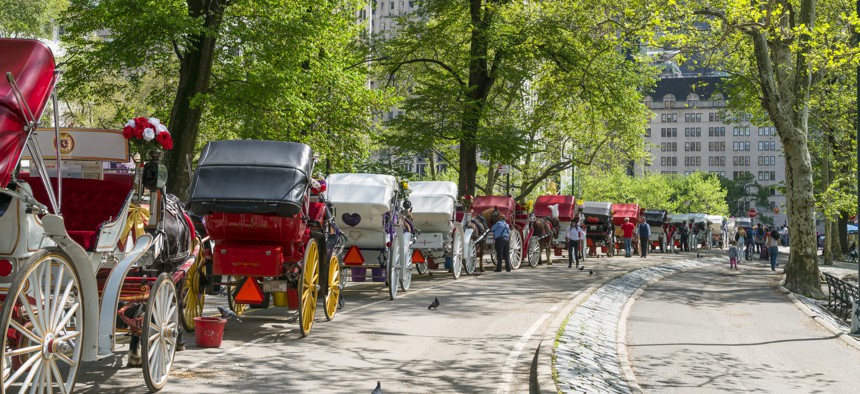
These horse carriages may not be in Central Park for much longer. Toshi Sasaki


In a city as disagreement-prone as New York, even horses have the power to divide us.
New York City politicians have wrestled for decades with the controversial horse carriage industry, trying to balance the protests of animal rights activists claiming the practice is abusive with the defense of local unions in support of carriage operators’ livelihoods. The topic emerged as a key issue in the 2013 and 2025 mayoral elections.
Outrage has boiled over in the past few years as multiple horses have died in Midtown since 2020, and the push for a ban increased after an 18-year-old tourist died after falling off an out-of-control carriage in June.
But after years of this seemingly endless horse race, the end may finally be in sight, with Mayor Zohran Mamdani and City Council Speaker Julie Menin both publicly supporting banning horse carriages – and Menin specifically supporting the council’s revised bill to end the industry. As the City Council prepares to hold a July 15 hearing on the bill, here’s the almost 200-year history of the city’s war on horses.
1832
Horse cars are first used in New York City as a mass transportation vehicle for the New York and Harlem Railroad.
1863
Tourist horse carriage rides begin in Central Park, five years after the park opens to the public.
1866
The American Society for the Prevention of Cruelty to Animals forms in response to horse carriage abuse in New York City, with the organization’s official seal depicting an operator beating a horse.
1981
The Horse Licensing and Protection Law is passed by the City Council, requiring horses to observe speed limits, wear lights or reflectors, and wear $25 a year license tags.
1986
The Carriage Horse Action Committee is formed to help advance council legislation to restrict the horse carriage industry.
1989
New York City Council Member Robert Dryfoos’ bill – which regulated when and where carriage horses could operate – goes into effect after the council overrides Mayor Ed Koch’s veto.
2006
The Coalition to Ban Horse-Drawn Carriages forms in response to a 5-year-old horse who was injured, and later euthanized, after being spooked and crashing into a station wagon.
2007
City Comptroller Bill Thompson releases the first audit of the city’s horse carriage industry, revealing issues such as insufficient access to water and a heightened risk of overheating for the animals. Later that year, Council Member Tony Avella introduces a bill to ban the industry.
2008
Horse carriage operators join the Teamsters Local 553 labor union.
2010
Council Member Melissa Mark-Viverito introduces a bill to replace horse-drawn carriages with electric vehicles.
2013
City Council Speaker Christine Quinn, an outspoken horse carriage defender, runs in a crowded Democratic mayoral primary. Anti-horse carriage organization NYCLASS launches a campaign opposing Quinn’s candidacy and boosting her opponent Bill de Blasio, who promises to disband the industry as his first order of business.
2016
A bill championed by de Blasio, which would have limited horse carriages to Central Park, is defeated after the council – lead, ironically, by now-Speaker Melissa Mark-Viverito – cancels a vote on the bill.
2018
De Blasio’s Department of Transportation issues a new rule mandating where horse carriages can wait for passengers, moving from Central Park South to five new locations within the perimeter of the park.
2020
Horse carriage operators join Transport Workers Union Local 100.
2022
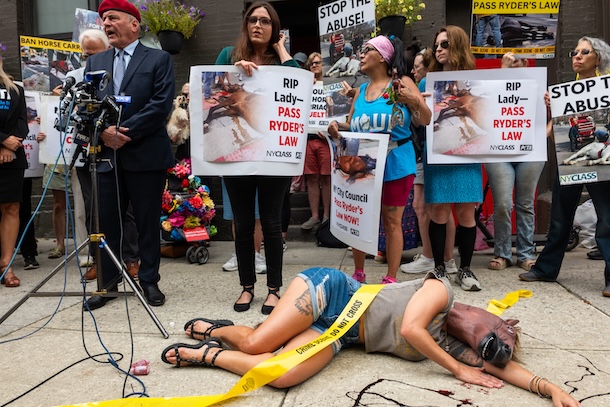
A 14-year-old carriage horse named Ryder collapses in Hell’s Kitchen and is later euthanized due to cancer, renewing calls to abolish the industry from animal rights activists.
2024
Council Member Bob Holden introduces Ryder’s Law, which aims to wind down the industry by stopping the issuance of new operation licenses.
2025
The Central Park Conservancy, the nonprofit in charge of managing the park, releases a statement after years of neutrality calling for a ban on horse-drawn carriages. That same year, Mayor Eric Adams issues an executive order to phase out the industry. But Ryder’s Law fails to move, as the council’s Health Committee votes against sending the bill to the full council.
2026
Ryder’s Law is reintroduced by Council Member Christopher Marte, two days after a carriage horse collapses and dies in Central Park. The next week, 18-year-old tourist Romanch Mahajan dies after falling out of a carriage after the operator lost control of the horse. Ryder’s Law was then renamed Romanch’s Law, and Council Speaker Julie Menin schedules a hearing for the bill on July 15.