

Policy
Should the state Legislature meet year-round? Maybe. Will it? Don’t hold your breath.
What even is a full-time legislature anyway?

Liberty & Justice’s excellent adventure Dan Page



After several marathon days at the end of the state legislative session, the leaders of both chambers took to their floors to give end-of-year speeches. After coming up against the clock in Albany to debate and pass hundreds of bills, state Senate Majority Leader Andrea Stewart-Cousins and Assembly Speaker Carl Heastie sent their members home until the start of the new legislative session in 2027.
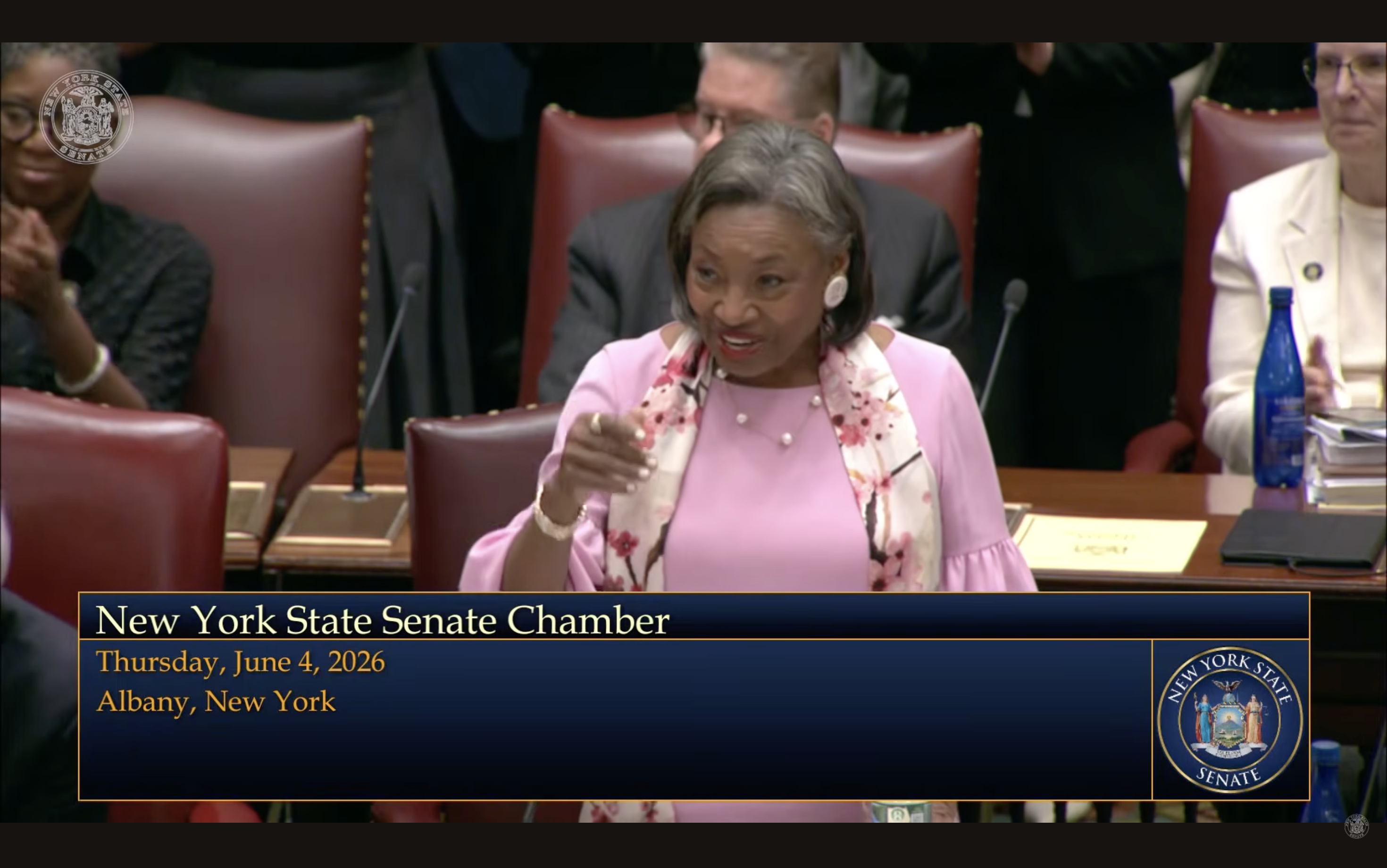
“God bless, enjoy the summer, win your races – y’all please,” Stewart-Cousins said, gesturing to the Democratic side of the chamber, before turning to the Republicans amid laughs. “You too! But enjoy, and we’ll see you back here next year.”
That was at the start of June, just halfway through the calendar year.
In New York, lawmakers only typically pass bills for half the year. Between the months of January and June, state legislators commute back and forth to Albany for one to four days a week for a total of roughly 60 scheduled session days every year.
The rest of the time, legislators return to their districts for an uninterrupted six months.
On its face, the state Legislature comes off as a part-time gig. In fact, next year will be the first time that lawmakers will have any meaningful limit on outside income they can earn, a typical indicator of a full-time legislating job, like Congress. While constituents can read about their representative’s attendance and job performance in the Legislature, there are no metrics of effectiveness to monitor when lawmakers return home.
But ask most legislators and they’ll call theirs a full-time job, despite only passing bills for about a quarter of all weekdays in the year. District work and preparing legislation generally keep them busy. And if you compare New York to other state legislatures that meet year-round – even to Congress and the New York City Council – it’s hard to argue the Albany officials are slacking in their lawmaking duties, regardless of how one chooses to define “full-time.”
Made in the shade
Every December, the state Legislature releases its annual session calendar that lays out all the scheduled session days – the “shaded boxes,” as Stewart-Cousins refers to them when responding to reporters’ questions about the prospect of extra legislating days.
Despite meeting for the session only half the year, the Legislature hasn’t actually voted to “adjourn” since the 1970s. The rest of the time, both chambers are technically in recess, able to return anytime at the call of leadership to take up legislative business. The only thing stopping them is willpower.
The state constitution doesn’t specify a required number of days for the Legislature to be in session. The number and concentration of days spent in Albany are at the discretion of leadership. “My sense is that the setup has been pretty stable for, I don’t know, the last few decades,” said former Assembly Member Richard Gottfried, who served for 51 years starting when Assembly Democrats were in the minority.
No change came when, in December 2022, lawmakers approved a $32,000 pay hike for themselves. Their new $142,000 annual salaries made them the highest-paid state legislators in the country. And it came with a $35,000 cap on most outside income, finally set to take effect next year after legal challenges, when legislators previously could earn as much as they wanted in second jobs.
State lawmakers had gone decades without a change in their salary prior to 2018, when rolling increases began that culminated in the 2022 vote. It’s easy to say they deserved a raise after so long with stagnant wages, but an unapologetically full-time salary, in theory, would come with full-time work.
Debate around pay raises brought with them discussions of whether the state Legislature is fundamentally a “part-time” position necessitating a second job to afford daily expenses. “As a part-time legislator, I should be able to work outside of the state Legislature to earn additional income to support my family,” then-Assembly Member Walter Mosley told the New York Post in 2018 when a pay commission first proposed a 15% cap on outside income alongside a salary increase.
Not all agreed with that descriptor though, particularly those without secondary salaries. “Doing either legislation work or district work year-round, I always considered myself a full-time legislator,” Gottfried said. Though he once “dabbled” in practicing law outside the Legislature, he called the experiment “a complete disaster.”
Also in disagreement with that descriptor is the National Conference of State Legislatures, which defines New York’s state Legislature as one of a handful of full-time governing bodies, even though it doesn’t meet year-round. In fact, it considers New York one of four top-tier full-time legislatures that have both high pay and large staffs. The state holds that distinction with California, Michigan and Pennsylvania.
“While it’s true that New York is only in session for about half the year … relative to other legislatures, New York is actually viewed as one of the most heavily, strongly professionalized,” said Alan Wiseman, program co-director at the Center for Effective Lawmaking at Vanderbilt University, which studies state legislatures. Using a metric known as the Squire Index, New York is the third-most professionalized state legislature in the nation, meaning it’s considered very close to how Congress operates.
Indeed, most of New York’s state lawmakers would not consider their jobs part-time. “In some ways, I tell my colleagues I’m actually busier in the off-session than I am during session, because we’re zipping all over the district,” said state Sen. Jeremy Cooney, who represents a portion of Rochester and its surrounding suburbs. Being a state legislator is his only job.
Assembly Member Gabriella Romero, whose district includes the state Capitol, also doesn’t have a second job, but commended those who do. “I don’t know how they do it,” Romero said. “I think some people might say it’s part-time because they also have another job, but the reality is that it demands so much more of your time, whether you’re working or not.”
Even those with another notable source of income – like state Sen. George Borrello, who owns businesses with his wife – agreed the job is demanding. But for the Western New York Republican, there’s a caveat. “I certainly do think it’s a full-time job, however, that you can’t simplify it as much as that, in my opinion,” he said. Borrello said there is value in the traditional idea of “citizen legislators” who have or have had other jobs outside of being politicians. “We used to have more people like me, quite frankly, people who know what it’s like to run a business, know what it’s like to sign the front of a check, not just the back of one,” he said.
But state Sen. Patricia Fahy said she wouldn’t even want a second gig outside being a legislator, even if she felt she had the time for it. “This is not just a job for me – it is my obsession,” she said.

“Who on earth thinks that New York is not doing enough legislating?”
One of the chief arguments for having the state Legislature meet year-round is that it might give lawmakers the time they need to avoid cramming big policy items into the end of the session (a complaint they themselves made after another late budget this year).
But if one were to compare the effectiveness of New York’s governing body to most other states, few pass nearly as many bills as lawmakers here. While other full-time legislatures meet throughout the year, New York’s outpaces all of them both in total legislation introduced and bills passed.
Comparing different state legislatures can be tough. But based on annual data collected by government data firms like FiscalNote and MultiState, New York regularly introduces the most bills in the entire country, and routinely passes the most bills in a two-year session (some states like Texas only meet every other year). FiscalNote ranked New York “the busiest” state legislature in 2025.
“Who on earth thinks that New York is not doing enough legislating?” quipped one longtime Albany insider, who was granted anonymity to speak candidly. The insider argued there were plenty of ways to reform legislative operations in the capital to make it run more efficiently, but adding more days to the calendar wasn’t one of them. “It’s why members of Congress are all miserable – they’re doing that grind, and then they feel like they’re barely even getting anything out of it,” the insider said.
But that’s not to say some legislators don’t see opportunity for an expanded calendar. “A full-time legislature means that we’re legislating full time, and we’re not,” said Assembly Member Brian Cunningham. While he remains active in the off-session in his Central Brooklyn district, Cunningham consults on the side for extra cash. He said legislators should get paid a salary closer to that of Congress and meet year-round. “I think our role, people forget this at times, is that our role is largely a role of passing legislation and passing a budget,” he said.
In the wake of the New York City Council approving a pay raise for themselves, Heastie expressed support for the idea of paying his own members more for the work they do, no added days required. “I don’t know if there’s enough money that could pay for the sacrifices that legislators make,” he recently told Politico New York. “Six months of the year, you’re away from your family. So I’m always supportive of members getting paid.” However, another salary hike isn’t necessarily in the cards right now.
Others consider the in-district work as part of the job description. State Sen. Gustavo Rivera, one of the elder statesmen in the Legislature, described his role as “50% representative and 50% legislator.” For half the year, he spends 65% of time on legislative work and 35% doing district work, a breakdown that switches the other half of the year. “Both of these things feed into each other,” the Bronx lawmaker said. But Rivera is also a proponent of adding more session days to the calendar.
Long Island Assembly Member Charles Lavine has long advocated for the state Legislature to meet throughout the year. But he acknowledged that having dedicated time in the district has important benefits. “When we’re in Albany, we are sometimes in an odd bubble … and so we don’t get to interact as much with people who live in our communities, and that interaction is critically important,” he said.
Blair Horner, senior policy adviser at the New York Public Interest Research Group, suggested more session days could lead to more transparency in the legislative process. “I don’t know if they would be more transparent if they had more time, but at least the possibility would exist,” he said.
But don’t expect lawmakers to book year-round Amtrak tickets anytime soon – by and large, an appetite for a full-year or even a fall session, as Rivera put it, “just doesn’t exist.”
“The work’s got to get done, no matter what the tenor of the spacing is,” said Manhattan Assembly Member Jordan Wright. “I think the way that it’s going right now … we’ve got some consistency there, so I think it’s working out pretty well.” Staying at home for half the year also affords legislators the time to campaign for reelection during the summer primaries and fall general elections.
Another Albany insider offered an emphatic “absolutely not” when asked whether lawmakers should spend more time in the capital. Taking a page from Cunningham’s book, the insider called legislators’ salary “mediocre at best” compared to private sector jobs that can attract qualified officials away from public service. “You get what you pay for,” the insider said. They added that increasing legislators’ salaries would justify more days in Albany, but it wouldn’t inherently lead to more bills getting passed given the large volume already moving through both chambers.
It’s true that legislative leaders could reorganize legislative procedures without making lawmakers pack their bags for Albany 52 weeks a year. But two things would be guaranteed with a year-round session: “It would cost more to the taxpayers, because they’d be up more, so more per diems, and there would be more campaign fundraisers,” Horner said.
“Those two things are for sure. Everything else, who knows.”