

New York City
New York City Council votes to ban horse-drawn carriages
City Council leaders championed the horse carriage ban as a humane and safe move after years of debate, voting Thursday to outlaw the industry.
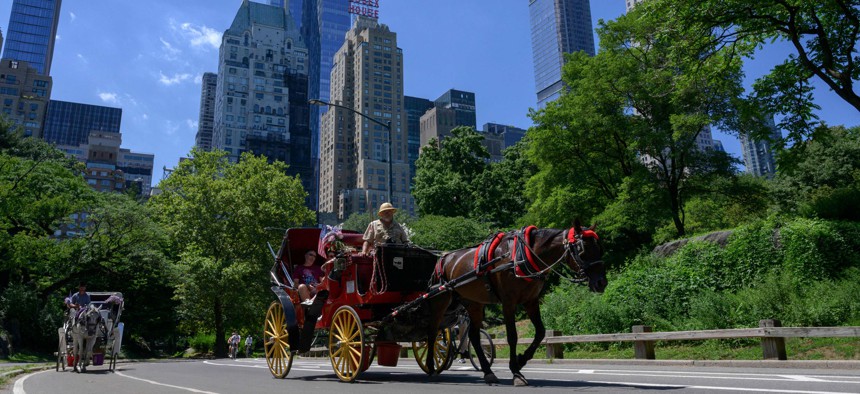
The City Council voted to get rid of Central Park’s remaining horse-drawn carriages on Thursday. ANGELA WEISS/AFP via Getty Images


The New York City Council said “neigh” to Central Park’s horse-drawn carriages, voting 40 to 7 on Thursday to ban the industry, with two members abstaining.
The legislation, known as Romanch’s Law, prohibits the operation of horse-drawn cabs in the city, phasing them out by June 1, 2028, while also mandating the establishment of a transition plan for the industry’s workers to find new employment.
Republican Council Members Joann Ariola, Vickie Paladino, Inna Vernikov and David Carr, and Democratic Council Members Simcha Felder, Jim Gennaro and Kevin Riley voted against the ban. Democratic Council Members Amanda Farías and Susan Zhuang abstained.
The deal was as good as done last week, when City Council Speaker Julie Menin and Mayor Zohran Mamdani came out in full support of the amended legislation, named for 18-year-old tourist Romanch Mahajan, who was killed over the summer after he jumped from a carriage trying to help his mother, who had been thrown off it.
“When Romanch Mahajan was taken from his family, from our city, from the world, it was a turning point,” Menin told reporters at a press conference on Thursday. “Today proves that our commitment to making New York safer and more livable is deeper than the words we are willing to say in the wake of a tragedy.”
“It’s beyond clear that New Yorkers are ready for us to evolve past the outdated tradition of a horse carriage industry in Central Park,” Council Member Chris Marte, the bill’s prime sponsor, said in Council chambers Thursday afternoon, adding it’s possible to preserve Central Park as a destination without allowing “legalized animal cruelty that puts the public at risk.”
Thursday’s vote brings a close to the decades-long fight to ban the horse-drawn carriages in Central Park – one that has animated a past mayoral election, dragged for years without movement in the City Council, and until now, been staved off by fierce opposition from labor unions.
While the bill’s passage is a huge victory for the animal-welfare advocates that have long supported it, there’s plenty of work ahead. The bill tasks the Mamdani administration with drawing the details of a transition plan for the more than 150 active carriage operators who will be put out of work. “We will help find them new jobs over the next two years,” Menin said Thursday. “That is something that the administration will do under the bill, including providing civil service trainings, career counseling, assistance, accessing education, and referrals to other employment opportunities.” Menin also emphasized that owners will be allowed to keep their horses if they choose, and that the bill prohibits sale of the horses to other carriage industries or slaughterhouses.
But critics say the council is still putting the cart before the horse. On Wednesday, the Transport Workers Union Local 100, which represents carriage owners and drivers, announced their intent to file a lawsuit against the city if the legislation were to pass, arguing that medallion owners should be compensated for what will soon become worthless permits. They also teased an argument over the transferring of horses to alternate locations as a potential illegal seizure of property. Menin didn’t appear concerned and said she was “very confident” about defending the legislation.
The industry transition plan for owners, drivers, and others involved in the industry, such as stable workers, has to be in place by April 1, 2027 according to the legislation.
Transport Workers Union International President John Samuelsen has railed against the bill, telling City & State last week that the transition plan doesn’t go far enough. “There’s a bunch of what trade unionists would call “supposals” in the bill. There’s no guarantees, there are supposals,” he said. There’s nothing concrete written into the bill. There’s no guarantee of compensation for individuals, business owners, that invested their life savings into horses and medallions.”
Among several points of his alarm is the legislation’s wording that tells the administration to “consider” a compensation plan, but not mandate one. Menin said that the matter is ultimately up to the administration, and that this language was agreed upon in partnership with its legislative team.
President Donald Trump, weighing in on the change to his old stomping grounds in a Truth Social post, called the horse-carriages a “great tradition” that will be missed. (He also incorrectly claimed that the city doesn’t stop cars from entering Central Park, which it does.)