

New York State
As Heastie tempers expectations on changing rape laws after Cornell case, pols introduce other fixes
The Legislature is ripe for early action next session in light of the high-profile case.
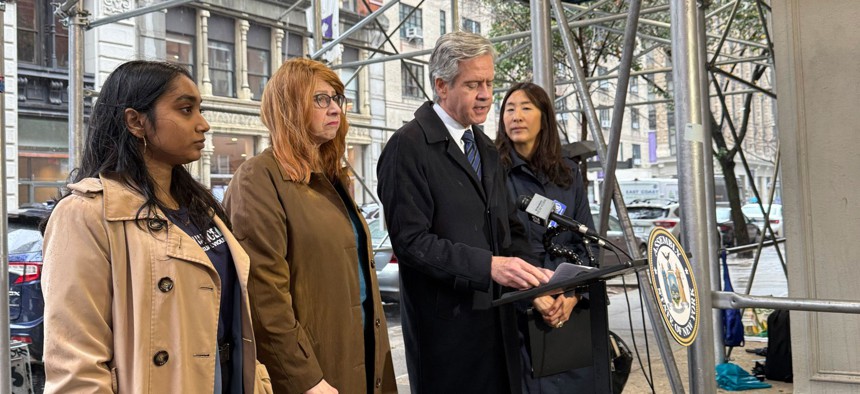
Assembly Member Linda Rosenthal, center, Manhattan Borough President Brad Hoylman-Sigal and Assembly Member and state Sen.-elect Grace Lee are taking on campus rape statutes. Emily Wilson / City & State New York



Lawmakers and state officials seem ready to start the next legislative session by taking up bills responding to the Cornell 7 case of alleged gang rape. Some lawmakers have introduced new measures to help student victims – but Assembly Speaker Carl Heastie once again indicated that a bill to change the state’s rape laws that has gained a national spotlight faces an uphill fight in his chamber.
Speaking on WNYC’s “The Brian Lehrer Show” on Thursday, Heastie again confirmed that a bill to close the so-called “voluntary intoxication loophole” in the state’s rape statutes didn’t have the votes to pass among Democrats in the legislative session that ended in June.
The measure would change state law in order to remove as a defense that an alleged victim was voluntarily drunk or on drugs. Currently, one is only considered incapacitated under sexual assault laws if they are drugged or made drunk without their consent. The bill has passed in the state Senate with unanimous support more than once. And in the Assembly, the legislation has numerous Republican co-sponsors, enough in theory for it to pass even if a majority of Democrats did not vote “yes.” “I do not pass bills with Republican votes,” Heastie said. “People put the Democrats in the majority, so mentioning that there’s a bunch of Republican sponsors, that’s not of consequence to us on the passage of a bill.”
Heastie said Democrats conferenced two versions of the bill, and neither reached a majority “yes” votes in the private member meetings. “I am never, as long as I’m speaker of the Assembly, going to put a bill on the floor that I hope passes,” he said on “Brian Lehrer.” “I put bills on the floor when I’m pretty confident I have enough votes to pass a bill.”
Gov. Kathy Hochul last month announced her support for changing the state’s rape laws, so the effort will have a powerful new ally next legislative session. And in the meantime, lawmakers like Assembly Member and state Sen.-elect Grace Lee and Assembly Member Linda Rosenthal are already introducing new measures in response to the high-profile case at Cornell.
The pair of legislators announced the Full Reporting Act on Thursday, which would establish a “clear standard” for how schools share information with law enforcement when serious crimes are alleged. Cornell has come under immense scrutiny for how it handled the rape allegation at the heart of the so-called Cornell 7 case and failing to share all its evidence with prosecutors, who did not bring charges when the alleged victim, referred to as Jane Doe, first came forward.
“When a case is referred to law enforcement, there needs to be no ambiguity about what information needs to be shared,” Lee said. “We need a clear, consistent standard for … how universities are sharing investigative records. Survivors deserve a process.”
Under the proposal, colleges and universities would need to provide local enforcement and prosecutors all available evidence it had gathered on alleged hate crimes, violent felonies or missing student cases within 72 hours of notifying police of an incident.
Rosenthal also introduced a different bill in October to expand the state’s Enough is Enough Law to strengthen rape reporting requirements on college campuses. “Together, these two bills will help shine a light and tell survivors we have your back,” she said on Thursday.
Last month, Lee separately introduced a bill dubbed the Survivor’s Choice Act, which would require colleges and universities to provide student victims of sexual assault tuition reimbursement if they take time away from school. Jane Doe’s attorney has said after her alleged assault, she wanted to take a leave of absence, but Cornell denied a tuition refund request.
– With reporting from Emily Wilson