

New York City Council
In theory, each City Council member’s office gets the same budget. In reality, some get much more
Expense reports obtained by City & State show annual spending among individual council offices can differ by hundreds of thousands of dollars.
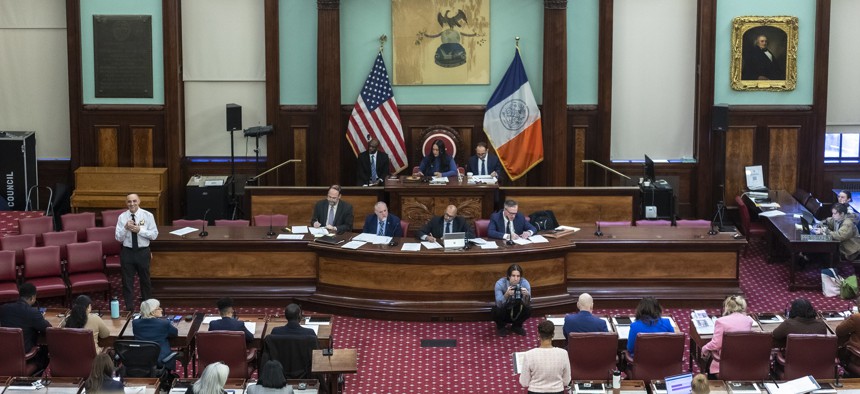
Different offices, different spending. Emil Cohen/NYC Council Media Unit


Officially, each member of the City Council is allocated $521,000 to run their office per year. But annual spending reports obtained by City & State show a wide range of actual spending, with a select few in leadership roles spending hundreds of thousands above the rest.
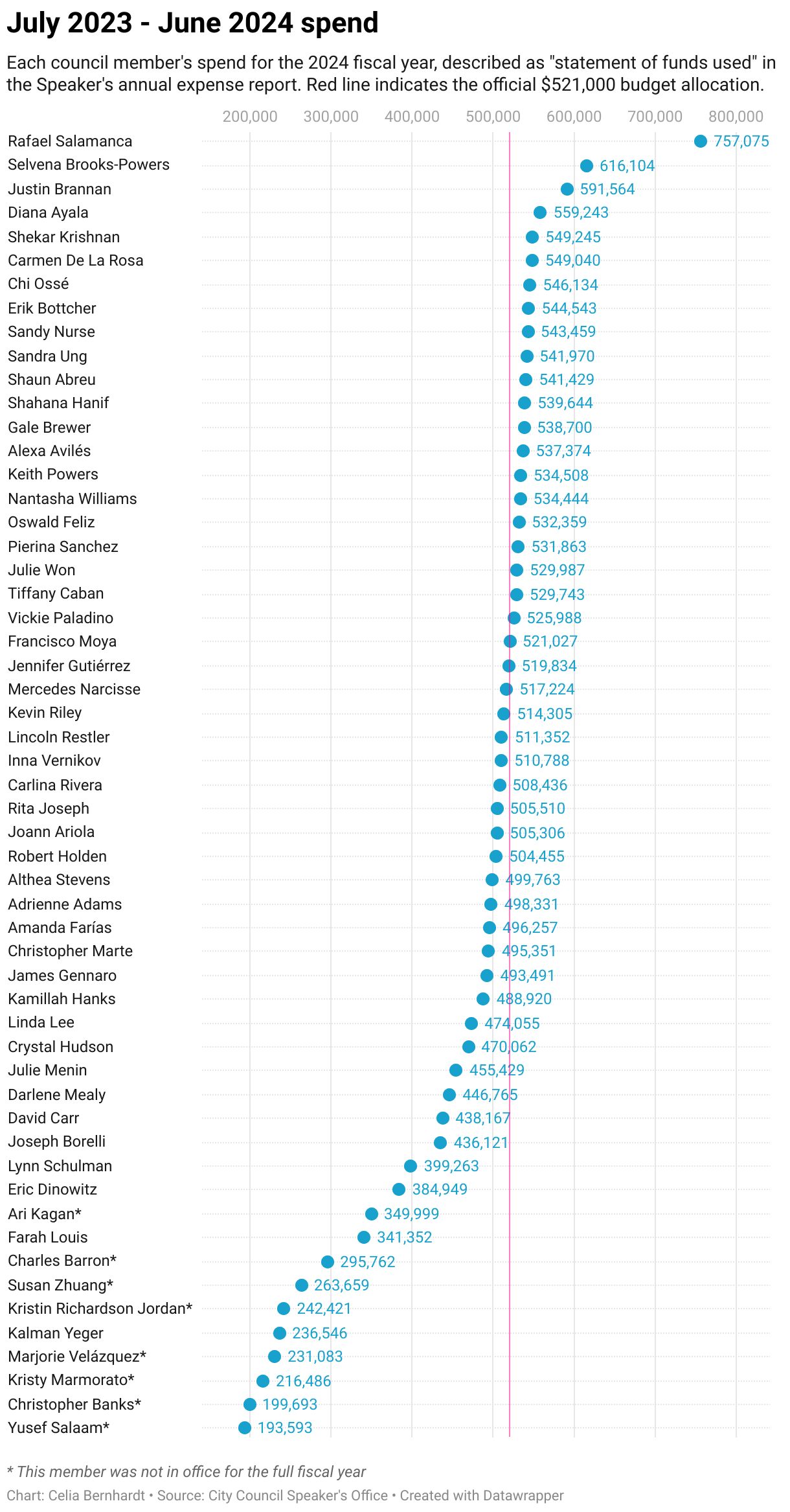
Take Council Member Rafael Salamanca, who chairs the powerful Land Use Committee. His office has spent more than $700,000 for the past three years. In 2025, he spent $787,878 when the average spend was $550,797, according to the reports. In 2024 he spent $757,075, when the council’s average spend was $507,393.
Finance Chair Justin Brannan spent a total of $888,388 in 2025, according to the report, the highest amount in the council by far. Granted, he opened up and staffed a second district office for the first time in that fiscal year, after redistricting left Council District 47 with an odd shape, stringing together Coney Island and Bay Ridge with a narrow strip of Dyker Heights. Brannan spent almost $300,000 less the year before that for a total of $591,564, and spent $495,453 in 2023, the reports say.
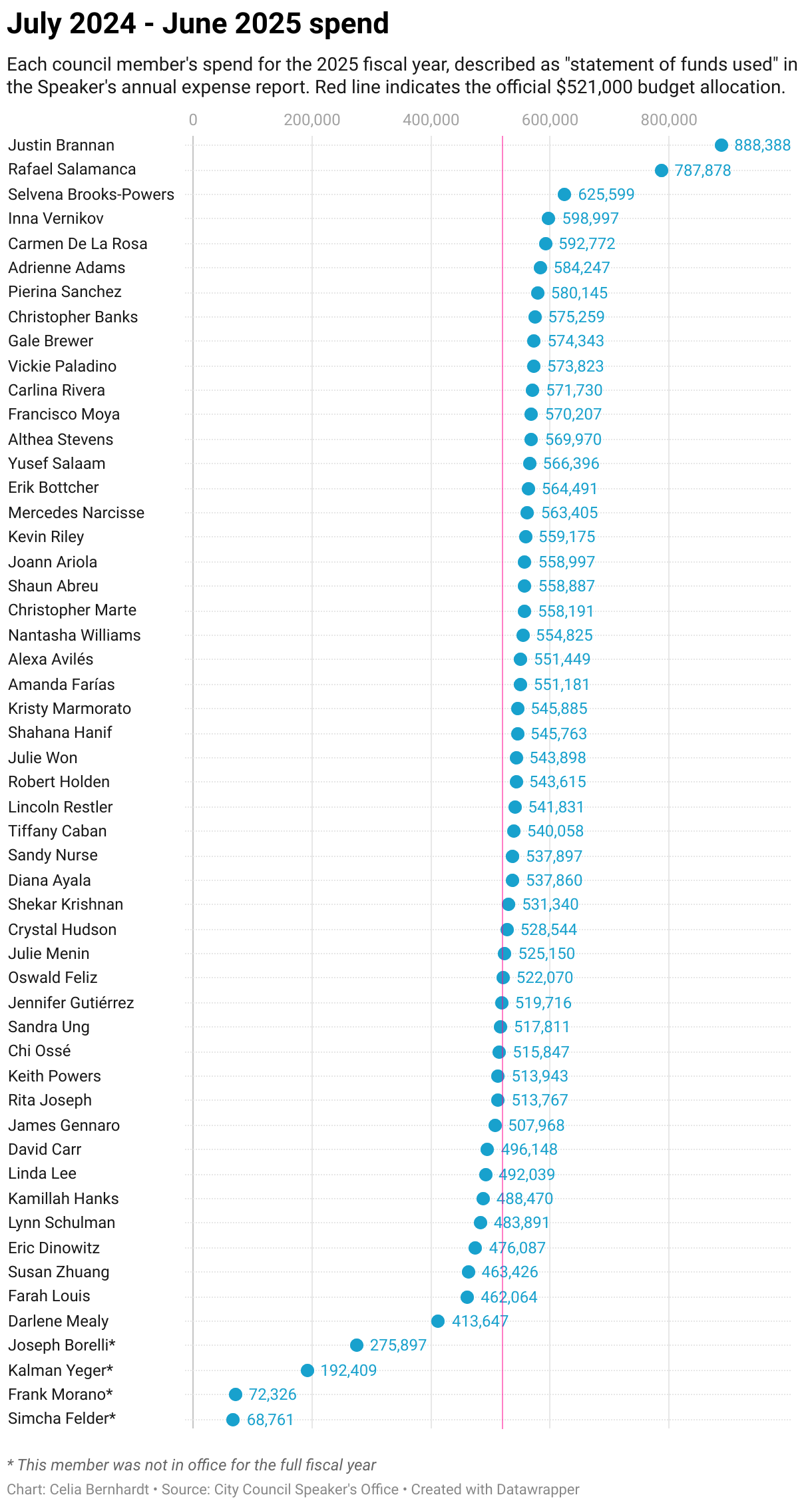
City & State obtained the City Council’s annual expense reports from fiscal years 2020 to 2025 through a Freedom of Information Law request. These documents are prepared by the speaker’s office and are made accessible to all council members, but aren’t posted publicly. The very last page of each report lists each council member’s “statement of funds used” – including what they spent on staff salaries (which makes up the bulk of the total) and on “other than personnel services” expenses, called OTPS, which include office supplies, appliances, furniture and the like.
Rent used to be a significant chunk of this spending, creating wildly different financial burdens for different members depending on the cost of office space in their district. But Speaker Adrienne Adams took that out of the equation in 2022, opting for the speaker’s office to cover the expense and freeing up more dollars for individual council members to spend on staff. (In fiscal year 2025, the council spent about $9.4 million on rent, according to the expense report.) Chairs of the powerful Land Use and Finance Committees often work with staff housed within the centralized council divisions for those categories – but members’ operating budgets don’t include those employees, only their personal staffers. Following a recent union contract ratification, cost-of-living increases for staff, retroactive to 2021, were included in the council members’ 2024 and 2025 budgets. And unused funds don’t roll over from year to year – they’re allocated back to the city.
Uneven operating budgets aren’t exactly new: the powerful roles of finance and land use chairs have historically gotten more funding due to the extra demands that come with them. Reporting from the Gotham Gazette in 2016 and Politico in 2019 showed that members in certain leadership positions, including those two heavy hitters, were granted an extra $70,000 to run their offices.
But the reports obtained by City & State reveal a nuanced picture. Some of today’s leadership has recently spent beyond those previous funding boosts: since 2023, Salamanca’s expenses have soared more than $200,000 above both the $521,000 budget and the average member’s spend for each year. And the top two spenders in 2020 and 2021, when the council was led by then-Speaker Corey Johnson, weren’t in either leadership role.
City & State reached out to a majority of council members and spoke with about a dozen current and former members, along with five current and former staffers. Several of them were granted anonymity to speak freely about their negotiations and relationship to the speaker. A wide variety of opinions emerged from those conversations: Some described the allocation and approval process as tinged by politics and impacted by one’s relationship with Speaker Adams, while others were unaware of the differences or described the system as basically fair. Many members and staffers said they wished there was more funding to raise staff pay and expand their teams.
When asked about allegations that political favoritism played out in this budgeting process, the council’s communications office declined to comment. Annual spending on staff and office upkeep aren’t considered the main mechanism through which the speaker financially rewards or punishes members – capital and discretionary funds carry that reputation.
But the speaker’s power over members can manifest in many ways: Council members make funding requests to the speaker’s office and are approved or denied on an individual basis. And the very leadership roles that historically come with more funding are tied to member’s closeness or leverage with the emergent speaker, who makes those appointments.
With a Julie Menin speakership on the very near horizon and some top spenders at the end of their terms, where these extra dollars flow could soon look very different.
Big (and small) spenders
When asked about his office’s higher spending, Salamanca said that he had asked the speaker for an additional staff member because his role as land use chair took away much of the time he would otherwise spend focusing on his district. “I’m a district guy,” Salamanca said, but “I have to focus more on helping members get to a ‘yes’ on projects.”
“I did ask if I can get a little bit more funding so that I can get more help in terms of the work that I need to do in my district,” the council member said, adding that he sat down with prior Land Use Chair Greenfield to ask him for advice. “I spoke to previous land use chairs and they said ‘Hey, make that ask, see what you can do,’” Salamanca said.
Majority Whip and Transportation and Infrastructure Committee Chair Selvena Brooks-Powers, who is one of a handful of members managing two district office spaces (her district includes part of the Rockaways, separated from the rest by water), has spent above $600,000 for the past three years.
“Our office’s budget reflects the responsibilities we carry and the needs of the community we serve,” Brooks-Powers said in an emailed statement, adding that as majority whip, her office “also supports additional leadership and legislative responsibilities that extend beyond the district.” She expressed support for additional resources to pay staffers across the council.
Brannan, for his part, said over text that his office’s records showed a total spend of about $790,000 for 2025, not $888,388 as reflected in the speaker’s report. He said that the new layout of the district required two offices with “staff to serve constituents on both sides of the map.”
The big spenders in 2020 and 2021, under Speaker Corey Johnson, included Minority Leader Steven Matteo with $634,699 in 2020, Council Member Ruben Diaz Sr. with approximately $610,000 both years, and Education Chair Mark Treyger with $646,428 in 2021.
Matteo enjoyed an extra $150,000 to work with in fiscal year 2019, according to Politico – the highest boost in the council. A source close to the speaker’s office during Johnson’s reign said that Treyger and Matteo were given the extra wiggle room simply because they were friends of Johnson. “It’s all political,” they said. “Whoever gets selected speaker, whoever their allies are, they get preferential treatment in the process.” Johnson declined to comment.
Some members who spent less in recent years – Council Members Kalman Yeger and Joe Borelli among them – said they did it out of principle and a penchant for frugality. “More staff is more problems,” said Borelli, who left the council shortly before his term ended to join a political consulting and lobbying firm. “I’d rather give people their money back.”
One staffer for a different council member said that they would have preferred to spend down more of their budget, but frequently ran into issues getting their expenses approved by the speaker’s office. “It's very tenuous and very difficult,” they said.
A different staffer argued that the process of getting approval, while sometimes tedious, didn’t present a major barrier for anyone following the rules. Council Member Lincoln Restler expressed a similar sentiment over text. “Council members and staff who carefully manage their office finances shouldn’t have any issues in fully spending down their allocated budgets,” he said.
What they’re saying
Some council members and staff were unsurprised by high-level leadership spending more on staff. Others said they had no idea about the disparity. Many expressed frustration.
“That discrepancy among the 51 – it should raise some concerns. Like, why is it that some members have more than others?” said Council Member Shahana Hanif. “My main contention is that the staff should be making much more than they are… What we have seen is a real struggle both recruiting good quality staff and also retaining good quality staff.”
Several members and staff described the process as political.
“If the council speaker likes you, then she gives you more OTPS,” one member said. “It goes back multiple speakers.”
“That’s how this has worked for as long as I can recall. And it is just the nature of the beast,” another member said. “Some of these people chair large committees, so they have a lot of responsibilities, so you could argue they need some additional staff to handle that work – you can defend this in a variety of ways. But what I can promise you is it won’t be the same council members that have the very large budgets next year.”
Some members and staffers, though, felt that the extra funds made sense. The land use chair, one member said, works “not only in their district but also with land use projects in every corner of the city. So it does make sense to give a member like that, maybe one or two additional staff members.”
While some said they thought the $521,000 number was inflexible, others said that they always knew it could be negotiated. One council member described making a case to the speaker that they should receive more city funds to bring on a new staff member to better serve their district. They were ultimately successful.
“Council members do speak a lot, including about their needs, and this is something that I’ve chatted about with other council members,” the member said. “Even though the speaker doesn’t have a written rule on this, council members kind of should know this.”
New speaker on the way
The presumptive next City Council speaker, Julie Menin, said that she intends to raise members’ budgets from the $521,000 base. “The overall population in New York City has increased, yet the office budgets haven't increased, and council members are on the front lines dealing with constituent issues,” Menin said.
It would certainly be a welcome change for members and staffers across the board. The recent cost-of-living increases, though helpful for long-time staffers, don’t translate to a higher budget for recruiting new ones.
“People are really having trouble replacing their staff when they leave,” council union president Matt Malloy said. “Raising these budgets is fundamental in delivering for our constituents.”
With differences in which specific roles members value most (do they want more communications or community organizing staffers?), how much they allocate for each salary, whether those roles are part-time or full-time and how much turnover takes place, there are near-infinite variations in how council members divvy up their personnel expenses. What most agree on, though, is that more breathing room in the budget helps them staff up the best way they see fit.
Whether Menin will continue the pattern of giving certain members leeway to spend much more than the rest remains to be seen – she declined to comment on the disparities in what offices spend.
Explore council office spending from previous years below.


With reporting from Holly Pretsky.
NEXT STORY: State Senate gets praise from environmental group, while Assembly gets faulted