

News & Politics
Get to know DSA’s internal caucuses
From Socialist Majority Caucus to Marxist Unity Group, these are the groups within the group that are driving its policies and priorities.
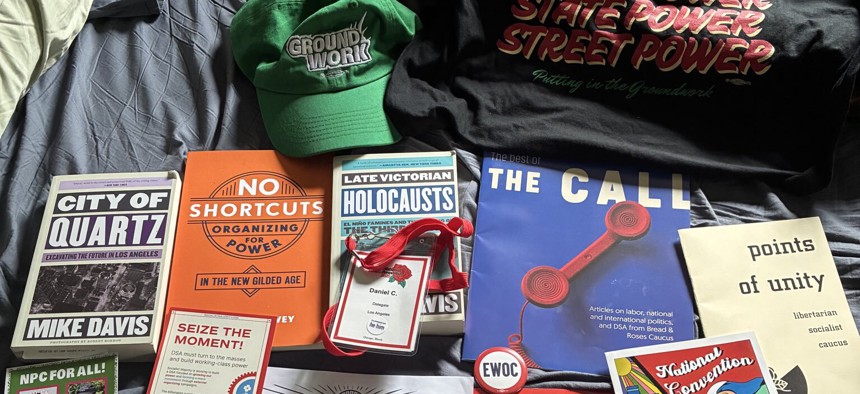
DSA caucuses distributed literature and swag to attendees at the 2025 DSA National Convention. Daniel C.


The Democratic Socialists of America may represent the far-left flank of American electoral politics, but the organization itself is a “big tent” that includes leftists of all stripes, from Bernie Sanders-supporting Democrats to communists. This (relative) ideological diversity means that the DSA’s internal politics can be just as contentious as other political battles.
The DSA includes a number of caucuses – internal groups of like-minded individuals who align on political strategy. Not all DSA members belong to a caucus, but they dominate the group’s internal politics. Caucuses often run their own slates of candidates for internal leadership elections, try to whip votes for and against specific resolutions during the DSA’s biennial national conventions and back candidates who are seeking the DSA’s endorsement.
There are more than a dozen caucuses within DSA, and they can be roughly divided into two groups: the “left” caucuses and the “reformist” or “right” caucuses (which hate being described as part of the DSA’s right flank). Nationally, DSA is divided fairly evenly between the two wings, though NYC-DSA is dominated by the more reformist caucuses. Here are some key caucuses to know.
The most influential caucus in NYC-DSA, SMC is part of the DSA’s more reformist wing and advocates for a “mass politics” strategy that convinces as many people as possible to join the DSA. They’re primarily focused on working to elect DSA members in Democratic primaries to pass policies that benefit the working class.
SMC is frequently criticized by more ideologically extreme caucuses that feel they’re too willing to compromise with mainstream Democrats and too unwilling to publicly criticize DSA-backed electeds, like Rep. Alexandria Ocasio-Cortez.
Most of the DSA members advising New York City Mayor Zohran Mamdani belong to SMC, including Cea Weaver (head of the Mayor’s Office of Tenant Protection) and Tascha van Auken (head of the Mayor’s Office of Mass Engagement). NYC-DSA co-Chair Grace Mausser and Assembly Member Claire Valdez are also in SMC.
The SMC and its allies control 32 of the 71 seats on the Citywide Leadership Committee, the main leadership body for NYC-DSA. But the caucus is less influential nationally, controlling just four of the 27 seats on the National Political Committee, the DSA’s main leadership body.
Like SMC, Groundwork represents the more reformist wing of the DSA, but with a greater focus on ecosocialism. The caucus was integral to the fight for the Build Public Renewables Act and continues to fight for public ownership of utilities and a transition from fossil fuels to renewable energy. Groundwork was also the primary caucus backing New York City Council Member Chi Ossé’s aborted primary challenge against House Minority Leader Hakeem Jeffries. NYC-DSA co-Chair Gustavo Gordillo is a Groundwork member, as is national DSA co-Chair Ashik Siddique.
Groundwork and its allies control 21 of 71 seats on NYC-DSA’s Citywide Leadership Committee and five of 27 seats on the DSA’s National Political Committee.
A catchall communist caucus, Emerge represents the left flank of NYC-DSA. The group is committed to police abolition and anti-imperialism. It’s not necessarily opposed to electoral politics – many of its members canvassed for Mamdani last year – but it’s equally focused on collaborating with activist groups outside of the DSA and it has created “community solidarity councils” to coordinate with local community activists who aren’t in the DSA. The caucus has high expectations for the DSA’s elected officials: It supports censuring Ocasio-Cortez over her support for funding Israel’s Iron Dome missile defense system, was split on endorsing Ossé and signed on to a statement calling for Mamdani to fire NYPD Commissioner Jessica Tisch.
Emerge was launched in New York City in 2019 and only expanded nationally in 2025, so it has significantly more sway locally than it does nationally. The caucus controls eight seats on NYC-DSA’s 71-member Citywide Leadership Committee but has no seats on DSA’s National Political Committee.
MUG puts the “orthodox” in orthodox Marxism. To a much greater extent than SMC or Groundwork, this caucus is focused on political theory – it even put together its own curriculum for members that includes readings from Karl Marx, Karl Kautsky, Vladimir Lenin and other socialist theorists.
MUG wants the DSA to behave like an independent political party with its own clear policy program, rather than just representing the left flank of the Democratic Party. For MUG, it’s not enough to get DSA candidates elected; those candidates also have to fight for specifically socialist policies. The caucus believes that the DSA’s elected officials should act as “tribunes of the people” who expose the rotten underbelly of politics, rather than prioritizing legislative compromise. Unsurprisingly, MUG was one of the caucuses that opposed endorsing Ocasio-Cortez in 2024.
MUG and its allies control three seats on NYC-DSA’s 71-member Citywide Leadership Committee and three of 27 seats on the DSA’s National Political Committee.
This group, which technically considers itself a network rather than a full-fledged caucus, represents the most committed anti-Zionists within the DSA. They frequently organize in support of the Boycott, Divestment and Sanctions movement against Israel and are also in favor of instituting “red lines” for DSA members and DSA elected officials when it comes to Israel and Palestine. Unsurprisingly, SOR is in favor of censuring, and even disendorsing, Ocasio-Cortez due to her opposition to BDS and support for funding Israel’s Iron Dome missile defense system. Like Emerge, SOR signed on to the statement calling for Mamdani to replace Tisch.
There are two SOR members on NYC-DSA’s 71-member Citywide Leadership Committee, and the slate also controls four seats on the DSA’s 27-member National Political Committee.
Labor is the name of the game for this Marxist caucus, which focuses on a rank-and-file labor strategy – recruiting DSA members to take jobs in strategically important industries like education, health care and logistics to help build militant unions and strengthen the relationship between organized labor and the socialist movement. B&R believes that DSA’s elected officials should act as “organizers-in-chief,” using their positions in government to help constituents join organizations like DSA, labor unions, tenant associations and other groups. When it comes to internal politics, B&R tends to act as a swing vote – sometimes joining with the left caucuses and sometimes joining with the reformist wing.
B&R controls three seats on NYC-DSA’s 71-member Citywide Leadership Committee and three seats on the DSA’s 27-member National Political Committee.
This article has been updated to reflect that Emerge announced its formation in 2019, expanded nationally in 2025 and currently controls a total of eight seats on the Citywide Leadership Committee.
NEXT STORY: OK Zohran, so you aced the storm.