

News & Politics
Understanding DSA’s structure
NYC-DSA is the socialist organization’s largest local chapter, but there are 10 other chapters in New York state.
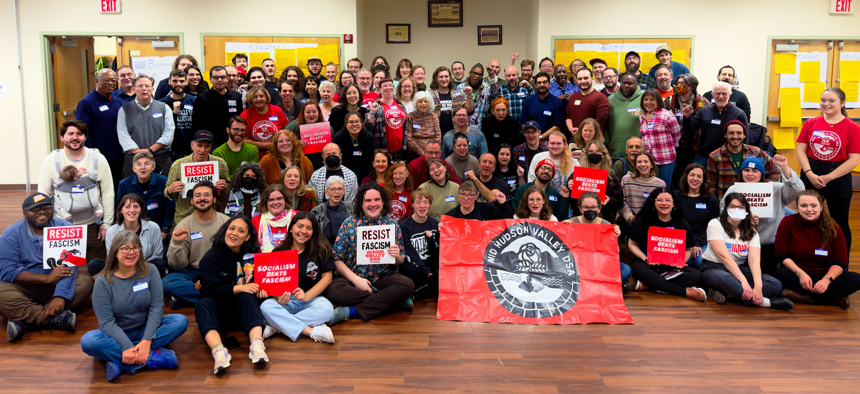
Mid-Hudson Valley DSA is the second-largest DSA chapter in the state, behind only NYC-DSA. Daniel Atonna


The Democratic Socialists of America is a membership-based socialist organization with more than 90,000 dues-paying members. Anyone can join the DSA – there’s no admissions process, and you don’t even have to be American – by simply signing up to pay dues. The standard rate is $15 per month, but people are encouraged to pay whatever they can afford; low-income members can pay as little as $5 per month, while more affluent members are asked to pay “solidarity income-based dues,” tithing 1% or 2% of their total income.
The DSA is divided into more than 200 local chapters, and every DSA member is simultaneously a member of the national organization and a single chapter. (Those who don’t live near a local chapter belong to the “at-large” chapter, which has about 4,500 members).
NYC-DSA, which includes more than 13,000 members across the five boroughs, is by far the largest DSA chapter in the country. But New York state is also home to 10 smaller DSA chapters: Buffalo (roughly 370 members), Capital District (420 members), High Peaks (40 members), Ithaca (240 members), Long Island (450 members), Lower Hudson Valley (400 members), Mid-Hudson Valley (840 members), Rochester (450 members), Syracuse (270 members) and Troy (170 members).
Because it’s so large, NYC-DSA is further divided into seven geographic branches: Queens, North Brooklyn (NBK), Central Brooklyn (CBK), Flatbush, South Brooklyn (SBK, which for now includes Staten Island), Lower Manhattan (LowMan) and Bronx/Upper Manhattan (B/UM). That means every NYC-DSA member is simultaneously a member of the DSA, NYC-DSA and a local chapter.
And that’s just the start! NYC-DSA members are also encouraged to join issue-specific working groups, such as the Electoral Working Group (EWG), Immigrant Justice Working Group (IJWG), Racial Justice Working Group (RJWG), Ecosocialist Working Group (EcoSoc), Socialist Feminist Working Group (SocFem), Trans Rights and Bodily Autonomy Working Group (TRBA), Anti-War Working Group, and Labor Working Group.
The highest decision-making bodies within both the DSA and NYC-DSA are the biennial conventions, where delegates representing each chapter (in the case of the national convention) or each branch (in the case of the NYC-DSA convention) vote on resolutions to direct the group’s strategy for the next two years. Between conventions, the DSA is led by the National Political Committee (NPC), a 27-member group elected at the convention, while NYC-DSA is led by the Citywide Leadership Committee (CLC), a 71-member group directly elected each year by a vote of all NYC-DSA members.
All of these various groups and committees have democratically elected leadership, and being an active NYC-DSA member means constantly voting (or even running) for various internal positions: the leadership of your branch, members of the Citywide Leadership Committee, delegates to the citywide convention, delegates to the national convention and the leadership of working groups, among others.
On a day-to-day basis, NYC-DSA operates largely independently of the DSA’s national leadership – a consequence of the DSA’s relatively decentralized structure. NYC-DSA is a legally distinct entity from DSA’s national organization and can raise funds directly from its own large membership, enabling it to pursue its own campaigns and initiatives without much assistance from the National Political Committee. But as a DSA chapter, NYC-DSA is ultimately supposed to follow decisions made at the national convention and by the National Political Committee, which can sometimes lead to tension, particularly when it comes to endorsing candidates.
In 2024, NYC-DSA easily voted to reendorse Rep. Alexandria Ocasio-Cortez, but the National Political Committee sought to impose strict conditions before endorsing the representative, which ultimately led to Ocasio-Cortez losing the DSA’s national endorsement. When NYC-DSA endorsed Zohran Mamdani for New York City mayor the following year, it didn’t even apply to the National Political Committee for a national endorsement.
NEXT STORY: Here are the NYC seats DSA is eyeing in 2026