

Politics
The charged fight over battery storage comes to a historic Black neighborhood in Queens
Members of the community, including some who live near the site, are pushing back.
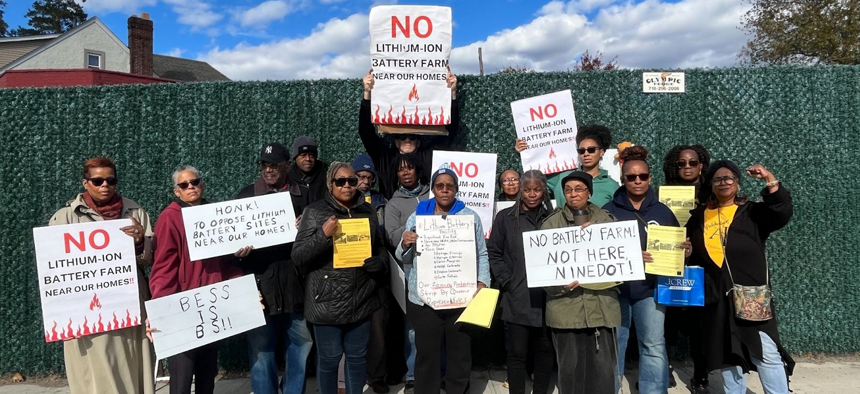
A group of community members who oppose the Addisleigh Park battery storage facility. Mrwa Abbas


Jasmine Lawrence remembers spending her childhood summers in Addisleigh Park at her grandfather’s house, and seeing a jazz pianist’s daughter walk down the block. Her grandfather moved into the neighborhood in the 1950s, joining a community of prominent jazz musicians and athletes who helped make this corner of Southeast Queens a historic Black enclave that has since gained landmark status.
She was shocked to learn last summer that a large battery storage site was set to start building on a former gas station steps from the home she owns.
“My house is only about 10 feet from the area,” she said. She mentioned she was concerned because there have been fires at other battery storage facilities in the nation.
“How do you lay your kid’s head down knowing that there's potential danger, deadly danger 10 feet away? That’s not OK.”
In an effort to meet New York state’s clean-energy mandate, the city has approved battery storage facilities across the five boroughs. NineDot Energy, the developer behind this 4.9-megawatt site, stores renewable energy in lithium-ion batteries for use when the city’s grid needs a boost. The proposed project, at 179-21 Linden Blvd., is adjacent to multiple homes and across the street from the St. Albans VA Medical Center.
Community members have testified against the project at City Council meetings and have been holding near weekly protests in an effort to stop the project.
“As part of the site-specific approval process, the facility must comply with New York City fire code requirements, which include continuous safety monitoring,” said Sam Brill, vice president of strategic development at NineDot Energy. He explained that the site will be equipped with 24/7 heat-sensing cameras connected directly to the FDNY’s central monitoring station, allowing firefighters to respond within minutes if overheating is detected. In addition to FDNY oversight, the facility will be monitored both internally and by an independent third-party consultant. The battery system will also include a battery management system designed to detect overheating at the individual cell level; if one cell begins to overheat, surrounding cells automatically shut down to prevent heat buildup or the spread of fire.
As part of the approval process, NineDot says it’s required to submit a site-specific hazard mitigation analysis examining worst-case scenarios, including what could happen if multiple safety systems failed simultaneously. The analysis looks at how nearby homes and properties could be affected, and the FDNY must confirm the surrounding area would remain safe before the project can move forward. They also confirmed that they are required to create an emergency plan outlining how firefighters would respond if an incident occurs.
“FDNY and DOB have issued all of the permits according to code, which allow us to proceed with construction, which we plan to do sometime in 2026,” Brill said.
New York state has approximately 6,000 battery storage projects that have been installed or approved– 83 of them in New York City, most of which began operating in 2022. The proposed Addisleigh Park facility is part of the state’s goal of installing 6,000 megawatts of energy storage by 2030 and approved funding to support new residential, community and large-scale battery projects across New York.
New York’s push for battery storage is part of a broader effort to move away from fossil fuels. The technology is an especially important companion to solar and wind power, which only produce energy under certain conditions. These large battery systems let the city store extra energy when it’s plentiful and then use it when demand is high.
Officials at the New York City Department of City Planning said there haven’t been any recorded fires from this type of battery storage system in New York City to date. However, there have been reported fires in Jefferson, Orange and Suffolk counties.
During a City Council meeting in late October regarding fire safety and battery storage facilities, the FDNY said they haven’t put out any battery storage system fires, adding that they’re meant to consume themselves and burn. But lithium-ion batteries store a lot of energy. If they overheat or get damaged, the materials inside can ignite. And it can take days to fully extinguish such a powerful blaze.
The transition to renewable energy is intended to make the electrical grid produce less pollution. When energy demands are high now, New York City relies on what are called “peaker plants.” These burn fossil fuels, and “put emissions into our local communities,” said Lauren Marbella, a chemical engineering professor at Columbia University.
But the question is which neighborhoods will bear this potential risk. William Scarborough, president of the Addisleigh Park Civic Organization and Southeast Queens Residents Environmental Justice Coalition, said that like many of his neighbors, he was stunned when he first heard about the plans for a battery site and was distressed that the city had not alerted neighbors to the project. Residents only learned about it after a few people saw it mentioned in the community newspaper.
“I understand the clean energy part of it. We understand the fact that it’s better than fossil fuel. But lithium batteries are flammable,” Scarborough said.
Addisleigh Park, now known as the African American Gold Coast, was predominantly a white neighborhood before the 1950s. There was significant resistance as it shifted from a predominantly white neighborhood to one with a growing Black population, with various tactics aimed at discouraging Black residents. Some white residents even discovered notes slipped under their doors warning of Black people moving into the area to help slow down Black residents from moving in.
In 1948, the U.S. Supreme Court ruled that property deeds that prevented houses being sold to people of color were unconstitutional. This led to an increase in Black residents moving in, and over time, white residents left.
By the 1970s, the area was considered one of the most affluent Black communities in the country, and it has stayed that way for the past 50 years. Today, the area is about 90% Black, with an average household income of over $80,000. But historic homes haven’t protected Addisleigh Park from being chosen to host this facility.
“When we look at the landscape of America, unfortunately, we see some troubling trends,” said Jalonne L. White-Newsome, associate professor in environmental justice at the University of Michigan School of Public Health. In the past, the U.S. government undercut Black neighborhoods through redlining, and that same trend continues in different forms, she said. “Even now we still see that primarily communities of color, Black and brown, are living near or in areas that are zoned to be industrial. When developers take it upon themselves to serve themselves at the expense of the health, wealth, and longevity of a community, it’s not only an issue; it is a public health crisis.”
Alicia Hyndman, the Assembly member for District 29, which includes the Addisleigh Park neighborhood, shares the concerns of residents. After learning about the proposal and speaking with members of the community, she consulted the local firehouse. They informed her that they do not have the capability or equipment to extinguish a fire of that scale and would likely have to let it burn itself out. FDNY officials confirmed this in an email.
“The best-case scenario is that this facility comes online and nothing ever happens, but because of the devastation that has occurred around the country, the residents of Addisleigh Park are concerned and rightly so,” Hyndman said.
In January 2025, a large lithium-ion battery storage facility near Moss Landing in Monterey County, California, caught fire and burned for days, according to NPR. No one was killed or injured, but the fire prompted evacuations and school closures, and residents reported symptoms including trouble breathing – due to the heavy metals found in lithium-ion batteries.
Scarborough explained that the community identified another location about three blocks away in an industrial area and offered to work with the developer if the facility were moved there. The company told him it already planned to build on that site as well.
“It’s not an either/or proposition,” Brill said. “We need to have energy storage all over the city, in residential areas, in commercial areas, and in industrial areas, because it’s not just industrial areas that are at threat of losing power during a brutal (heat) wave.”
In neighborhoods like Addisleigh Park, where most residents own their homes, projects could affect home values, White-Newsome said.
“Outside entities often come into communities and disrupt long-standing continuity and generational wealth, claiming it’s in the name of energy efficiency or economic development,” she said.
In predominantly white New York neighborhoods, similar battery projects have been withdrawn. For example, a large facility planned on Staten Island was canceled without explanation. The Swiftsure project, a 650-megawatt system proposed by Fullmark Energy, would have been the largest battery storage facility in New York and one of the largest in the country before it was withdrawn.
“Why is it that in this case, despite the historic nature and beauty of Addisleigh Park, the developer – and the city – are doing nothing?” Lawrence said.
Farudh Emiel, a resident of Southeast Queens and an energy justice activist, said the city and the developers should be doing equity impact assessments before moving forward with new projects. These assessments look at who might benefit from a particular development, who might face negative impacts, and whether certain groups – especially communities of color – would be affected unfairly.
“So even though batteries can be a good thing, you have to look at the full life cycle of effects of solutions,” White-Newsome said. “Just because they say ‘clean energy’ doesn't mean that it checks the box on all the other things that can actually make it detrimental to society and harmful to people.”
This story is published in partnership with the Craig Newmark School of Journalism.
NEXT STORY: NYC’s budget outlook gets Moody