

New York City
Jessica Tisch isn’t too worried about scrapped plans to hire 5,000 more cops
The NYPD commissioner stayed aligned with Mayor Zohran Mamdani during the City Council’s preliminary budget hearing.
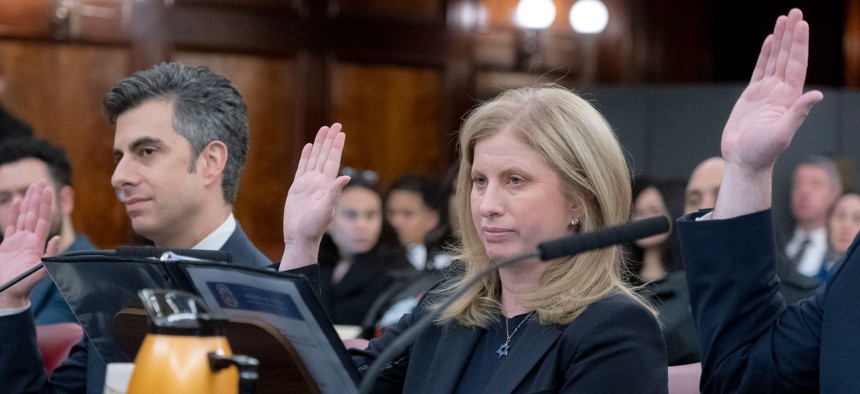
NYPD Commissioner Jessica Tisch testified before the City Council on Wednesday. Gerardo Romo / NYC Council Media Unit


When Mayor Zohran Mamdani scrapped funding to hire 5,000 additional cops last month, the move predictably elicited criticism from Republicans and even some Democrats.
But New York City Police Department Commissioner Jessica Tisch, with whom the lefty mayor has managed to maintain an alliance, suggested that outrage over the move has been overblown. “The narrative that we cut 5,000 cops is frankly absurd because they never existed,” she told City Council members during a preliminary budget hearing for public safety on Wednesday.
“In an ideal world, would I love to have more cops? Absolutely,” she said, when asked whether additional cops would help lower crime. “But in a realistic world of limited resources, I believe that the 35,000 number that we are at now is strong.” That’s due in part to the department’s recent success in staffing up, she said, stating that they’ve been able to move past the hiring crisis. Tisch, however, had been supportive when former Mayor Eric Adams announced funding to hire the 5,000 additional cops back in November, on his way out of office.
That exchange was one of several in which Tisch showed alignment with Mamdani or avoided exposing areas of disagreement throughout three hours of testimony. The working relationship between Tisch, a respected veteran of city government who served under Adams, and Mamdani, a democratic socialist and historically vocal critic of the police, is among the most closely watched of the new administration.
Tisch avoided saying much about discussions with Mamdani over his stated intention to disband a controversial police unit known as the Strategic Response Group that specializes in counterterrorism and responds to large protests. She said she’s “aware of the mayor’s concerns about SRG” and that they have had conversations about it. “I’m not going to discuss private conversations with the mayor, but I will say that I will never do anything not in the best interests of the New York City Police Department and the people of the city of New York.” She added that SRG was on standby for just under 6% of protests last year and was called in to make arrests at just 1%.
Tisch was also asked about Mamdani’s proposal to create a Department of Community Safety that, among other things, would divert some mental health 911 calls away from a police response. She again said that her team had discussed the issue with the mayor’s office but did not offer a straight opinion on the overall pitch, except to say that she believes “you need to send the police when there’s a call for a violent person.” Later on Wednesday, The New York Times reported that Mamdani will sign an executive order creating a pared down “Office of Community Safety” on Thursday with around $260 million from existing programs, though it’s unclear which programs.
Asked during the hearing if she thought standing up a new Department of Community Safety would result in a reduction in the NYPD’s budget, Tisch answered plainly “no.”
Plenty of City Council members at Wednesday’s hearing praised Tisch’s leadership in the mostly cordial hearing, in particular characterizing it as “stable.”
Though it wasn’t her first time testifying at an NYPD budget hearing, Tisch pointed to several areas of reform under her leadership, including progress on reducing overtime spending. According to Tisch, there wasn’t previously a plan to manage the massive spending category. “The way we have been so successful in reducing overtime 14% last fiscal year and 12% last calendar year, was by implementing our overtime management plan,” she said. “Basically, as far as I can tell, before last January, overtime was not being managed at the New York City Police Department.”
She also indirectly criticized practices under prior leadership that resulted in NYPD executives being allocated multiple “kitted out vehicles assigned to them personally” that were intended for undercover investigations. “The results of it were galling,” she said of a review she initiated into the practice soon after taking over as commissioner. “I think by last June we fixed all of this.”