

City & Sports
Yes, voters do care who really knows ball
Sports fandom can be a useful tool to New York politicians – if they know what they’re talking about.
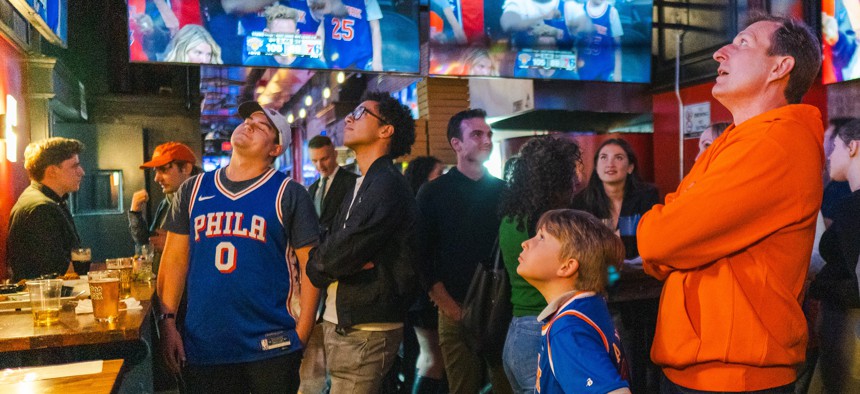
Rep. Dan Goldman hosted a Knicks watch party amid a competitive reelection campaign. Donovan Mierlak


About a year ago, then-New York City mayoral candidates Zohran Mamdani, Brad Lander and Scott Stringer were asked at a candidate forum hosted by Hell Gate and New York Focus: “Name a current Knick other than Jalen Brunson.”
With the Knicks in the midst of a playoff run, it wasn’t completely out of left field from moderator Christopher Robbins. Stringer sheepishly fumbled the question, tossing out NFL quarterback Aaron Rodgers, and Lander named Knicks forward Mikal Bridges. Then Mamdani – who aired a campaign ad during the Knicks playoff broadcast – came up just short: He said “Thibs” – then-head coach Tom Thibodeau.
For Knicks fans in New York politics, Mamdani’s answer elicited an odd combination of groans and chuckles. He tried! But compared to questions regarding public safety and the city’s housing crisis, why does it matter if the mayor is the biggest fan of New York’s top NBA team?
“We asked because we wanted to see how ‘deep’ or ‘real’ the fandom was,” Robbins told City & State via email. “It’s a kind of authenticity question that also has the potential to generate interesting answers. I don’t think we TOTALLY accomplished that, but that was the goal!”
Sports fandom is a way for politicians to come across as relatable, regular people – it makes them someone voters can see themselves having a beer with. It also raises the question of authenticity: Are the people vying for votes actually fans, or is it just for show?
The added complicating factor for local politicians is that if they act against the wishes of a powerful team executive, members of the team’s fanbase – who are also voters – have the ability to oust them from office. Issues like streaming blackouts, ticket markups and stadium renovations may not be the most important issues, but taking a stand on them is an avenue for elected officials to directly impact voters in a way that is easy to grasp – and affects something they are passionate about. They can also tell when there’s an imposter in their midst.
Former New York City Mayor Eric Adams’ dual Mets/Yankees hat sparked so much outrage because you can’t have it both ways.
“I don’t know any sports fans who like both teams, and I think there’s something that just feels deeply inauthentic when a politician both tries to present themselves as a sports fan and tries to cut it down the middle,” said political communications adviser Aaron Ghitelman.
“I think authenticity is the most important currency in politics right now,” said Democratic consultant Ryan Adams. “I think the people that are doing well in politics are doing well because they’re authentic, and I think people that are falling flat on their face are doing so because they are not authentic.”
Rep. Dan Goldman, the Manhattan and Brooklyn member of Congress best known as an heir to the Levi-Strauss fortune and the attorney who led President Donald Trump’s first impeachment inquiry, has spent time becoming a more personal figure in the district. Part of what has been humanizing for him, particularly this year as he tries to fend off a challenge from Lander, is his Knicks fandom. During the Eastern Conference semifinals, he held a campaign watch party at a sports bar near City Hall. While to some, it may have seemed like a gimmick, his love for the team clearly went beyond his Knicks hoodie and orange and blue pair of Nike Dunks. He cheered genuinely after every one of Mitchell Robinson’s (scant) made free throws, and lamented bad calls with the rest of the crowd. And he talked strategy in detail with his school-age kids, who were also decked out in gear of their own. Goldman knows his stuff too – he said he was captain of the varsity basketball team at Sidwell Friends in Washington, D.C. – some 20 years before the Knicks’ own Josh Hart was on the team.
It’s not lost on Goldman that such watch parties are powerful tools. “Sports is the great equalizer,” he said. “It cuts through partisanship, it cuts through different backgrounds, it cuts through everything. … We can disagree about lots of things, but we are New Yorkers, and we are Knicks fans. We agree on that, and that bonds us.”
But a lack of true fandom creates the opportunity for a gaffe. When Gov. Kathy Hochul was asked about Trump’s claim that he’s a lifelong Knicks fan, she said, “I ask him to name the starting lineup from (the) 1993 championship team and see how he does.” But the Knicks haven’t won a championship since 1973. Her team tried to walk it back and suggested she was testing Trump, but it appears the governor does not know ball.
“When I advise clients, I tell them … ‘Don’t pretend to be a sports fan, because sports fans freaking hate that,’” Adams said.
While state Sen. Zellnor Myrie is without a doubt a diehard Knicks fan, it was clear which voters he was trying to court during his failed mayoral campaign last year. In addition to constantly tweeting about the team, he also appeared on a Knicks podcast and analyzed the team extensively. His appearance suggested he was trying to get younger male voters to the polls. While Myrie’s campaign never really took off, Mamdani leaned into that strategy as well, posting videos of himself talking to Knicks fans outside Madison Square Garden about the high prices of tickets and affordability in the city. Rep. Pat Ryan, for his part, has taken a similar approach in the Hudson Valley, looking to galvanize young men on issues like streaming blackouts and cable disputes.
But the same desires that draw politicians to use sports to connect with voters also make them susceptible to acquiesce to the demands of owners. The public will be on the hook for more than $1 billion for the Buffalo Bills’ new stadium. The Willets Point redevelopment, the future home of New York City FC’s Etihad Park, will cost New York City taxpayers more than $500 million in lost tax revenue, according to the Independent Budget Office. In those cases, those costs may have gone under the radar because the politicians championing them – Gov. Kathy Hochul and former New York City Council Member Francisco Moya, respectively – have leaned into their fandom, celebrating the developments as massive victories for their communities. The same cannot be said of state Sen. Jessica Ramos with regard to Mets owner Steve Cohen’s casino bid. While her endorsement of Andrew Cuomo for New York City mayor played a big role, Ramos’ failed attempt to block the casino, and subsequent fall from grace, shows it can be politically fraught to go up against powerful team owners who have lots of money. As much as Ramos, a big Mets fan herself, has tried to frame her crusade as a fight between the little guys and a billionaire, Cohen has been affectionately referred to by fans as Uncle Stevie. Ramos, ultimately, cannot escape that.
In the weeks to come, New York elected officials will be hosting their fair share of Knicks watch parties. Mamdani even signed an executive order allowing kids to stay up to watch the games. Of course, he and his fellow elected officials and hopefuls will look to seize the moment.
“The energy around (these) Knicks is so insane that if you’re a politician who can speak the language of sports, even slightly, like, you’re getting on board,” Ghitelman said.
The difference here is that Knicks fandom is not just the latest TikTok fad, it’s one that fans have in their veins and have been yearning to see another championship since 1973. The politicians who succeed in this month’s primaries may at least in part win not because the Knicks win or the Knicks lose, but because they’ll have genuinely seized the moment; ball don’t lie.