

New York City Council
Good government groups back 18% pay raise for City Council, elected officials
But they don’t think raises should be automatic, as the council moves closer to passing the bill.
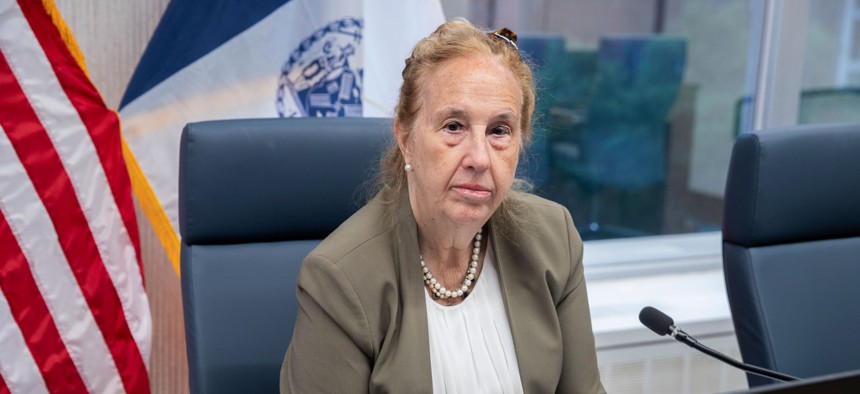
Council Member Gale Brewer, who chairs the Committee on Governmental Operations, oversees the pay raise hearing. John McCarten/NYC Council Media Unit



The New York City Council moved one step closer to enacting an 18.2% pay raise for elected officials Tuesday morning as members heard largely supportive testimony.
The hearing, which was conducted by the City Council’s Committee on Governmental Operations, came just two weeks after a three-person commission convened by Mayor Zohran Mamdani released a report recommending that the legislative body pass a measure to raise salaries for council members, citywide officials, borough presidents and district attorneys. If the City Council approves a bill to do so, as they are expected to later this summer, elected officials would get their first raise since 2016. Inflation in the New York area grew 31% between then and 2025, underscoring the need for the adjustment, according to the commission.
If approved by the City Council, elected officials would see a big jump in their salaries – higher even than the 16% raise initially proposed by the legislative body last year. City Council members would get $175,500, up from their current $148,500 salary. Comptroller Mark Levine’s salary would go from $209,050 to $247,100, borough presidents would get $211,800 instead of the current $179,200 and Public Advocate Jumaane Williams would make $218,400 – up from $184,800.
There’s a long history of proposed pay raises for elected officials eliciting strong emotions. Despite city law requiring the commission to meet every four years to decide whether a salary increase is warranted, former mayors Eric Adams and Bill de Blasio declined to call one in their outgoing terms, likely not wanting to look like they were padding their pockets while New Yorkers struggled with the cost of living. Cognizant of the sensitive politics at play, both Mamdani and City Council Speaker Julie Menin, who make $258,750 and $164,500 respectively, have said that they wouldn’t accept a raise.
But Tuesday’s hearing surprisingly proceeded without fireworks despite the complex dynamics. Just a handful of people testified about the potential pay increase, all in its favor. The biggest point of disagreement came not over the increase itself, but on whether the legislation should establish a mechanism for salaries to be automatically raised to account for changes in the cost of living, or at most 8.25%, if salaries aren’t changed during a four year period. Hoping to avoid another ten year gap, the commission recommended that the City Council implement this alongside the 18.2% raise. This is currently what the legislation proposes.
Good government group leaders, Rachael Fauss of Reinvent Albany and Grace Rauh of Citizens Union, disagreed. While both were supportive of increasing local leaders’ pay, they warned that the implementation of an automatic inflation-adjusted salary increase could dissuade a mayor from calling the commission in the future – thus diminishing transparency and debate.
“The provision would effectively eliminate all public input regarding elected official salaries if a Quadrennial Advisory Commission is not formed,” Fauss said, adding that future mayors may be inclined to take this “path of least resistance” to avoid any perception that they’d called a commission to increase their own salary.
One possible alternative floated by Rauh was to amend the bill to authorize another citywide elected official, such as the comptroller, to form the commission if the mayor fails to do so during their term. It’s unclear whether this prospect would require a change to the city charter.
Carl Weisbrod, chair of the commission, said he thinks it likely would. “We strongly believe that since the mayor does control ultimately the resources of the city and the budget, the mayor should be the one to convene a commission,” he told council members.
City Council Member Nantasha Williams, the sponsor of the legislation, didn’t rule out the possibility of the legislation being amended in some way. She noted that while the City Council accepted all of the commission’s recommendations as is, conversations are ongoing – though the window is narrow. The speaker’s office plans to finalize the bill’s language tomorrow so it can be passed quickly, possibly as soon as Thursday’s stated meeting.
De Blasio, who declined a raise in 2016, said he’s not up to date with the commission’s latest recommendations, but he recognizes the importance of elected officials being well-compensated. “I get of course the public context that everyone is struggling economically right now and they don’t want to see what they regard as extravagant salaries for public officials,” he told City & State. “The problem in all of that is to get the very best public officials, we have to compensate them.”
With reporting from Jeff Coltin.