

New York City Council
Horse carriage ban sponsor Chris Marte is having a moment
A Q&A with the the lower Manhattan council member who’s in the middle of two major legislative battles, regulating horses and home health aides.
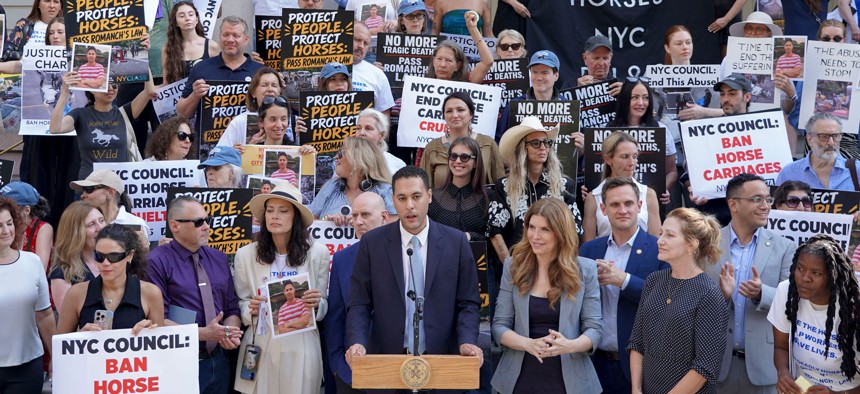
New York City Council Member Chris Marte rallies with Speaker Julie Menin and other supporters of his bill to ban horse-drawn carriages on Wednesday. Gerardo Romo / NYC Council Media Unit



Tears, jeers and cheers punctuated the New York City Council’s long-awaited hearing Wednesday on legislation sponsored by Council Member Chris Marte that would ban the city’s horse-drawn carriage industry.
It was a long, emotionally charged day. Family members of Romanch Mahajan, the 18-year-old tourist who died last month falling out of a horse carriage in Central Park, opened the hearing by imploring council members to pass the bill renamed in his honor. That was followed by a slew of testimony from animal welfare groups and elected officials including Manhattan Borough President Brad Hoylman-Sigal and state Sen. Erik Bottcher who advocated for the ban, and union representatives and carriage drivers advocating against it. After nearly than five hours of testimony, the hearing showed no signs of coming to an end, as dozens more waited to testify.
Efforts to ban horse-drawn carriages have stagnated for years due to fierce opposition by Transport Workers Union Local 100, which represents the industry. But tides appear to be changing. The legislation is approaching majority support in the City Council. Mayor Zohran Mamdani is broadly supportive of banning horse carriages, albeit with amendments to beef up worker protections for carriage drivers. And just one day before the hearing, City Council Speaker Julie Menin officially declared her support. All bode well for supporters.
It also bodes well for Marte, who is at the forefront of not only the horse carriage ban bill, but another bill picking up steam recently. He also sponsors legislation that would ban grueling 24-hour shifts for home health aide workers – another longstanding fight that’s getting new life.
City & State spoke with Marte on Tuesday about why the tide is shifting on horse carriages, whether he thinks Menin should be protested for not advancing his home health aide reforms and how recent primary wins shake up Manhattan politics.
This interview has been lightly edited for length and clarity.
Momentum to ban horse-drawn carriages in New York City has built significantly in recent weeks, especially in wake of the death of Romanch Mahajan. Your legislation is nearing a majority of support, with members representing a broad ideological spectrum. That’s a sharp juxtaposition to last year when the bill died in committee. Why do things feel different now?
I think a few things. Before I took on the bill to become the prime sponsor, I wanted to make sure that there was mention of a workforce development program because historically, issues have been pitted against other issues – whether it’s animal welfare and whether to protect and help the workers transition into another job. We wanted to make sure that it had both of those things when we introduced it while also making sure that horses can go to sanctuaries as well. I think that is a big difference. But also, unfortunately, the death of Romanch, the Indian tourist who was here with his family, really set the tone that we have to act now, and we can no longer wait for something else to happen.
Mamdani said that while he supports “the spirit of the bill,” he has some concerns about the “inefficiencies of the worker protections” in terms of horse carriage drivers who’d be forced to leave the industry. Some of the potential options he mentioned were things like beefing up development and training programs. Are you receptive to either of these things?
Absolutely. I don’t want anyone to lose the opportunity of getting another job. Whatever the Mamdani administration agencies are proposing, I will definitely listen to. However, I don’t want the timeline to change. Right now there’s a two-year timeline to transition workers into other jobs. If the proposal we’re receiving extends that timeline, I think it will be too much. But look, we want to have a dialogue. We have been talking to the administration leading up to the hearing, and we want to work with them to make sure that this can be a success for both sides of City Hall.
The Transport Workers Union of America tweeted at you describing you as “an absolutely unserious person pushing a ban on carriage horse rides in Central Park.” This was attached to a clip from a hearing last year where you spoke about how if a human or another animal like a cat or a dog was forced to pull a horse carriage, we would call it inhumane. What’s your reaction to that criticism?
I stand by that statement. Why is it only horses where they think it’s okay for them to push a carriage that’s thousands of pounds with passengers on it throughout the year? Whether it’s hot or cold, I think it’s unacceptable. I’m glad that they're promoting that rhetoric because I think it helps.
What is the latest on your legislation to ban 24-hour shifts for home health aides? That also looked like it was gaining ground earlier this year, buoyed by support from Speaker Julie Menin, but things appear to be at a standstill now. Menin ended up pulling the legislation from consideration and Council Member Shahana Hanif, who chairs the council’s Committee on Disabilities, stepped down as a sponsor. It seemed like a deal to bring it forward was struck in late April, but that’s clearly yet to happen.
The conversations are still ongoing. I check in with the speaker's team fairly regularly on this bill, and we’re going to pass it. We’re just working with the speaker and other stakeholders to get it to a place where workers feel like we’re actually going to end the 24-hour workday.
I do think there’s been a lot of momentum recently with the United Nations’ letter which called these 24-hour shifts pretty much a crime against humanity, modern-day slavery, and discrimination against women. There’s been additional news that the home attendants who decided not to go with the union arbitration in part of their lawsuit over wage theft actually just won their case in the highest courts in New York.
We know this is wage theft, we know this is inhumane and now the court has backed our movement, saying that these workers should be paid the hours that they’ve been working. So while we’re still negotiating in the City Council, there’s a lot of momentum happening outside that’s definitely going to help push this bill over the finish line.
Home care workers brought the fight directly to Menin’s door, kicking off a sit-in outside of her apartment Tuesday in an effort to push her to bring the legislation forward for a vote. Do you think she deserves to be protested?
You know, we’ve been talking a lot with the speaker's office. I wish we could have passed this bill a long time ago, but we continue to work with them, and we welcome the opportunity to move forward with this piece of legislation.
Are you hopeful that will happen before the end of the year?
Yes.
More broadly, it seems like it’s been a pretty good year for you. You’re chair of the Subcommittee on Landmarks, Public Sitings, Resiliency, and Dispositions, you’re at the helm of these two big bills that are major conversation starters and actually looks like they may pass after years of that not being the case. You’ve talked about how you feel like your bills have been overlooked in the past. What do you think has changed and how do you intend to leverage this moment?
I think it’s never giving up on an issue and having political coverage. Both of these pieces of legislation have been through a number of administrations – especially the horse carriage bill – and you know we didn’t want to give up on this fight. When (former Council Member) Bob Holden, the prior sponsor, was term limited, we wanted to make sure that we were going to actively fight for this and make sure it was top of mind.
Sometimes things come easily, in a few weeks or months, but I think my office, we’re committed to the harder fight. We’re also looking to potentially reintroduce the retiree (healthcare) bill this August or September.
There’s a new cohort of people who’ve won Democratic primaries set to soon shake up downtown politics. What changes are you expecting?
I want to first congratulate Brad Lander and Illapa Sairitupac on their victories. I’ve worked with both of them. When he was comptroller, Brad Lander was an ally in the retiree fight. He showed up to many of my home attendant rallies and actually released a list of some of the worst employers – home care agencies were at the top of those lists. I’m excited to continue to work with him in this new position. I think we’re going to have a lot of alignment.
I also look forward to working with Illapa. I’ve known him for a few years now, he worked on my 2021 campaign and I look forward to meeting the affordability crisis and being a local partner with him.
Have you met with Illapa since his primary victory?
We’ve traded a few text messages, but I look forward to meeting with him when things calm down.
What about Darializa Avila Chevalier? You endorsed Rep. Adriano Espaillat in the Democratic primary. What relationship do you have with her or do you expect to have with her?
I also look forward to working with her. I focus a lot on bringing reforms to the Manhattan Democratic Party – I’m sure she’s going to be an ally in making sure that we bring reforms to that organization. And you know, even though our geographic boundaries don’t overlap, I think a lot of the issues that we care about do. For example, public housing. She’s been a huge advocate for Section 9 and I’ve organized for years to fight against privatization. I think having a partner on the federal level and also locally with future congressman Lander, I think it’s going to be great to have two future Manhattan congress members that have that viewpoint.