

New York City
Mamdani’s push for free buses takes a back seat to faster ones (for now)
Road work ahead? The mayor sure hopes it does.
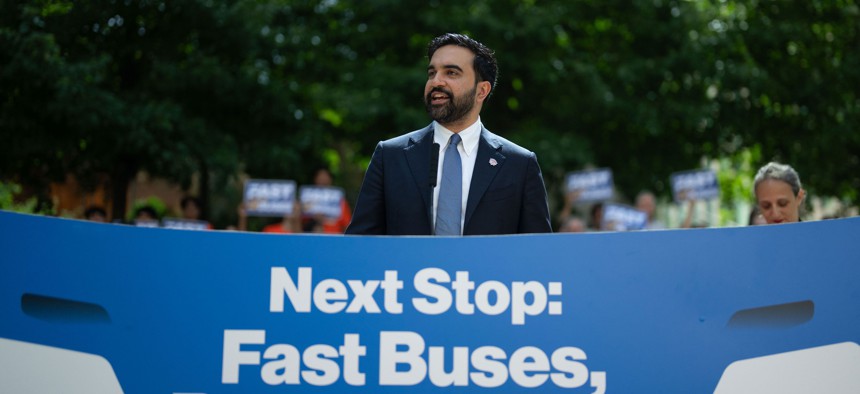
Fast buses: En route. Free buses: It’s complicated. Michael Appleton/Mayoral Photography Office


New York City buses are en route to becoming faster, thanks to a new 51-page plan unveiled Wednesday by Mayor Zohran Mamdani and Gov. Kathy Hochul that aims to save bus riders up to six minutes on their routes.
Not included in the plan: Any sign of progress on free buses, a central pillar of Mamdani’s mayoral campaign.
Wednesday’s announcement was massive and celebratory. Dozens of advocates, elected officials and bureaucrats took over an entire Downtown Brooklyn plaza as Madonna’s “4 Minutes” blasted onto Lafayette Avenue – remixed as “6 Minutes,” for the time saved target. Would this be the administration’s crowning transportation achievement? Would free buses be left by the wayside?
Asked at the press conference, Mamdani insisted the fight for free buses is “not at all” over.
“I’ve been very clear with New Yorkers that my commitment is to make buses fast and free. Today, we stand together on how we deliver the fast,” he said. The new plan – titled “Next Stop: Fast Buses, Better Service” – simply focuses on other elements of the bus experience, he said. “It’s not just about the bus, it’s also about the bus stop, it’s also about the streetscape, it’s about every single thing that delays New Yorkers when they’re trying to get around.”
But Mamdani still faces headwinds that could make free buses a slow and difficult goal. The state operates the Metropolitan Transportation Authority, and Gov. Kathy Hochul and MTA CEO and Chair Janno Lieber have not hidden that they are less than thrilled about the prospect of free buses. The City Council has focused instead on expanding the Fair Fares program targeting discounted rides to low-income riders, and some advocates have suggested MTA funds could be better used for other transit needs, like extending the subway system.
Indeed, Hochul and Lieber seemed more amenable to improving the city’s bus system in ways other than making them free, and the plan prescribes improvements like all-door boarding, advancing bus lane projects and adding seating and shade at bus stops. Hochul and the MTA have committed to purchasing 2,500 new buses to replace much of its aging fleet.
“Not everybody agrees about every single thing,” Lieber said Wednesday. “We do agree about affordability, and a blow was struck for affordability last week when the City Council and the mayor increased the eligibility for Fair Fares.”
Despite Mamdani’s “fast and free” rallying cry, there’s only so much he can do given the state’s power over the MTA and its funding. Still, the mayor will be judged by his ability to meet the benchmarks he set for himself – and he’s already drawn criticism for pivoting on some of his major campaign promises when faced with the fiscal realities of the office.
But transit advocates remained confident that this isn’t the end of the road for free buses.
“Free buses is something that’s a seed of an idea that’s been planted,” Lisa Daglian, executive director of the Permanent Citizens Advisory Committee to the MTA, told City & State. “It’s going to take a little while for that tree to grow, and once it does, then that fruit will be on the tree for the picking – but it's not immediate.”
Or, as Riders Alliance’s Policy and Communications Director Danny Pearlstein put it: “This plan is the end of the beginning.”