

New York City
New rules: You don’t need labor during an election; you need them after
In the reshuffling of power over the past two years, Big Labor has lost several big races.
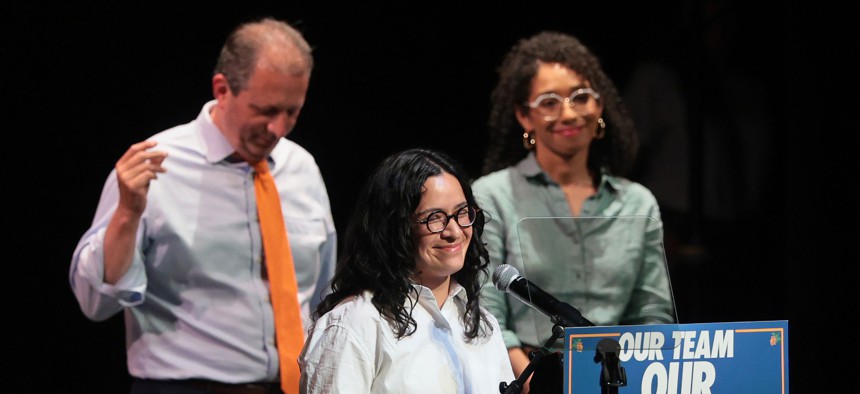
Congressional candidates Brad Lander, Claire Valdez and Darializa Avila Chevalier each won their primaries despite widespread union support for their opponents. Michael M. Santiago/Getty Images


If recent elections in New York City have taught us anything, it’s that the axis of political power is shifting. The biggest organized labor unions, long regarded as major power brokers in city politics, haven’t been immune to this seismic reshuffling.
Take last year’s Democratic mayoral primary where a young democratic socialist triumphed over a political goliath. Zohran Mamdani defeated Andrew Cuomo in June 2025 without any support from major labor unions, bucking historical precedent. Rather than take a chance on the lefty upstart, the Hotel and Gaming Trades Council, building service workers union 32BJ SEIU, healthcare union 1199SEIU, the United Federation of Teachers and the New York City District Council of Carpenters hedged their bets with Cuomo and a few of the other well-known candidates in the race. Municipal workers union District Council 37 was a rare exception – and even then, they ranked Mamdani second, behind then-City Council Speaker Adrienne Adams.
But Mamdani’s victory wasn’t a one-off. With his support, democratic socialists Claire Valdez and Darializa Avila Chevalier also defeated well-funded, establishment opponents in congressional races last month without the support of traditional labor powerhouses. Brad Lander, in a slightly different boat given the relationships he’d forged with unions as a council member and city comptroller, had the support of 32BJ SEIU, though most played it safe by sticking with Rep. Dan Goldman.
“Labor still has influence in elections and obviously in terms of public policy,” Democratic political consultant Eli Valentin said. “But there is certainly a shift happening, one that says a lot about broader shifts that are occurring politically in New York and elsewhere.”
Union support alone has never won elections. An array of complex factors and calculations spell the difference between victory and defeat. Historically though, the overarching sentiment has been that they do matter – so much so, candidates sometimes start vying for labor backing before they jump into a race. Beyond giving endorsees an air of legitimacy in the eyes of voters and the political class, labor unions are seen as vehicles to reach New Yorkers within their own ranks and beyond, capable of deploying volunteers and financial resources in mass. Mamdani, Valdez, Avila Chevalier and even Lander’s victories challenge long held beliefs about how much these things matter.
In last month’s congressional races, for example, Big Labor spent millions in support of Brooklyn Borough President Antonio Reynoso, who dominated Valdez in endorsements from labor and mainstream Democrats. Same goes for Assembly Member Alex Bores, who ultimately fell to fellow state lawmaker Micah Lasher in the crowded Manhattan race to succeed Rep. Jerry Nadler, and Rep. Adriano Espaillat, the longtime incumbent unseated by Avila Chevalier in Upper Manhattan and the Bronx. Money was only a piece of it. Labor leaders coalesced around their chosen candidates, standing shoulder to shoulder with Reynoso, Bores, Espaillat and Goldman during rallies. All four lost. State legislative races were more of a mixed bag in terms of how labor-backed candidates fared, but big questions about their clout in elections remain.
There’s no solid answers about what it all means. Some would argue that organized labor’s electoral power is dwindling – and it has been for some time, prior even to Mamdani’s victory. That’s not a New York City thing. “The power of labor unions in New York and the way in which it is waning in elections is not something that is unique to New York,” one Democratic strategist said. “Democratic voters coast to coast are completely fed up and frustrated with the way the party is going, and unions and the party are very synonymous.”
For others, it’s more of an evolution – one that organized labor needs to evolve with.
“Endorsements have to mean something,” said Brandon Mancilla, the director of United Auto Workers Region 9A. “More of the question is not that the influence of labor is waning or anything like that. It’s that the influence of labor may be waning only because we’re allowing it to.”
He’s earned the right to say so. UAW’s local chapter, a relatively small union representing a diverse array of academics and human service workers, has had massive success in recent elections.
After backing Mamdani in the Democratic mayoral primary, UAW got behind Lander, Valdez and Avila Chevalier early on, further solidifying the progressive union’s reputation for backing long-shot lefty candidates that defied expectations. Pointing to Valdez, a former organizer for UAW, and Avila Chevalier, another one of its rank-and-file members, Mancilla attributed the group’s success to recruiting from within to run for office. That, and hitting the ground in force. Lacking the robust resources of the city’s biggest labor groups, UAW’s rank-and-file members canvassed the old-fashioned way, reaching more than 50,000 voters by knocking on doors.
“Our political process is very member-led, so we knew in making these endorsements we were going to have the capacity to actually get out there and organize for these candidates,” Mancilla said.
And the candidates are keeping the relationship going in turn. A week after winning, Lander, Valdez and Avila Chevalier marched on back-to-back UAW picket lines.
“What UAW is doing right now is building a truly democratic union that is getting its members out to doors, asking them to talk to each other about these great political questions of our time,” Valdez said. “That’s what I want to see every single union do.”
Lander described the recent election cycle as a wake-up call – both for unions and the Democratic Party.
“Unions are going to need to experiment with new and bigger organizing strategies and with more aggressive and creative political strategies in order to build enough power to win for working people,” Lander said. “You just have to remember what you’re supposed to do is listen to your constituents if you are an elected official, your members if you’re a union, and when things aren’t working for them, try something new.”
So don’t count the unions out. One political labor veteran cautioned against painting the implications of recent elections on labor with too broad of a brush. Upon taking office, elected officials need unions – regardless of whether they did or didn’t support them when they were a candidate.
“Unless these (new politicians) get corrupted and become mainstream very quickly, if they mean what they say – and I think most of them do – this wave should be good for labor unions,” they said. “The unions that are the most sophisticated should be able to reenergize their own base and their members and their engagement and end up with being in a mutually beneficial dynamic.”
– with reporting by Rebecca C. Lewis
Rule #13: You don't need labor during an election; you need them after. Read the rest of the 26 new rules for elections in '26 here.
NEXT STORY: Cutting satire: Pro-circumcision Constantino campaign flyers are fake