

2026 New York state elections
Voters may have been caught on camera for years in Fulton County town
The BOE’s investigating courtroom cameras in Broadalbin left on during the June 23 primary.
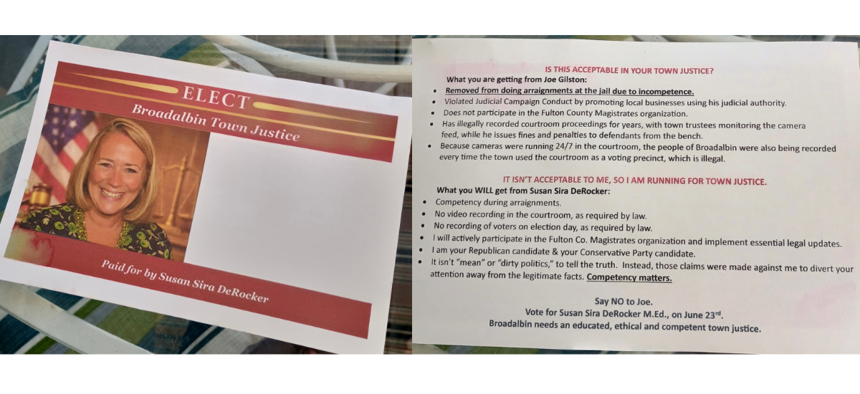
An upstate judicial candidate accused her incumbent opponent of recording in the courtroom. Now the courtroom cameras are being investigated. Courtesy Susan Sira DeRocker


Surveillance cameras in the town of Broadalbin courtroom may have been illegally recording local court proceedings since they were installed several years ago – as well as voters casting ballots when the room doubles as a polling site, according to documents obtained by City & State.
And complaints about the courtroom cameras have kicked off an investigation by the state Board of Elections, in the Fulton County town of fewer than 5,200 people, 45 miles northwest of Albany.
Longtime Broadalbin Town Justice Joseph Gilston was up for reelection last month. His opponent in the Republican primary, Broadalbin Village Trustee Susan Sira DeRocker, distributed mailers to hundreds of Republican voters in the village ahead of the race explicitly claiming that Gilston “has illegally recorded courtroom proceedings for years, with town trustees monitoring the camera feed, while he issues fines and penalties to defendants from the bench.” DeRocker’s mailer also claimed voters had been illegally recorded – and said if she were elected, she wouldn’t allow it.
“To me, it's not about winning – it's about what's the right thing to do, what's right for the voters, what's right for our public,” DeRocker told City & State. “It's about ethical, moral fortitude. To me, having those cameras in there is like having a camera in a confessional. … I don't care if you're a Democrat, a Republican, independent, Conservative, it’s about integrity.”
DeRocker didn’t win, losing to Gilston by 59 votes last month. And town officials have brushed off the controversy, saying the cameras were too blurry to read any ballots anyway. But now the state BOE’s Division of Election Law Enforcement is investigating claims that the security cameras were allegedly left on for over 10 hours of voting during the recent June 23 statewide primary election, potentially violating state and federal election law.
Broadalbin records show the town received $4,500 to install cameras in the courtroom and around the municipal building that houses it through a 2016 state security grant under the Justice Court Assistance Program. The municipal building has three security cameras, including one facing the entrance and two others that show different angles of the courtroom. That same room is used as a pollsite.
Assembly Member Mary Beth Walsh, a Republican who represents Broadalbin, said her district office has received several calls concerned that courtroom security cameras were not removed, or covered during the recent primary.
“Constituents expressed concern that the positioning of these cameras may have created the possibility that completed ballots or individual voting activity could be visible or identifiable,” Walsh wrote to county election commissioners June 29, requesting the agency investigate the matter. “Regardless of whether any ballots were actually captured on camera, the perception that ballot secrecy may have been compromised has understandably caused unease among voters.”
Complaints about the courtroom cameras all started with Gilston’s fellow judge, Broadalbin Town Justice Jan Bohne, who took office in January. Bohne first noticed the cameras were on 24/7 back in March, according to a complaint she sent several state agencies last month, including the state Office of Court Administration. According to the June 24 complaint obtained by City & State, Bohne confronted court clerk Jennifer Gilston – Town Justice Joseph Gilston’s wife – and her sister, court clerk Janey Dygert, about the cameras when she noticed they were improperly recording court proceedings.
“The clerks insisted because they received a grant from New York state for the cameras they were legal and I was wrong,” Bohne wrote. “I requested a copy of the grant. It has never been produced for me to read. I required the cameras to be turned off during my court sessions. At no time did I have access to the cameras or the video feed.”
Both New York state and federal laws heavily restrict or outright ban recording inside a courthouse. Taking photographs or filming audio or video anywhere inside a courthouse, including courtrooms, offices and hallways, is strictly forbidden regardless if court is in session, and is only permitted if the chief administrative judge or a designee grants explicit, written permission.
But that was just the beginning. According to her complaint, Bohne noticed the cameras were also tracking and recording voters in the courtroom during the June 23 primary, and she suspected that town officials with access to the feed may have been able to see their ballots. Bohne noticed the cameras were on, and tracking her movements, when she went into the office that afternoon to do some work. She then called Village of Broadalbin Mayor Steven Murray, according to the complaint, and they both witnessed the live security feed located inside a code-protected closet in the courtroom.
“The mayor and I saw that not only had the voters been video recorded but you could actually see their paper ballots when they turned to put them into the voting machine,” Bohne wrote.
Bohne declined to comment about the complaint or discuss its contents. Murray confirmed he saw the camera feed on while polls were open, but declined to comment further.
Soon after Bohne raised the alarm on election day, Fulton County Board of Elections Republican Commissioner William Eschler and Democratic Commissioner Robin Wentworth came to town hall, and Bohne showed them the live camera feed she had shown Murray. The commissioners contacted Broadalbin Town Supervisor Joe DiGiacomo, who also chairs the Fulton County Board of Supervisors. DiGiacomo and an information technology worker with him agreed to disconnect the cameras at 4:43 p.m., with fewer than five hours left for voting. Commissioners told the IT staffer to delete the video feed going back to 6 a.m. when polls opened, according to the complaint. Poll workers were present for the dispute.
DiGiacomo has downplayed the controversy, telling The Leader-Herald – which first reported on the investigation into the courtroom cameras – that the cameras lack the resolution to view a ballot, or which candidates a person voted for. DiGiacomo did not return multiple calls and emails from City & State requesting comment. The Broadalbin town clerk said town officials are not allowed to discuss the investigation, and that the town attorney advised officials at the latest town meeting to decline comment about the cameras.
Multiple people familiar with the investigation said several residents have called the town of Broadalbin with concerns they were illegally recorded while voting, and that officials have responded by taking down their contact information.
One voter who noticed the cameras spoke with City & State about what he saw while casting his ballot. The voter, who declined to be named, said he noticed the three security cameras were on and moving as voters entered the building and picked up their ballots from poll workers.
“As you're looking at the people who were working, there was a camera right there, and of course, as you walked around and actually voted, there was a camera right there, right where you’d put the piece of paper in the machine,” he said.
The voter, a lifelong Broadalbin resident who’s voted in the town for more than 50 years, said he submitted his ballot facing upward and later considered that who he voted for could have been visible on the camera feed. But he’s not convinced the cameras were left on maliciously.
Gilston declined to comment on the accusation that he has allowed the recording of or reviewed video from the courtroom, and referred all questions about the security cameras to the town supervisor.
Multiple people filed a complaint against Gilston with the state Commission on Judicial Conduct this spring after seeing DeRocker’s mailers and learning the courtroom cameras may be on 24/7 or improperly recording court and elections. The independent entity that investigates all allegations of judicial misconduct at the state and local levels, confirmed receipt to each person who submitted a complaint, cannot comment on an investigation.
The state Division of Election Law Enforcement declined to comment. Neither the state Board of Elections, nor the Office of Court Administration, has answered questions about the probe.
A spokesperson for the state Attorney General’s office said the office reviewed the complaint, but is not conducting a separate investigation.
Two people familiar with the incident also told City & State that a town official sent correspondence to the U.S. Department of Justice last week about the incident because a federal race was on the ballot to determine the Republican candidate to replace retiring Rep. Elise Stefanik in Congress. The DOJ didn’t respond to a request for comment.
Fulton County Board of Elections Republican Deputy Commissioner Cinda Spraker told City & State that the state Board of Elections sent investigators to the town July 9. Spraker referred all other questions to the state Division of Election Law Enforcement and the state Board of Elections.
But the county board is working to make sure that every polling site is in compliance with the law.
A day after the state BOE sent investigators, the Fulton County BOE sent a letter to every municipality in the county.“It was recently brought to our attention that there are poll sites within Fulton County that have security cameras in place,” it read. “To protect the integrity of our elections, it is imperative that any cameras within the room used for voting MUST be removed or covered while the space is being used for voting.”
NEXT STORY: Lasher is keeping Katz