

New York City
Book excerpt: How steel from the twin towers came to symbolize the tragedy
In a new book, “Scattered Steel,” the authors chronicle how 9/11 memorials made of steel beams connected the rest of the country to New York.
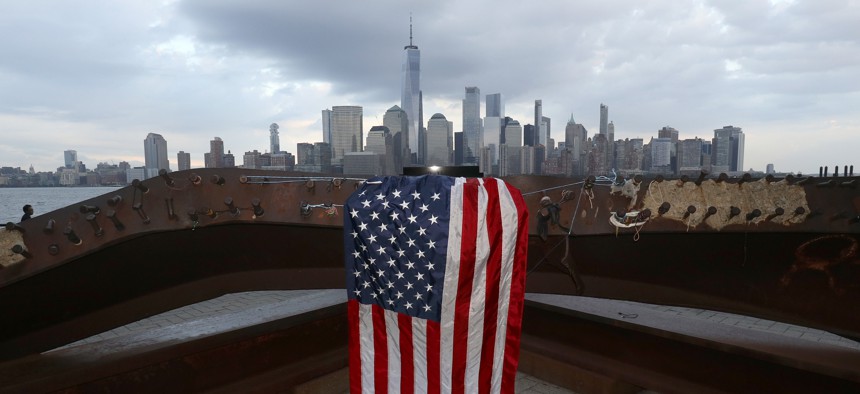
9/11 memorials have been built across the country with steel recovered from the World Trade Center. Gary Hershorn/Getty Images


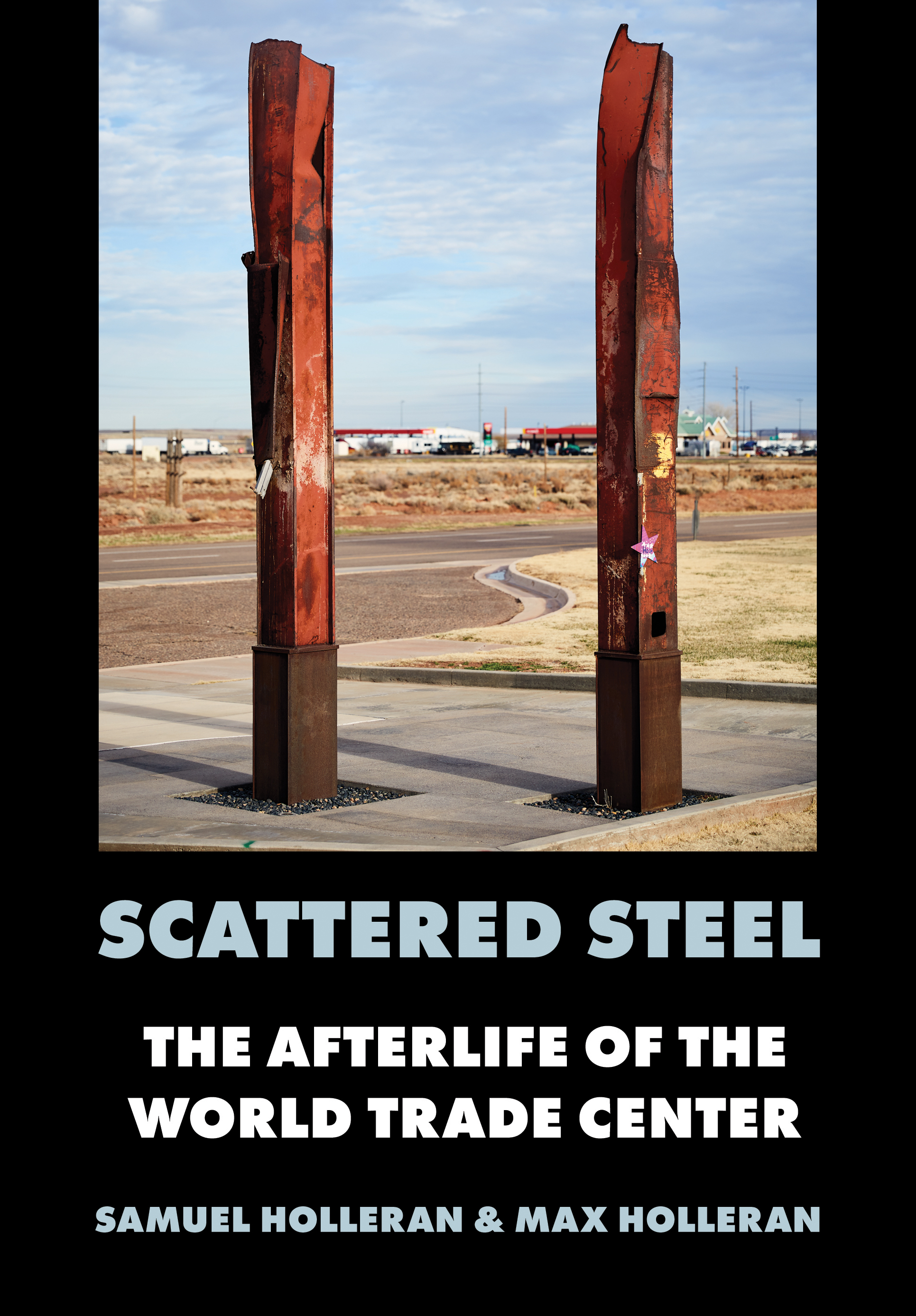
The recovery from the World Trade Center attacks on 9/11 began almost immediately. That night, trucks began moving debris out of lower Manhattan to Staten Island. A portion of the steel was distributed by the Port Authority of New York and New Jersey, which owned the site, for the creation of 9/11 memorials, largely in the lead-up to the 10th anniversary of the terrorist attacks. From the introduction of “Scattered Steel: The Afterlife of the World Trade Center” by Samuel Holleran and Max Holleran, which published on Aug. 15, the authors write about how the steel from the twin towers became the main symbol of the 9/11 terrorist attacks, and how these memorials connected the rest of the country to this tragedy.
In the years since 9/11, steel has become the de facto language of memorialization, and the placement of hundreds of salvaged steel beams in local memorials has spread the grief of the attacks to every US state. These scattered memorials are relics of a new kind, diffusing the national grieving process. Their appearance in quotidian suburban settings has helped to sacralize 9/11 and spread its remembrance.
Through a partially improvised process, authorities cleared the WTC site over a period of nine months, separating scrap-destined steel from beams and cladding that would become forensic evidence. The “relic” steel was held by the Port Authority, which also appointed a small committee to archive objects that were meant to show the “three chapters” of the buildings’ life: the pre-9/11 era, the day of the attacks, and the aftermath and recovery efforts. This collection of over two thousand objects included the miscellany of office life (glasses, a phone message book, a Three Stooges magnet), crushed fire trucks and police cars from the towers’ collapse, and memorials left on-site by the thousands of workers who helped clear debris. Above all, the collection contained structural steel: roughly seven thousand tons in total.
As early as 2002, the Port Authority began to informally gift steel to cultural, civic, and defense institutions. In the lead-up to the ten-year anniversary of the attacks, the agency formalized distribution through a special program that released 1,890 pieces of steel of varying sizes. Many were incorporated into firehouses and police stations located across the United States, but they were clustered densely in the tri-state area. Steel was often taken out of storage and brought to memorial sites with honor guards, convoys, and patriotic parades. The reverence and pageantry demonstrated for the steel can be seen as an attempt to provide a final burial for WTC victims, most of whose bodies were largely irrecoverable.
Many steel memorials were placed in front of civic buildings. These often consisted of a small section of I-beam placed on end, bolted directly to the ground, or resting on a plinth. Some were positioned immediately beside building entrances like the carved statues historically placed outside cigar stores or the bible-scroll-holding mezuzahs affixed to doorposts by religious Jews. These memorials, such as the beam bolted in front of the Fire and Rescue Company in Staunton, Virginia, force visitors to look upon them when entering the building. Other pieces were far too big for this and were positioned like roadside sculptures. In Wellington, Florida, a three-column exterior section of the WTC is mounted diagonally next to a wide thoroughfare; it is almost as tall as the nearby palms, and it casts its shadow across part of the street. A W-shaped piece, cut from the WTC’s pointed arches, sits in the oak grove at the center of Indiana University of Pennsylvania; it occupies a plinth at the intersection of two footpaths, like a piece of modern art commissioned for the campus. In Green Township, Ohio, a horizontal beam sits on a triangular island in the parking lot of the City Administration Building; a line of parked cars sits just ten feet away. At Prospect Hill, a historic cemetery in York, Pennsylvania, a large piece of steel, with concrete and twisted rebar still attached to it, is positioned on top of two massive columns, forming a “Court of Valor” honoring local service members. In Croton-on-Hudson, a town that’s an hour from New York by train, a riverside memorial uses a piece of steel, fused to a boulder, to form a giant sundial.
The framing of the WTC steel as a “sacred” set of relics that, in their distribution, help to keep the memory of the events alive has some precedent in the dispersal of Berlin Wall segments, the monuments built from pieces of the USS Maine, and the (limited) reburial of soil from concentration camps at memorial sites. As in the architectural tradition of spolia, where ancient column capitals and ornamental stonework are repurposed into new structures, pieces of the demolished buildings were incorporated into larger memorial structures with the explicit purpose of creating a commemorative link to Ground Zero.
This book focuses on the sacralization of WTC steel and how it became the primary visual language for memorializing the attacks of September 11, 2001. The steel has been conceptualized as a straightforward example of strength and rebirth, but its history is more complex. The difference between scrap-destined steel and sacralized steel was largely arbitrary. An ad hoc process saved and sanctified a small fraction of the WTC steel pieces, whereas the majority was shipped abroad for recycling. We examine the process by which architectural components were sorted and delivered to memorial sites as a form of controlled embodiment of memory, in effect franchising 9/11 memory. Solemn delivery processions not only provided rituals of national unity but also coded the losses as archetypically masculine heroism (primarily by working-class first responders). This shift in commemoration practices helped to frame 9/11 as an attack on American manhood and not just on the symbolic power of American capital embodied in the WTC’s towers.
Writing from the vantage point of a quarter century later allows us to periodize the steel’s initial distribution in the years leading up to the tenth anniversary of the attacks (when most of the memorials we examine were completed), placing this process in the context of the Great Recession and growing public criticism of the wars in Afghanistan and Iraq. “Support Our Troops” decals, “survivor trees,” and WTC murals have been analyzed as unique building blocks of political community and martial obligation; this work helps to better define the intersection of national mourning, memorial-making, and overt displays of patriotism.
Scholars, such as Andreas Huyssen and Erika Doss, have rightly noted that the 1990s saw a bumper crop of memorials, described as a “boom” or a “mania.” The scale, cost, and number of memorials shot up as architects and city officials sought to “get in on” memorialization without truly considering what their communities should commemorate. This was in keeping with a feeling that was in the air. The fall of the Soviet Union, expansion of telecommunications technology, and the millennium on the horizon led some to suggest that the “End of History” was at hand. With the stability of a world united by liberal democracy and free-market capitalism seemingly guaranteed – grand historical narratives seemed over, or at least paused – an urge to preserve, display, and heritagize took hold.
September 11 fundamentally undermined the “End of History” thesis, but it supported another, smaller uptick in memorial construction, particularly in the lead-up to the ten-year anniversary. The themes of these memorials range widely and include freedom, first responders, sacrifice, coexistence and religious tolerance, and the obligation to remember itself (a sort of teleological plea for the importance of history). Our book is also part of a larger discussion about how we remember shared tragedies and public events and how those events “gel” in our minds and in shared public spaces. It situates the attacks of 9/11 in a past that is still being formed.
NEXT STORY: Pataki says Mamdani should skip 9/11 memorial