

New York City
NYC Council probes NYPD stats
The NYPD is reporting major crime declines, but council members have some questions about the data.
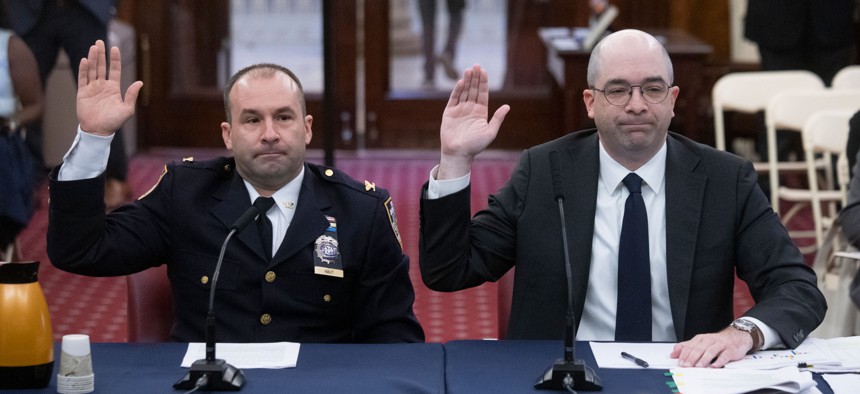
New York City Police Department Inspector William Haut and Deputy Commissioner of Legal Matters Michael Gerber testify at a City Council hearing on Wednesday. John McCarten/NYC Council Media Unit


The New York City Police Department has yelled from the rooftops about crime trending downwards at an historic pace, but some City Council members decided to pump the brakes on their excitement.
The council’s Committee on Public Safety convened in an oversight hearing Wednesday to question NYPD officials on the department’s crime data collection methodology and resource allocation across the city.
NYPD Inspector William Haut and Deputy Commissioner of Legal Matters Michael Gerber testified but neither Police Commissioner Jessica Tisch nor any police chiefs were present at the hearing – a fact that was not received well by Republican Council Member Frank Morano.
“I do want to express some disappointment about who is here today,” Morano said. “This committee has an obligation to oversee the NYPD, and I think a hearing of this importance warrants representation from the department's senior operational leadership.”
The hearing was chaired by Council Member Oswald Feliz and attended by members of the committee including Council Members Phil Wong, Sandy Nurse, Kamillah Hanks and Joann Ariola along with Public Advocate Jumaane Williams and Council Member Tiffany Cabán.
The most contentious grilling came from Cabán, who questioned the officials on whether police brutality and uses of excessive force by police are included in the crime data. She suggested their exclusion would cloud that data. Gerber said that crimes committed by officers counted in the data but use of force by police consistent with the law and best practices did not.
Cabán referenced expensive settlements the city makes over instances of excessive force. “Those officers aren’t being charged with a crime. If they were in civilian clothing, then they probably would be,” Caban said. “The crime statistics don’t really show the full picture of what we are looking at.”
But miraculously, Cabán and Gerber were able to come to some agreement on underlying socioeconomic factors leading to crime.
“There are underlying social issues that go far beyond anything the NYPD can deal with in terms of economic disparities,” said Gerber. “100%. I agree with you. There are root causes to these problems that the NYPD is not charged with addressing.”
Feliz brought up alarming patterns of crime specifically in the Bronx where more than 40% of both murders and shooting incidents occurred this year and inquired as to why more officers weren’t dispatched to the borough. The NYPD officials noted the Bronx leads the city in overall major crime declines – from 20,846 to 18,369 crimes in all major seven categories – year to date and said the deployment of police officers across the city is fluid.
Several members of the committee on both sides of the aisle brought up incidents of constituents claiming they had trouble reporting crimes with the NYPD as well as incidents of crime misclassifications. While Gerber acknowledged the issue of misreporting crimes isn’t new in the department – either due to errors or in some cases, misconduct – he maintained the department reported the vast majority of crimes and had checks in place to catch inaccuracies.
The hearing comes as the Mamdani administration and NYPD have touted major crime declines. In the first seven months of Mamdani’s term, the city recorded the fewest shooting incidents, shooting victims and murders since such figures were recorded.
But the council members present still felt there was room for improvement within certain crime categories such as felony assaults and grand larceny which Feliz pointed to and some implied in their questions the full picture of crime was clouded.
“New Yorkers don't feel as safe as they are,” said Public Advocate Juumane Williams. “We’ve got to figure out why that is.”