

New York City
Free buses? Julie Menin and Shaun Abreu prefer Fair Fares
At a City & State event, City Council Speaker Julie Menin and Majority Leader Shaun Abreu suggested expanding eligibility to Fair Fares is the best way to tackle transit affordability.
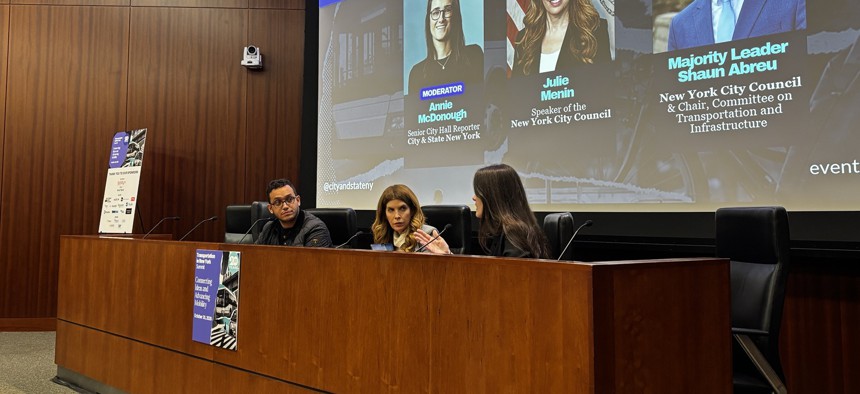
City Council Speaker Julie Menin and Majority Leader Shaun Abreu joined City & State’s Transportation in New York Summit for a discussion on transit affordability. Jeff Coltin


New York City Council Speaker Julie Menin and Majority Leader Shaun Abreu are championing Fair Fares over free buses as the best way to tackle transit affordability in New York.
“We must focus on what we can control at the city level,” Abreu, who also chairs the council’s transportation committee, said during a fireside chat about transit affordability at City & State’s Transportation in New York Summit on Friday. “When you’re thinking about a free bus program, we’re talking about anywhere from $900 million to $1.3 billion. That’s not something I think we have the capacity to be doing.”
Earlier this year, Menin pushed expanded eligibility for the half-priced transit program known as Fair Fares, which is targeted at low-income New Yorkers, eventually getting it into the final budget for Fiscal Year 2027. New Yorkers at or below 200% of the federal poverty level now qualify (up from at or below 150%), making it available to an additional 340,000 people, with roughly 1.3 million New Yorkers in total eligible.
While Mayor Zohran Mamdani agreed to that expansion in the budget, Fair Fares is a distinct approach from his campaign pitch for free buses for everyone, regardless of income level. (That pitch wasn’t a priority this past state legislative session – Mamdani focused on pitching state funding for universal childcare, and succeeded in that – but he hasn’t ruled out pursuing the idea next year.)
But don’t expect Menin or Abreu to be strong backers of that push. Both said their focus is on Fair Fares, which Menin noted reaches New Yorkers who take more modes of transportation. “We felt it was really important to get to those New Yorkers that need it the most with this large expansion of Fair Fares, so that they can take the subway, bus or paratransit,” Menin said.
They’re also focused on improving Fair Fares. “If anything, maybe next year we focus on 250% ... below the federal poverty line,” Abreu said, of potentially expanding eligibility further.
And they noted there’s still plenty of work to be done on increasing enrollment in the program. Only 41% of New Yorkers eligible are actually enrolled, according to an estimate by the Independent Budget Office in June. The council leaders attributed that to a lack of education and awareness about the program. “We need to continue to do more outreach so that New Yorkers are aware,” Menin said.
Menin and Abreu also attributed low uptake to a cumbersome application process. “It’s like a 13-page application,” Menin said. “It’s not very user-friendly. That creates barriers to entry, and that’s very problematic.”
Mamdani has argued that barriers to entry to means-tested programs like Fair Fares are why he supports free buses for all.
The council took a step towards simplifying the application process in September by passing a bill sponsored by Council Member Crystal Hudson that would allow New Yorkers on food or cash assistance to enroll in Fair Fares as part of the same application. An earlier iteration of the bill was aimed at automatic enrollment, but it was amended after the city Human Resources Administration raised concerns about privacy of people enrolled in those other programs. Menin said Friday that the city can “absolutely” address the privacy concerns, and that automatic enrollment is still the goal.
One enrollment achievement the council is celebrating: high uptake of a more limited pilot program for free OMNY cards for 700 qualifying City University of New York students. Menin announced Friday that the new program, also approved in the budget earlier this year, has connected 95% of those students with their free OMNY cards already, and cited CUNY’s promotion as a reason for the success. She and Abreu also said they hope to expand the program next year, which 28,500 eligible CUNY students expressed interest in.
The conversation also touched on access to transit, and what kind of role the council can have in improving access in subway deserts.
Citi Bike ridership has been growing in transit deserts, but the costs are rising, prompting a push by some advocates and lawmakers for the city to regulate the Lyft-owned bike share’s pricing. A bill sponsored by Council Member Lincoln Restler would cap rides at the price of a subway or bus ride – right now, $3. Though Abreu is a co-sponsor, he said Friday he didn’t know if the $3 cap is achievable, but said he wants to bring awareness to the high costs.
Self-driving cars have also been pitched as a solution to the “last-mile” problem. Mamdani has expressed concerns about job loss that could come in a self-driving future, and Menin and Abreu shared similar concerns on Friday. Neither council leader was overly enthused when asked if they have or would ever ride in a self-driving car.
“It’s not that I would never. I think it’s important, as elected officials, to look at new technology,” Menin said. “We want to make sure that those issues around job displacement are being properly addressed,” adding that she was also concerned about congestion on city streets.
Abreu had a more succinct answer: “Not interested.”