

Politics
How Hudson Valley politics has changed over the past 20 years
Former Rep. Sean Patrick Maloney weighs in on the local media landscape and the Mike Lawler versus Cait Conley contest.
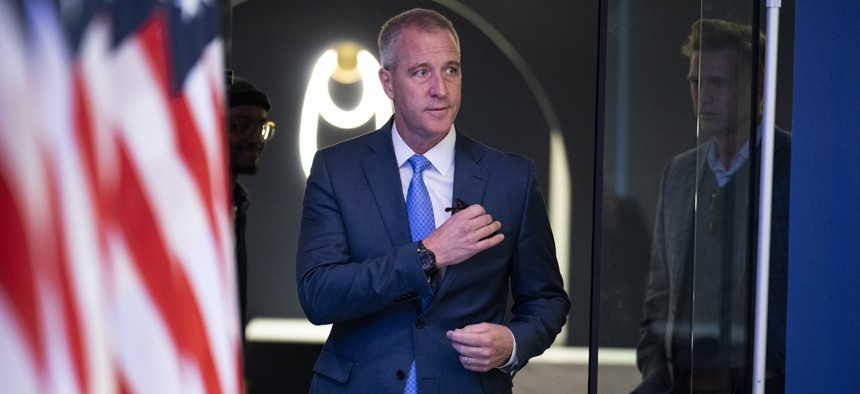
Former Rep. Sean Patrick Maloney is now the president and CEO of the Coalition for Prediction Markets. Tom Williams/CQ-Roll Call Inc. via Getty Images



Sean Patrick Maloney sees the Hudson Valley as a microcosm of American politics, in particular the purple nature of his old congressional district and the region. Maloney represented the Lower Hudson Valley in Congress for a decade before his 2022 loss to Republican Mike Lawler. This came at the same time that Maloney chaired the Democratic Congressional Campaign Committee. Maloney now serves as the president and CEO of the Coalition for Prediction Markets and during the Biden administration was the U.S. ambassador to the Organisation for Economic Co-operation and Development. He talked to City & State about the changing face of Hudson Valley politics over the past 20 years. This interview has been edited for length and clarity.
How has politics in the Hudson Valley changed in the past 20 years?
I would say the evaporation of local media and therefore the coverage gap that officeholders feel in communicating with the public. So when you are in the shadow of the New York City media market, it’s very hard to get those outlets to cover what you’re doing, and before, you would rely on venerable newspapers like the Times Herald-Record, the Poughkeepsie Journal, The Journal News, and they have all suffered massive budget cuts and a corresponding reduction in resources they can devote to local stories, so you end up getting some Gannett product with the local sports scores, a fire report and a bunch of national stories. So I'd say communicating with your constituents has become very difficult because (the) Hudson Valley (is) next to a massive media market.
When I ran for office, you better bring your A game to the editorial board meetings of the Times Herald-Record, the Poughkeepsie Journal and The Journal News. I'm not even sure they do them anymore, and they used to all hold debates, often widely publicized or televised. I’m not sure those are held anymore. I think this tracks a national phenomenon of local media being hollowed out because of online sources and because (of) the way that we consume news. It presents a real challenge.
Some of my colleagues who represent smaller media markets, I mean if you pin a merit badge on a Boy Scout in Syracuse, you’d probably get all three major networks covering your event. You know, I could light myself on fire in the Hudson Valley and the network affiliates wouldn’t cover it, because they have more than enough to do in the city.
So you either rely on paid media, in the context of a campaign, but of course, that’s a very specific kind of communication. We would resort to scalable town halls by telephone because you could reach thousands of people in a cost-effective way, And that could be an official communication, a substantive communication. We did 200 town halls, but these were all efforts to communicate.
But the fact is that without dedicated local coverage at local newspapers and local outlets, it’s really changed how people receive news and whether they know anything about what their local representative is doing.
It’s true though. I mean like THR was great, used to be 4 inches thick on a Sunday. You know, it’s a big-ass newspaper. I’m not even sure what it looks like today, but it’s probably like some thin Gannett product. And you know what they do? They give you a bunch of AP stories, a bunch of wire service stuff and that’s fine. And maybe they’ve thrown in some local sports scores, but there’s no reporters on the beat locally. I mean, there’s a couple, you know Chris McKenna’s still up there, I’m sure doing the hard work of freedom. But like John Penney at The Journal News, I used to know all these guys. They would come to my events. We would do press conferences and they’d write stories about what was going on at the local infrastructure project or the issue with the VA hospital locally, or things that were important to the community that might have you know relevance to whether the officeholder was doing their job or not.
But we’re still doing something today. I mean, I think the difference is that the tension in the media landscape has completely changed the way politicians do their jobs, and it’s not for the better.
As a former chair of the Democratic Congressional Campaign Committee, how do you view the midterm elections this year?
I think it will be a disguised wave, meaning you will get a very powerful Democratic turnout that is not as impactful as it should be in the House because of the structural changes, meaning through redistricting and hollowing out the Voting Rights Act. So, what was 42 seats in 2018 during Trump’s first midterm will be probably half of that this year with a similar behavior by the voters. That’s not good for democracy. And we’ll see the wave effect more prominently in local races and in statewide races like the U.S. Senate, for example. But I think the Democrats have a structural ceiling in the House of about 225 to 230, and that is man-made.
How do you think House Minority Leader Hakeem Jeffries has reacted to the redistricting wars with Democratic-led redistricting in blue states?
I think he’s doing the very best job he can in a really difficult moment with a lawless administration and tremendous discontent in his own party. I mean, the guy is a masterful listener, a consensus builder, and those qualities are more important than ever, though they are a thankless business model, because that’s not what the media demands.
But he’s doing the hard work of building consensus in the Democratic caucus, which will allow them to govern with a slim majority. I think his work is deeply underappreciated, but it will prove enormously valuable when he can deliver the votes because he has a unified caucus as speaker.
Some Democrats running for the House and U.S. Senate have suggested replacing Jeffries and U.S. Senate Minority Leader Chuck Schumer next year. What are your thoughts?
I think Hakeem is underappreciated, and it would be a huge mistake not to use his skill set in the new Congress. I also think it’s very unlikely that he won’t be the next speaker. I’d be shocked.
He’s a consensus builder, and that’s exactly what you need with a narrow majority to get things done. Over time, I think both the party and the country will really come to appreciate his skills, which are extraordinary. I think Chuck Schumer has a lot to be very proud of. I think he’s going to have a challenge, and he knows that, remaining as the leader in the new Senate because of desire to turn the page, but I wouldn’t count him out either.
How do you see the race in your old district between Republican Rep. Mike Lawler and Democrat Cait Conley shaping up, in particular with split-ticket voting in 2024 with Lawler and former Vice President Kamala Harris both winning the district?
I think that shows you the challenge Mike Lawler has. He is going to lose this year because, despite pulling out all the stops and using every trick in the book, he is wrapped around the axle of the Trump record, particularly on the war in Iran and the cuts to local healthcare. And the voters know it. My guess is he will outperform other Republican candidates, but it won’t be enough. His opponent, Cait Conley, is running a great race, and I think she goes to Congress next year.
Do you see the Hudson Valley and your district remaining as competitive as it has been the past few years, no matter who wins?
Yeah. Barring a redistricting, I think the area will remain very competitive. Yes, and I think you’re seeing some real shifts in the way the voters behave in Rockland County that are very different than in Westchester County. So it’s no accident that Lawler has been able to win and hold that seat because it’s a truly competitive district, in a world without many of them.
What are some of your biggest accomplishments while you served in office?
Apart from the work we did to protect the Hudson River, particularly from oil barge anchorages, I’m proud of our work with veterans in the Hudson Valley. At the end of the day, the things that are most meaningful to me are the individuals who still come up to me and say, “You know, you helped save my dad’s house, or that you were there for us when we couldn’t get those disability benefits from the VA.” Those are the things that matter when you meet people you actually helped, and I’m proud of that. (I’m) also proud of being an honest public servant. You know, I didn’t take a dime that I didn’t deserve. And I worked with everybody regardless of political party, and I’m proud of that.
Where do you see Hudson Valley politics going in the next 20 years?
Well, I think it remains a competitive district that in many ways reflects the country as a whole. If you look at the demographics between Hudson Valley and the rest of the country, both in terms of the urban-rural landscape and the demographics, it’s a bellwether that way. I would look to it to tell you what’s going on in America more generally.