

New York City
Police reform advocates charge Mamdani’s plan to dismantle the SRG doesn’t go far enough
There’s been a strategic response to the NYPD reform proposal.
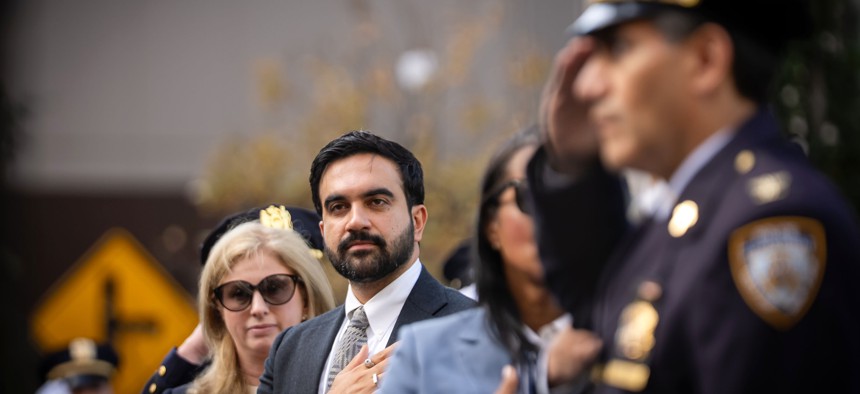
Mayor Zohran Mamdani says he’s fulfilling a campaign promise to disband a controversial NYPD unit – but critics aren’t so sure. Ed Reed/Mayoral Photography Office


Police reform advocates and leftist groups aren’t convinced that New York City Mayor Zohran Mamdani’s plan to disband the New York City Police Department’s Strategic Response Group will ultimately quell the police force’s heavy-handed responses to protests.
While many praised the mayor for making good on his campaign promise to dissolve the controversial police unit and for endorsing a City Council bill that would further restrict protest policing, groups like the New York City Commission on Racial Equity, the Legal Aid Society and Justice Committee also expressed concerns that the NYPD may still be permitted to carry out SRG-like actions – just under a new name.
“We want to see a dismantling of SRG, but we want to make sure that the dismantling does not reproduce the same group under a different title,” Linda Tigani, the executive director and chair of the Commission on Racial Equity, told City & State. “The campaign promise was not to change the name of a police unit, it was to disband a unit.”
Under Mamdani’s plan, which he announced Monday morning, the city will separate SRG’s counterterrorism operations from how it polices protests, establishing several new units to handle the latter.
The new civilian-led Community Dialogue and Deescalation Division, housed within the Mamdani administration’s Office of Community Safety, would spearhead how the city responds to protests and crowd control – doing so without weapons or the power to make arrests. The unit would work closely with the new First Amendment Support Team, housed within the NYPD’s Community Affairs Bureau, which would consist of 30 police officers “trained in communication and de-escalation,” according to information provided by City Hall. As the civilian force wouldn’t be operational at least until 2028, the latter would take the lead in the interim. The mayor’s overhaul also formalized existing restrictions on the use of tear gas, kettling and long guns and banned the use of pepper spray as a crowd-control tactic.
Criminal justice advocates and leftist groups are united in their desire for the City Council to pass legislation known as the CURB Act, which would prohibit the SRG and any successor group from responding to protests and ban any NYPD officers from using kettling techniques, tear gas, pepper spray, bicycles and long-range acoustic devices while policing protests. Mamdani and the bill’s sponsor, Council Member Chi Ossé, joined forces to announce the changes in a video Monday.
“The mayor made a promise to New Yorkers when he was on the campaign trail to disband the SRG, and he has kept that promise,” NYCLU Executive Director Donna Lieberman told City & State. “We are very glad that the mayor has disbanded the SRG and that he has come out in support of the CURB Act and indeed adopted key provisions of the CURB Act immediately. … We're glad that he has separated out, in this restructuring, cops with long guns going after terrorists from cops who are dealing with protests and protesters – even when there is a public safety question and they perceive the need for an arrest. The SRG was notorious for its bullying, hyper-aggressive, abusive tactics.”
But it's the creation of a new NYPD unit called the Patrol Support Division that’s spurred the bulk of advocates' concerns. Though the Mamdani administration stressed that there will be strict eligibility requirements for officers, this unit would still take over certain protest-specific functions of the SRG, like carrying out mass arrests when necessary.
Police Commissioner Jessica Tisch herself has suggested that not much would change. "Nothing would change about the way that the NYPD responds to crowd control conditions, like, for example, the celebrations following the Knicks' epic championship," she said in a joint ABC 7 interview with Mamdani released Monday morning. "New Yorkers can expect in crowd control type situations to see the very same response that they are accustomed to."
Tigani said she found Tisch’s words to be troubling. “Everyone needs to be in alignment and on the same page about understanding why this is a racial equity issue and the people’s voice matters,” she said. “We need consistency, not only in action, but also in messaging. The fact that we don’t have that here is a cause for concern.”
Other, more radical activist groups have also loudly opposed the plan. One such group, NYC for Abortion Rights, charged that the Mamdani administration chose not to consult with community groups who’ve long fought for the dismantling of SRG.
“It has become abundantly clear that when it comes to policing, this city is governed by a billionaire heiress intent on maintaining the status quo, while the man we elected to change it stands by her side,” the group said in a statement, describing the Patrol Support unit as “a repackaged SRG.”
In addition to being skeptical about the Patrol Support Division, Justice Committee expressed concerns about the new civilian unit planned for the Office of Community Safety – especially given how new that office is.
“We’re really concerned that would basically position OCS to end up being an NYPD co-response team for protests, which will undermine the broader goals of what OCS is supposed to be and what the Department of Community Safety later on would be,” Joo-Hyun Kang, a spokesperson for Justice Committee, told City & State. “We think the intent to reduce police involvement is great. We’re just not convinced that this is the moment to then decide that those functions have to be outsourced somewhere else.”
Many groups are taking a wait-and-see approach. The Legal Aid Society praised the mayor for disbanding SRG, but stressed the need for “vigilant oversight” to ensure SRG’s tactics aren’t repeated. “We urge the mayor to closely monitor the NYPD’s use of force, surveillance, and arrests, both at demonstrations and in the low-income communities we serve,” the group said in a statement.
The mayor’s endorsement of the CURB act could become a major fight between the Mamdani administration and the legislative body. Several sources told City & State last week that City Council Speaker Julie Menin remains opposed to the bill and Council Member Oswald Feliz, chair of the council’s Public Safety Committee, won’t allow it to advance for a hearing.
“The administration has the authority to implement any changes it wants to see to the operations and structure of the NYPD without legislative action,” Jack Lobel, a spokesperson for the City Council speaker’s office said in a statement.
But Lieberman, the NYCLU executive director, insisted that the council now has a duty to act. “The City Council has a responsibility to protect the public safety and the right to protest, and what Mayor Mamdani has done will provide a significant measure of protection during his administration,” she said. “The City Council's job is to pass a law that makes those rights permanent.”