

sponsor content What's this?
Sponsored Content
The Doctor Shortage Begins in the Classroom, Not the Clinic
Understanding the Social Determinants of Medical Education and its Implications for the Health of New Yorkers
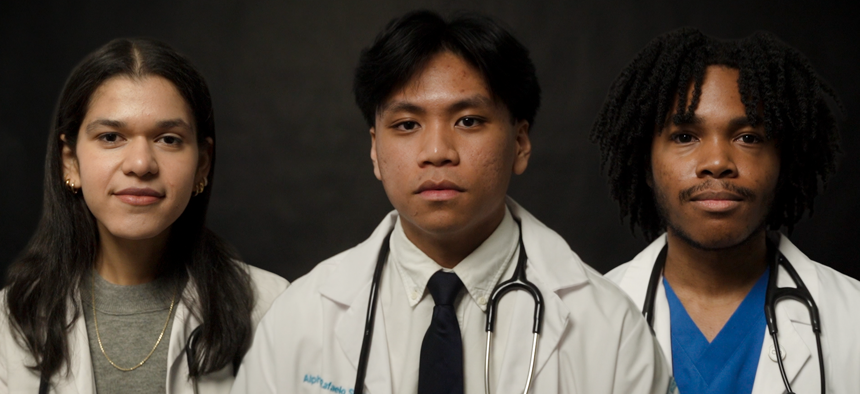
Heather Bonilla (first-year medical student), Alphonse Rafaelo Sinlao (first-year medical student), and Ramyr Tunis (second-year medical student). Cyrus Rosen, CUNY School of Medicine


.png)
The sirens signaling distress from an ailing health care system are loud and clear!
Access to medical care in the emergency department is mandated by law, and roughly 1 in 5 adults visits one each year. Among them, approximately 60% are seeking care for preventable conditions that can – and should – be managed in the doctor’s office. This shocking statistic is likely to increase as the Affordable Care Act subsidies expire, exacting a tremendous toll on those who are already medically underserved. It will also further exacerbate known health and health care disparities.
It is in our nation’s emergency departments that the effects of the worsening doctor shortage, especially in primary care, are most acutely felt. Yet, the genesis of the critical and deepening physician shortage – 86,000 to 124,000 doctors nationwide by 2036 – originates in elementary and high schools. At this early point, gaps in access to economic and social resources contribute to early educational barriers that result in a leaky pipeline into higher education and the health professions. This, in turn, perpetuates and exacerbates educational and health care disparities.
The high cost of medical education and length of residency training further threatens this already fragile health professional pipeline as talented students, especially those who are underrepresented in medicine and from socioeconomically disadvantaged backgrounds, opt out of careers in medicine because they and their families cannot afford the tuition. Indeed, medicine today is competing with tech, finance and AI-adjacent fields that promise faster returns with less debt. Those who persist often rely on federal student loans to pay tuition and associated costs, and then graduate with a significant and unequal burden of educational debt.
It is well established that the social determinants of health – where people work, live, play and pray – influence New York’s vitality. It is also through the lens of educational debt, that the social determinants of medical education come into sharp focus, further influencing the health and well-being of New Yorkers.
Access and affordability are intrinsically intertwined and have long defined who can reasonably dream of becoming a doctor, and who can’t. Nearly 80% of U.S. medical students come from the top two household income quintiles, while students from low-income families comprise only about 5% of medical school matriculants – a group that disproportionately includes those who are underrepresented in medicine. These disparities are likely to intensify in 2026, as new federal loan caps and lifetime borrowing limits take effect, further widening the cracks in the already leaky medical-education pipeline. They will also create a more complex financial path, further disincentivizing prospective doctors, including many who are New Yorkers among us. Unfortunately, in the medical-education enterprise, underrepresented and socio-economically disadvantaged students who wish to pursue and are able to achieve their dream of becoming a doctor are already rare.
To improve health care quality and reduce health disparities for all Americans – especially medically underserved people – medicine itself needs to undergo a fundamental demographic transformation so that the face of medicine reflects our society’s rich mosaic. These dramatic demographic changes require us to capture the talents of all who wish to serve.
In an increasingly aging and diversifying society, there will be increasing demand for health care services. As Americans live longer but with higher rates of acute and chronic diseases – cancer, diabetes, hypertension, kidney disease, dementia – they will require continuous coordinated care. Each of these conditions and others are more prevalent in minority and socioeconomically disadvantaged populations. To maintain the New York physician workforce at the status quo, an additional 1,200 primary care physicians will be required by 2030 as substantial shortages particularly plague low-income areas. At the same time, the physician workforce is itself growing old and moving toward retirement, with nearly half of practicing physicians over age 55. Altogether, a perfect tsunami is approaching as both the nation and physician workforce are aging, creating an acute demand for health care services amid an insufficient supply of doctors, that continues to hammer strained safety-net clinics and hospitals.
In New York, 2 million people in New York City – about a quarter of the population – and 8 million people statewide live in federally designated Health Professional Shortage Areas (HPSAs). Not surprisingly, fewer medical students from the highest-income families opt to practice in HPSAs. For students from less-affluent homes, medical school debt may shape where and how they practice, potentially encouraging them to seek higher-paying jobs in more affluent communities to the detriment of medically underserved people living in both rural and urban areas. These doctors do not lack commitment; rather, they may not have the financial flexibility to make a different choice. Put another way: The structure of medical-education financing quite literally determines the geography of care. Thus, financing itself must be reoriented to become more equitable so medical schools can address New York’s substantial physician shortage – estimated to be over 2,000 over the next decade – as well as the needs of the most vulnerable, marginalized and medically underserved New Yorkers desperately needing their care.
That’s where CUNY School of Medicine’s 7-year BS/MD pathway programs and its iconic Sophie Davis School for Biomedical Education play a vital role in building a representative health professional pipeline that directly addresses educational, health and health care disparities in New York. The school recruits the most promising high school graduates and makes admissions decisions via a novel mission-aligned process, without using the Medical College Admissions Test (MCAT). Our first-year college students begin their journey into medical school in our rigorous accelerated 3-year BS in Biomedical Science program, and then have the opportunity to transition into our 4-year MD program.
As one of two public medical schools and the only community-based medical school in the city, CUNY School of Medicine focuses on mission-driven pathways into medicine and maximizing its impact with each graduate. Specifically, CUNY medical students come from households that closely reflect the city and state’s demographics by including many students from medically underserved communities. Additionally, 100% of CUNY medical students are New Yorkers upon matriculation and 82% speak two or more languages, making them particularly adept at communicating with their patients during their clinical rotations in safety-net clinics and hospitals across the city. Students learn the art, science and practice of medicine by caring for their neighbors – New Yorkers. Inspired to care about and practice in their hometowns, approximately 80% of our graduates stay in New York and more than half enter primary care, a rate 2.5 times that of New York’s medical schools. Nearly 40% practice in HPSAs, again a rate 2.5 times more than New York’s medical schools.
Since the launch of our undergraduate Sophie Davis program at City College of New York in 1973, the CUNY School of Medicine remains committed to access, affordability and New York. Against this backdrop, we have invested in curricular innovations and partnerships with mission-aligned educational and health care systems, extending our Careers in Medicine and Junior Medical Ambassador programs into middle and high schools located in high-need communities where educational and health care disparities persist. And it’s working. Increasing both interest and enrollment will help ease New York’s physician shortage. And as applications to CUNY School of Medicine soared to 3,000 – a two-fold increase since last year – it is time to invest in a medical education pipeline that closely represents New York’s rich mosaic and deeply cares for New Yorkers, especially New York’s medically underserved, while also changing the skyline of academic medicine in New York.
Unfortunately, there is no easy cure for our ailing health care system nor a quick fix to address the uninsured and the unmet needs of those without care. However, within our sphere of influence we can address the social determinants of medical education by investing in medical schools with an explicit mission to serve high-need communities and to produce physicians who reflect New Yorkers. It’s not a panacea, but reducing or eliminating the cost of medical education – for example, through expanded loan-forgiveness programs, generous philanthropy, affordable in-state tuition at public institutions, and safe, low-cost housing and transportation options for students in need – most certainly would help. Doing so would give those who dream of becoming physicians the opportunity to devote themselves to mission-driven work in the communities that need them the most. The return on these investments can be calculated in longer, healthier lives – and an overall lower cost of care compared to high-cost late care in emergency departments.
Public medical education and community-based health care are society’s greatest public goods – and needs. If we are to improve population health, now is the time to focus on access, affordability and reducing student debt for those most in need and by fully including those who aspire to serve the medically underserved. Guided by our core values and consistent with our mission, CUNY School of Medicine continues to train the doctors New York needs, and New Yorkers want to see. Recognizing the ongoing need and untapped potential, producing more doctors willing to answer the call for mission-driven work would allow high-quality health care to reach people and entire communities across this great city and state, improving access for those who need it most.
Dr. Carmen Renée Green is the dean of the CUNY School of Medicine.
NEXT STORY: Hollis Public Affairs Expands Service Platform with Launch of Strategic Communications Practice