

sponsor content What's this?
Sponsored Content
Rep. Mike Lawler pledges to find a compromise on healthcare spending
A Q&A with the Hudson Valley Republican who’s running for reelection against Cait Conley in NY-17.
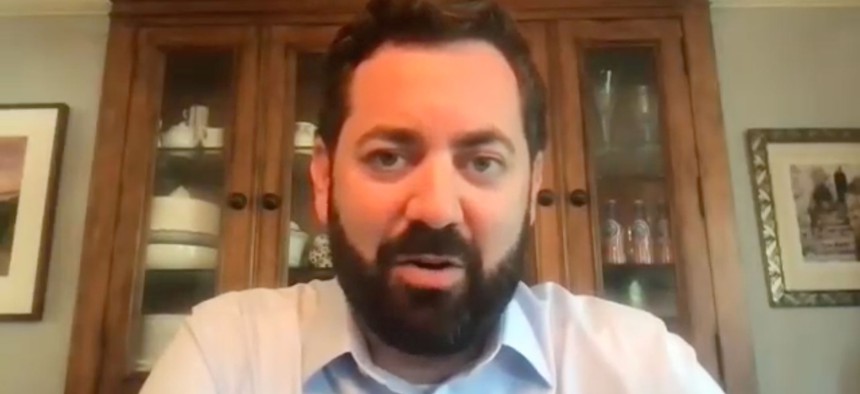
Rep. Mike Lawler is a former Assembly member and political consultant, now running for reelection. Screenshot / City & State

Presented By:

Rep. Mike Lawler is seeking a third term representing the 17th Congressional District after a narrow reelection two years ago. Facing a challenge from Democrat Cait Conley, a combat veteran and national security expert, Lawler is making his case to his Hudson Valley constituents in the Democratic-leaning district that they should keep him around for at least another two years.
He spoke with City & State’s Rebecca C. Lewis, in partnership with AARP New York, about his positions on issues impacting older New Yorkers, including Medicare, civic engagement and affordability. You can read our interview with Conley here. This interview has been edited for clarity.
To get started, I wanted to ask about – since it's timely – your recent letter to (the Centers for Medicare and Medicaid Services) about the 340B drug program and asking for the reversal of cuts. Why is that important? And why is this something that you are focused on?
Well, look. Prescription drug costs are one of the most important issues to seniors, and one of the biggest things that we have focused on this Congress with most favored nation status. We saw the largest decline in prescription drug prices in 60 years, with an over 3% drop in drug costs. The 340B program was created to support, in large measure, our safety net hospitals. So as they look at reforms – and specifically, it’s centered around hospitals that worked around the system, if you will, and found ways to access this that are not necessarily safety net hospitals, and, frankly, taking advantage of the system. But to me, any reforms need to protect the safety nets, which is what they were intended to do, and the (federally qualified health centers) of which there are many across the state to serve underserved communities. And so that’s why we reached out to Dr. (Mehmet) Oz with a letter to CMS on the issue of 340B, and I’ve been in touch with Dr. Oz since, and we’re having conversations on it.
How do you see your vote on the One Big Beautiful Bill that included cuts to or ending a subsidy for Medicare Part D. Do you think that that fits in? Are you concerned about the impact that particular aspect of the bill will have on older New Yorkers? Or what should they know about that impending change that will take –
That wasn’t included in that bill.
My apologies, I might have gotten mixed up about which bill it was.
That’s a decision by the administration on something that the Biden administration had put in place. So that’s a totally separate issue. But what we’re talking about on the changes with respect to Medicaid in the bill – Medicare was not touched. With respect to Medicaid in the bill, there were common sense reforms. The Medicaid program had doubled under the Biden administration, and that is certainly not a sustainable trajectory for Medicaid. And frankly, people were on the system taking away from the very people who need and rely on Medicaid. Medicaid was created to support our seniors, to support the disabled, to support children and single mothers. And what we saw was an expansion of Medicaid that was draining the system. So we said, “Look, there needs to be eligibility verification twice a year.” The Biden administration had eased eligibility verification.
Secondarily, there needed to be citizenship verification to make sure that illegal immigrants are not collecting Medicaid benefits like we see in states like New York. And three, work requirements for able-bodied adults without dependent children – and that’s something Bill Clinton and Democrats championed in the '90s. Work requirements are something that many New York Democrats voted for just a few years ago with the expansion on SNAP. So work requirements (are) not an unreasonable policy. It's something that has had broad bipartisan support and something that most Americans support. And what we were able to do, and what I was able to do in the negotiations was protect our hospital system by ensuring that (disproportionate share hospital) cuts were not part of the bill, ensuring there were no changes to the (Federal Medical Assistance Percentage) floor and the federal share of Medicaid. Making sure that there were no per capita caps for block grants. I was able to negotiate with Dr. Oz to extend the (managed care organization) tax for New York for an additional nine months, bringing back over $1.2 billion to New York's hospital system.
In addition, working with (Rep.) Andrew Garbarino, we were able to get (the Federal Emergency Management Agency) to release over $2 billion in funds that were due from COVID, that the Biden administration sat on for the entirety of their term and did not release. We were able to get that released to all of our hospitals in New York. So that was a huge win for New York when it comes to the hospital system.
When it comes to the essential plan, New York was one of only three states in the country taking advantage of this tax provision starting in 2015. New York, Minnesota and Oregon, and no other state was benefiting from it. And so the tax bill let this specific tax provision expire. But from my vantage point, we tried to get our senators from New York to negotiate with (U.S. Senate Majority) Leader (John) Thune – they did not – and try and find an extension period, whether it was one year, two years, three years. Ultimately, we were able to get a waiver for the basic plan for many of these individuals. (Gov.) Kathy Hochul could have chosen to fully fund these folks in the state budget, which is what New York did prior to 2015. New York paid for it in full, and she chose not to. She told people it was too expensive, so that was a choice by the state not to fund a program that the state created, and the state chose not to do that.
From the perspective of, as you were saying, Medicaid and making sure it’s running well, (that) there’s not fraud in the system. Looking ahead, if you win again in November, what are some of your priorities for addressing the prevention of fraud. I know, especially here in New York, there's been a lot of attention from the federal government on, for example, the Medicaid system, the administration of Medicaid, and especially the (Consumer Directed Personal Assistance) Program. What would be your priorities for next session if you went again in November to address some of the alleged fraud and to make sure that older New Yorkers are protected from it?
Again, the objective of these programs is to provide for those who need it, and any time there is fraud in the system, it takes away from the people who rely on the program. And all of us as taxpayers should be outraged by it. When you look at the CDPAP program, it went from a $10 million program to an $11 billion program in just a few years. And even Kathy Hochul and the state will acknowledge that it's rife with fraud. Now their solution to it is problematic. I mean, they entered into effectively a no-bid contract with a donor of hers, and created this scheme by which everybody has to go through one fiscal intermediary. And they effectively get turned over to 1199SEIU to become union members. I think, obviously, there’s a lot of questions about how she came up with this quote-unquote solution. But one of the big problems has been the lack of criminal investigation and prosecution by (state Attorney General) Letitia James and the Attorney General's office. New York used to be a leader on prosecuting Medicaid fraud. They don’t do it. It’s effectively null and void, and so the federal government is coming down on New York for that. And I think that is something that the state needs to get serious about, and making sure that people are not scamming the system and stealing money from the very people who rely on it.
But moreover, look, New York has the most expensive Medicaid program in the country per capita, most expansive. Anybody qualifies after 30 days of being in New York. There are things that I think the state needs to look at. They were about to do a Medicaid redesign right before COVID. Obviously, COVID happened and they scrapped it. But I think the state needs to evaluate how these Medicaid dollars are being spent and whether or not they’re being spent efficiently and effectively to support the people who need it.
But look, healthcare is much bigger than just government payer Medicare and Medicaid. Healthcare requires real bipartisan compromise and reform in the coming years. One of the things that I’ve, frankly, agreed with some of my Democratic colleagues on is the fact that large insurance companies like United Healthcare should not be owning providers, and that should be prohibited. One of the things that we saw as a result of the Affordable Care Act is that there was major consolidation, and it did not produce economies of scale. It did not reduce cost. Everything has gone up. Insurance premiums are up 150% in 16 years, while insurance company profits are up over 2,000% during that time. So, if you really want to address some of the inequities in the system, you have to break up the monopoly here. You need more competition. You need people to be able to purchase across state lines. You also need businesses to be able to provide employer-based health coverage, which means you need to allow for associated health plans so that small businesses can pool their resources together and purchase plans at a much lower rate because the risk pool will be expanded. So, for instance, I live in Pearl River. If there's 20 small businesses in Pearl River and they all want to pool together and purchase a plan for their employees, they would be able to do so at a much lower rate than having to go out onto the open market and purchase it individually. We’ve seen the open market plans are through the roof and just continue to go up and up and up and up, and New York keeps approving it without any real reforms or any oversight, and so the cost of health care has gone up exponentially.
I think we have real workforce issues that have to be tackled. We have a shortage of doctors, of nurses. It requires immigration reform. It also requires education reform. We need more people going into you know two-year associate degree programs at our community colleges. We need more people on a career path, starting in high school, coming into college, we need more people getting certifications at community colleges. These are critical if we are going to be able to fill the workforce needs across the healthcare system. Those are just some of the, I think, common sense ways to deal with cost and access. And there's a lot more. I mean, there's so many bills in Congress that do have broad bipartisan support that I think we can start to tackle the system. But people have to get over the dogma on both sides and actually start to work to fix what is broken instead of just doubling down on what is not working.
What do you see as the biggest affordability issue that you'd want to tackle, especially for caregivers, so that they’re able to save money, that they’re able to spend more time taking care of family members? Affordability obviously is a huge issue and one of the top issues for many New Yorkers. So for you, what do you think is the biggest area that you would want to tackle to address that issue?
I think it’s way more complex than just specific to caregivers. I mean, part of the challenge here is the overall cost of living in New York is significantly higher than almost anywhere in the country, whether it’s housing costs, whether it’s taxes, whether it is healthcare costs, whether it is utility costs. Utilities are up 58% in six years in New York state. That has nothing to do with Washington, nothing to do with the Middle East, and everything to do with the policies coming out of Albany. Shutting down nuclear power, banning natural gas extraction, blocking pipelines, requiring all electric construction – all of these things result in higher costs. You look at housing; we don't have enough housing supply. It's why I led on the issue of housing and passed the largest bipartisan housing package in 36 years to increase supply, cut red tape, increase access to capital for home builders and home buyers and bring down costs.
A lot of our seniors struggle because they’re living on fixed incomes. They’re reliant on social security as their means of income. They’re stuck in their homes because they’ll get whacked on the capital gains. There are real challenges across the system that I think we have to evaluate both at a federal level and a state level, how we reduce overall cost of living for our seniors. One of the things that I had pushed when I was in the state Legislature was on the issue of property taxes towards the school tax bill for seniors over the age of 80. They’re not, obviously, using the school system, and the school taxes continually go up while their source of income – most of them relying on a 401(k) or investments and social security. They struggle to maintain that. So it’s not enough to just do the STAR rebate or the enhanced STAR rebate. You have to figure out a way to actually offset their taxes. It’s part of what we did with cutting social security taxes on them and offsetting that this year in the tax bill by passing for the first time no tax on social security and creating a new $6,000 tax deduction to offset that per senior, $12,000 per married couple. A lot of people benefited from that.
What I was able to do by lifting the cap on (state and local tax deductions) from $10,000 to $40,000 to help reduce their property tax and state income tax burden on their federal income tax returns, so that they get a big refund. For the average Hudson Valley family, they saw an over $4,000 tax cut this past April. So there’s a lot that we can do from a tax standpoint to help offset costs for seniors. But I think from the standpoint of families that have to provide care, long term care is a major challenge for families, not only from a financial standpoint, but there's a mental health toll on it. I introduced legislation to provide mental health care access for caregivers because that is a big challenge (when) dealing with either a loved one who’s ill or dealing with a senior who needs long term care. It’s very cost prohibitive for families either to get them into a long term care facility or to be able to provide that level of care, and in many cases they have to not work in order to do that. So I think we have to evaluate, especially as the baby boomer generation has reached the age of retirement (and) Social Security and Medicare outlays are going to increase. How do we tackle the cost of this long term care system and allowing a lot of our seniors to be able to age in place at home or get into an assisted living facility, of which we just don't have enough to be able to provide the level of care that's needed?
I’m curious because I know you did fight very hard to increase the SALT deduction cap. Do you think that there is potential to remove it altogether? I know it was a big fight to increase it at all. What do you see as the future potential for that potential fight? Is that something that you think is largely settled, or will you continue fighting to either continue to increase it or lift it altogether as it was prior to 2017?
So the only people who benefit from unlimited SALT are the billionaires and the millionaires that my Democratic colleagues always rail against. So I’m not sure why Kathy Hochul and others are pushing so hard for the billionaires and millionaires to get unlimited SALT. From my vantage point we cut a very good deal to lift the cap from $10,000 to $40,000. Over 90% of my constituents were able to fully deduct their state and local taxes, either because they took the standard deduction or they used the itemized deduction and were able to offset their property taxes and their state income taxes.
I think the bigger issue on the tax burden in New York is, what is Kathy Hochul in Albany doing to reduce the tax burden? We have the highest tax burden in the country, and so what are they doing to actually cut taxes and cut the cost of living in New York? Everybody looks at Washington, but why is it that New York leads the nation in all the wrong categories when it comes to housing costs, when it comes to healthcare costs, when it comes to energy costs? That’s a product of the policies and the decisions being made in Albany. So look, we obviously produced the largest tax cut in American history. Every New York Democrat voted against it. They were against no tax on tips. They were against no tax on overtime. They were against no tax on Social Security. They were against lifting the SALT cap from $10,000 to $40,000. I think we produced a very good tax deal for New York. New York state was one of the biggest beneficiaries of the tax package. Kathy Hochul won’t tell you that, but that’s the truth. And ultimately, I think we’ll continue to work to reduce taxes from a federal standpoint. But I think New York state needs to get its fiscal house in order. You can’t increase state spending by $19 billion in one year and not think that there's going to be a negative impact in terms of cost of living in New York.
What do you think is the biggest opportunity for New Yorkers to become more civically engaged, to increase voter registration? I know that right now the big bill that is being discussed is the SAVE Act, and that’s more to do with voter ID at the polls, not necessarily registration. But is there any concern that the discussion around this legislation, or if the legislation becomes law, that it could have a negative impact on civic engagement?
Over the last decade, voter participation is up significantly. There’s a lot of factors as to why, including social media and engagement with the general public on issues that matter to them, and more and more people being interested in the electoral process. But I think we also want to make sure that there is integrity in the system. Voter ID is a 90/10 issue. Most Americans agree with voter ID, and the opposition to voter ID makes no sense whatsoever, and nobody can honestly articulate a reason against it. When (New York City Mayor) Zohran Mamdani is saying you need ID to be able to access government-run grocery stores, or the state of New York is saying you need ID to be able to get unemployment benefits as a an undocumented immigrant, the fact is that people are able to get ID, and there’s no reason to be against it. As far as proof of citizenship goes, look, we saw what happened in New Jersey, where at minimum over 6,000 people got registered, over 400 of which voted. They should not have been on the rolls, and so you know that's something that I think is something we need to tackle and ultimately pass.
I think when it comes to mail-in balloting, if you look at the provisions of the SAVE Act, it’s no different than the state of New York's constitution. It requires an excuse to vote by mail. It requires you to request an absentee ballot. If it’s good in New York, I don’t know why it’s not good elsewhere.
Since you did write CMS about the 340B drug pricing program, I'm curious what you would say to any constituents of yours that might be concerned about the earlier thing I mentioned, the Medicare Part D subsidy. Granted it was a short lived subsidy but there (are) those who might be concerned that their prices will go up or concerned that they will be impacted by the end of the subsidy at the end of the year. What would you say to your constituents who might be concerned about that particular decision?
Again, what we saw over the last year is actually the largest drop in prescription drug costs, over 3%, which is something I know a lot of folks in the media don’t want to actually talk about and recognize. But it is the largest drop in drug costs in a generation. I think there is more work to do, and it’s not always just a function of government subsidies. You have to reform the system. If prices are totally dictated by the government subsidizing prescription drug companies or subsidizing insurance companies, we’ve seen how that works. Drug prices and insurance prices keep going up. All you’re doing is handing money to the insurance company. So maybe what we need to do is figure out how to actually reform the system and make it fairer for the American taxpayer and American consumer.
And so that’s what we’re looking at across the system, is how to do that. It’s not always just a function of throwing more money at it. New York spends more on Medicaid per capita than any state in the country, and yet New York has the most expensive healthcare system of any state in the country. Why is that? Shouldn’t we be trying to get to the root of why healthcare is so expensive and what actual reforms need to be made to reduce cost? I mean, that’s fundamentally, I think, that the challenge here is that folks want to associate more government spending or more subsidies with cheaper costs, and that’s just not true. It’s just not the case, and I think that’s been borne out that it’s not the case. So, how do we actually reform the system? What we did on prescription drugs, going after most favored nation. Why are American taxpayers subsidizing Europeans on their prescription drug costs? That’s something that for years has been talked about. Nobody did anything about it, so I think there’s a lot to do to ensure that Americans are getting quality, affordable, accessible healthcare, whether they’re on Medicare or Medicaid, or whether they are on private insurance. But I think just sticking with the status quo and acting like that’s working when we all know it’s not, I think, is undermining the ability to actually reform the system and make positive steps forward to reduce costs for Americans.