

sponsor content What's this?
Sponsored Content
Gov. Kathy Hochul says Social Security isn’t a handout
A Q&A with the Democratic governor as she seeks reelection
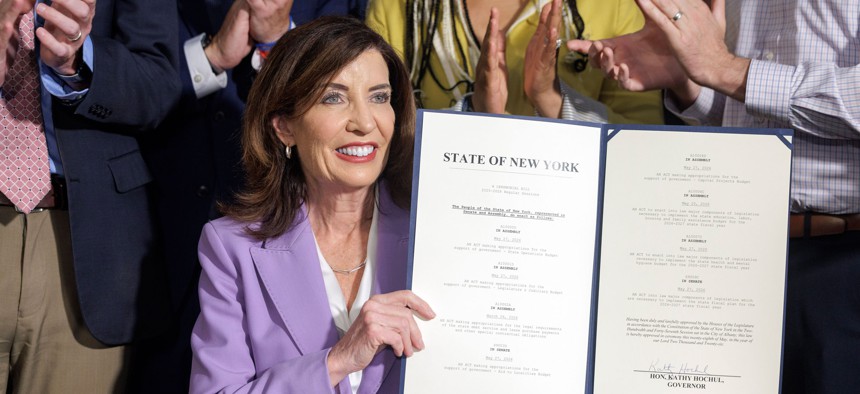
Gov. Kathy Hochul at a stop celebrating the budget Mike Groll/Office of Gov. Kathy Hochul

Presented By:

Gov. Kathy Hochul said she doesn’t want young people thinking democracy is something they watch from the sidelines. She’s in the middle of the big game right now though, running for reelection against Nassau County Executive Bruce Blakeman, the Republican nominee.
The first grandma governor is now running on a ticket with fellow grandmother Adrienne Adams, her lieutenant governor pick. Hochul responded to questions from City & State, in partnership with AARP New York, about affordability, her differences with the Trump administration and caretaking for her mother. We also interviewed Blakeman, her Republican opponent, which you can read here. This interview has been edited for length and clarity.
What do you think is the top issue for voters over 50 in New York this year?
Affordability. But for someone over 50, that can mean a lot of different things. You may still be working and helping your kids. You may be caring for a loved one with a long-term illness. Or you may be retired and wondering whether your savings are going to keep up with your property taxes, utility bills, groceries and healthcare.
I meet New Yorkers all the time who did everything right. They worked hard, played by the rules and saved what they could. They should not spend these years worrying about whether they can afford to stay in the home and community they love.
That is why I have been relentless about lowering costs through my affordability agenda. This year alone, we secured $1 billion in energy rebates, and millions of homeowners are receiving STAR property tax relief, including larger benefits for eligible seniors. My focus is simply giving people a little more breathing room and making New York a place where you can actually afford to grow older.
If reelected, how would you work to protect and strengthen Social Security for New Yorkers, our children and our grandchildren?
Social Security is not – and has never been – a handout. People earn it. I started working when I was 15 years old, and like millions of New Yorkers, I’ve paid into this system with every paycheck. You should be able to count on that promise being there when you need it. That is why I have spoken out when the Trump administration and Washington Republicans have taken steps that make it harder for seniors to access their Social Security benefits. I have a very different view. We should be making it easier for people to get the benefits they earned, not putting more obstacles in their way.
And I want our children and grandchildren to grow up knowing that the same basic promise will be there for them too. Washington needs to deal with that now, not wait for a crisis. But strengthening Social Security should mean protecting the benefits people earned and making sure the same promise is there for our children and grandchildren.
Congress and the Trump administration are trying to reduce Medicare and Medicaid spending, hoping for savings on the federal level and enacting a work requirement and ending subsidies for states like New York. How do you think that will affect New Yorkers? And how would you respond as governor?
This is one of the clearest differences I have with the Trump administration and my Republican opponent. I don’t believe you balance a budget by taking healthcare away from people who need it.
These cuts are not numbers on a spreadsheet. They are the home health aide who helps an older New Yorker stay in her own home. They are the only hospital for miles in rural New York trying to keep its doors open. They are a working parent who needs to see a doctor without going broke.
Federal law now requires certain Medicaid recipients to meet an 80 hour a month work or community engagement requirement, and New York is also losing billions in federal healthcare funding. We immediately took decisive action to preserve coverage for 1.3 million New Yorkers through our Basic Health Program. But no governor can simply replace federal cuts of this magnitude. I will keep fighting for every dollar and using every tool we have to protect people’s care.
Nearly 4 million New Yorkers care for a family member or another loved one, working an average of 27 hours a week just on caregiving – and spending an average of more than $7,000 a year out of their own pockets. How would you help family caregivers here in New York save money and time so that they can continue caring for their loved ones?
This one is personal for me. I watched my own mother battle ALS, and I was able to be there holding her hand at the end of her life. I know what it means when somebody you love needs you. And I know that caregiving can be an act of enormous love while also being physically, emotionally and financially exhausting.
Nobody should have to figure all of that out alone. New York provides respite care, counseling, training, transportation and other support through our aging network, and our Caregiver Portal gives families free help and information whenever they need it. This year’s budget also continues $68 million to address unmet demand for aging services and invests in community organizations providing services, including respite care.
The goal is to help more New Yorkers stay safely in their own homes, give the people caring for them a break when they need one and make it much easier to find help before a family reaches a breaking point.
The average Con Edison utility bill was up to $220 last year, from $157 in 2020. According to an AARP survey, 84% of New Yorkers over the age of 50 said that their spending on utilities has increased. How are you addressing the high cost of utility bills and helping New Yorkers who are struggling?
People don’t experience energy policy as a white paper. They experience it when the bill arrives.
I hear this everywhere I go, and it is especially hard on older New Yorkers living on a fixed income. You should not have to turn down the thermostat or cut back on groceries because your utility bill suddenly jumped again.
So we are putting $1 billion directly back into New Yorkers’ pockets through energy rebates, and we passed tough new protections for ratepayers. Utilities seeking rate increases will have to show how they can control their costs, and customers will no longer be stuck paying for things like lobbying, political contributions or unnecessary executive travel.
There are plenty of ideological arguments about energy happening in Washington. My job is to make sure the lights stay on and New Yorkers can afford the bill.
Adults over 60 and older across the country have lost nearly $300 million to elder fraud just in the past year. Scammers are using new technology like AI and cryptocurrency for new schemes. How are you helping protect older New Yorkers from fraud and scams like this?
It makes me furious when somebody spends a lifetime working and saving, only to have a scammer try to steal it from them with one phone call or text message.
The technology is changing quickly, so our protections have to change with it. We have made identity theft a form of elder abuse under New York law, and this year’s budget is funding new training and a public awareness campaign specifically aimed at scams and fraud targeting older New Yorkers.
And this is another place where I disagree with the direction coming out of Washington. The Trump administration has called for a barely existent national AI framework and has moved to challenge state AI laws it considers too restrictive. I believe leading on innovation and protecting New Yorkers with basic safeguards can coexist. That’s why I signed New York’s RAISE Act, requiring the largest frontier AI developers to disclose their safety practices and report critical incidents. We can embrace new technology without abandoning New Yorkers when something goes wrong.
What do you think is the biggest opportunity to increase voter registration and civic participation in our state?
Make it easier to participate.
People are busy. They are working, raising families and caring for parents. Exercising your right to vote should not require you to navigate a maze of rules or discover that you missed an arbitrary deadline weeks before Election Day.
That is why I signed legislation moving New York’s voter registration deadline from 25 days before an election to 10 days, and why I signed the John R. Lewis Voting Rights Act to protect New Yorkers from voter suppression, intimidation and other barriers to the ballot.
But civic participation is bigger than voting once a year. I want young people to grow up believing that their voice matters, that government can actually respond to them and that democracy is something they take part in, not something they watch from the sidelines.