

Nonprofits
A charter school leader says Trump administration policies are putting pressure on Black students
In an NYN Q&A, Dr. Curtis Palmore of United Charter High Schools reflects on DEI as Black History Month celebrates 100 years.
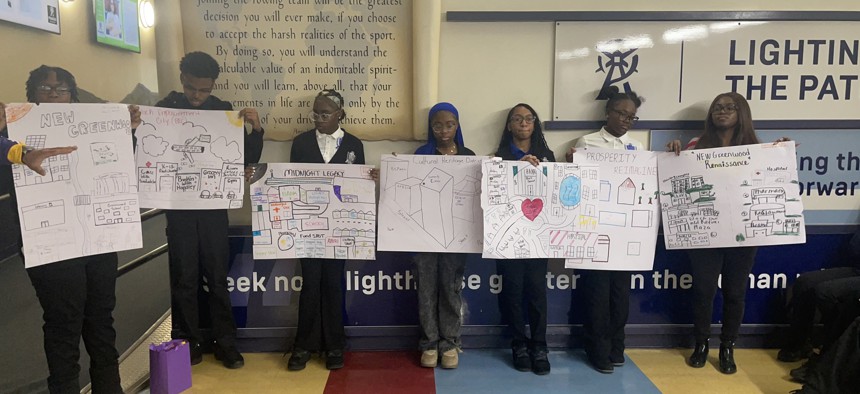
United Charter High School students present their work ahead of an HBCU tour. United Charter High Schools


While New York City Schools Chancellor Kamar Samuels has made equity and desegregation key priorities of his leadership, implementing these goals could be a challenge given federal pressure from the Trump administration. And with President Donald Trump’s “One Big Beautiful Bill Act” changing federal student loan eligibility requirements and capping graduate student loans later this year, students hailing from strained financial backgrounds are bracing for bigger obstacles to higher education.
For educators like Dr. Curtis Palmore, CEO of United Charter High Schools, these changes are worrisome, potentially leading to greater difficulties among Black and Brown students.
In order to best prepare students for college, the network of seven public charter high schools based in the Bronx, Brooklyn, and Queens offers a range of college preparatory classes and financial planning workshops for parents to ensure students have a fair shot at matriculating and graduating from college. From their Historically Black Colleges and Universities tour in April paired with weekend workshops throughout Black History Month, Palmore said United Charter aims to highlight Black excellence and inclusivity.
Palmore, who started with Teach for America in 1995, aims to center United Charter’s teaching model on collaboration and community – key elements to ensuring student and faculty belonging, according to his own doctoral thesis on Black male educators in urban school settings.
New York Nonprofit Media spoke to Palmore about how charter schools can help confront resource disparities, while retaining diversity, equity and inclusion at the forefront of their teaching model. This interview has been for length and clarity.
From starting your teaching career with Teach for America to now leading United Charter High Schools, what’s unique about the charter school space?
I think I've always been an advocate for just great schools – whether it's traditional, public or independent, or in my case, charter schools. Charter schools have given us the ability to create great systems with possibly just a little bit less red tape than traditional public schools. That red tape is typically a “one size fits all” cookie-cutter approach. When I say red tape, it's around things like curriculum selection, selecting board structures and how we evaluate leaders and teachers. So it gives you a little bit more flexibility than traditional public schools.
And how impactful can getting rid of that red tape be for students?
That can be extremely impactful. It really provides you the ability to provide quality pathways for post-secondary success. To do that, you have to ensure that kids are getting a high quality educational experience and have a sense of belonging, of community and parent partnerships.
Given your experience teaching in public schools, charters and even having pursued your doctorate, I'm curious to hear your take on critics of charter schools, in terms of funding. What are we misunderstanding from this debate?
I can't speak for the funding aspect for all localities. I can just speak for New York. First off, charter schools are public schools, a majority of charter schools are funded solely through the public dollar. I think the biggest thing we're missing is that these students and families are in under-resourced communities. These are students that, quite frankly, because of the ZIP code in which they live in, they're not afforded a high quality educational opportunity in their neighborhood.
In centering on underprivileged students, what role can charter schools play in desegregating education?
What we're doing here at United Charter High School, is ensuring that our kids, our students, have pathways to great institutions of learning. We're doing this through our college tours in New England which will be kicking off in April. We do several college preparatory experiences, we have financial planning workshops with their parents, and we also provide a ton of career placement through our partnership with Genesys Works. These things help our students ultimately compete and have a level playing field.
Since the start of the Trump administration, a lot of nonprofits and institutions were taking DEI language off their platforms. Did you also feel any of that pressure, being in the education space?
So I'll be very frank. We definitely had some conversations within our board, our leadership about certain watchdogs, if you will, who were looking over our networks and district web pages and doing some funding shifts. At that time, I wrote an op-ed to talk more specifically about inclusivity. I spoke candidly about the work that we're doing to affirm all students, regardless of their background, gender and sexual orientation. We spoke very candidly about ensuring that all students will be welcome. Do we have to be careful about DEI in this day and age? Yes, we do. But we feel that we have to do what's best for our students and our families in keeping these structures in place. Even though there's been a push for DEI initiatives, I personally have felt that a good number of these DEI initiatives were window-dressing and not actually systemically working on addressing a number of ills in our country.
What would be the opposite of window dressing, what kind of initiatives would you like to see more of?
I think it's being very honest about the topic, and not erasing the issue of the lack of diversity, inclusion and equity in our country. I think secondly, we do need to really think strategically about programming within educational, academic, government structures and laws that will truly promote diversity, equity inclusion, and not ones that necessarily will be a facade to appease certain groups.
With everything that has changed surrounding affirmative action for the college admissions process, how have your students been impacted? Has this changed the way they approach schools?
Some of the changes that have happened, particularly around college funding sources, are going to impact students’ abilities to take loans in their fourth year of college. I think that is going to be a big deterrent. We have not felt it yet. The reality is, Black and brown students that are considered high poverty, typically don't finish college because of financial inability, so those shifts around federal funding or loans will be a big blow. United Charter High Schools is looking to do more programming where we're teaching our families about the financial management that needs to happen throughout their time at UCHS.
In order for children to have a good education, they need good educators. For Black and brown educators, what might be some of the unique challenges they experience and what do you think could help them?
I did my dissertation at the University of Pennsylvania and my doctoral study was looking at a systemic problem in our country, which is around the plight of Black male educators. More specifically, I looked at the fact that when I started teaching in 1995 in New York City, nationally, there were a little bit over 1.3% Black male teachers. 30 years later, that's only increased to 1.5% of educators. Part of what I found through my study, which I see through my practice, is that organizations and districts need to have well thought out structures for Black and brown educators that really promotes a high level of belonging. What we're doing here at United Charter High Schools, is setting that up. We definitely need to be a little bit more intentional about the structures we have within our schools.
As we celebrate Black History Month, has this period been somewhat more reflective this year?
Well, this year is very special, because this is the 100th year anniversary of the actual Black History Month experience in our country. Dr. Carter G. Woodson. who was a Harvard scholar, founded Black History Month 100 years ago. So we're celebrating by promoting our Black history tour that is happening in April. I think that this year for me, because of some of the oppressive things that are happening through legislation, and the tone and shifts of our country with regard to DEI initiatives, there's been a reverse appreciation for culture and the variety of communities that are under-resourced and undervalued. For me, there’s definitely a sense of pride that I have around my work. There's a high level of Black excellence that our students are going to see when they're on the campuses of schools that are largely led by Black leaders and largely attended by Black students. I'm really excited to promote this sense of pride amongst our students.