

NYN Media
Opinion: Domestic violence isn’t a one-size-fits-all problem
The solution is clear: New York must designate funding for culturally specific organizations for domestic violence survivors.
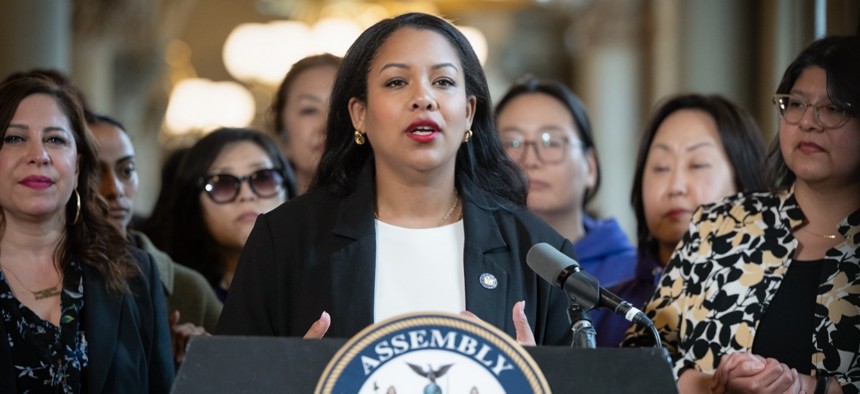
Assembly Member Amanda Septimo rallies in Albany with advocates from domestic violence organizations on March 11, 2026. New York State Assembly


Domestic violence remains one of the most urgent public safety and public health crises in New York. Every year, thousands of survivors seek safety, legal support, counseling, and shelter through community-based programs across the state. But behind the statistics lies a deeper truth: for women of color, the crisis is often more severe, and the systems meant to support survivors frequently fall short.
Women of color face a disproportionate burden of intimate partner violence. Research shows that African American women experience some of the highest rates of intimate partner violence–related homicide in the United States and are more likely than women of other racial groups to be killed by a partner. And according to data from the Centers for Disease Control and Prevention’s National Violent Death Reporting System, nearly half of homicides involving Hispanic and Latina women are connected to intimate partner violence.
That violence often occurs within a web of structural barriers like racism, economic inequality, immigration fears, language barriers and distrust of institutions, all of which make it harder to seek help.
The crisis is visible here in New York City. According to the New York City Mayor’s Office to End Domestic and Gender-Based Violence, domestic violence homicides in the city have remained stubbornly persistent for years, with women accounting for most victims. Data also shows Black and Hispanic residents account for roughly 83% of intimate partner homicide victims in the city. Each of these cases represents a failure of prevention and intervention systems that should have protected survivors sooner.
New York state government has invested in significant resources to address domestic violence. There are hundreds of funding programs offering victim assistance grants, shelters, and legal services. Yet funding levels alone do not tell the full story. The problem is not simply how much money is spent; it is a question of where that money goes.
Across New York, hundreds of organizations provide services to domestic violence survivors but fewer than ten of the groups funded by the state’s Office of Victim Services are culturally specific organizations rooted in communities of color. These organizations are created by and for communities that face distinct barriers when seeking help and serve as a refuge in communities where stigma and mistrust of institutions make reporting abuse especially difficult.
Culturally specific organizations play an indispensable role in bridging these gaps. Groups like the Korean American Family Service Center, Voces Latinas and the Islamic Center of Rochester provide multilingual services and culturally informed counseling for survivors of gender-based violence. Organizations such as Sakhi for South Asian Survivors, Violence Intervention Program and Dominican Women’s Development Center work within immigrant communities to address domestic violence while navigating issues such as immigration status, cultural stigma and language barriers.
Despite their critical role, culturally specific organizations often operate with far fewer resources than larger providers. Many rely on small grants, unstable funding streams and overstretched staff to serve communities facing some of the most complex barriers to support. The result is an inequitable system where communities experiencing some of the greatest barriers to safety are served by organizations with the least financial stability.
This funding imbalance reflects a structural blind spot in how domestic violence services are supported in New York. Historically, most funding streams have favored large providers with the infrastructure to compete for statewide grants. While these organizations perform vital work, this structure can unintentionally disadvantage smaller grassroots groups rooted in communities of color.
The solution is clear: New York State must designate funding for culturally specific domestic violence organizations.
A dedicated state funding stream would ensure that organizations serving Black, immigrant, Asian, Latino, Indigenous and other communities of color have the resources they need to reach survivors who might otherwise remain invisible to the system. It would allow these organizations to expand language access, community education, legal advocacy, and culturally relevant crisis services, while removing geographic barriers which often exist in rural areas.
Domestic violence is not experienced equally across communities, and our response cannot be one-size-fits-all.
If New York is serious about protecting survivors, we must ensure that the organizations closest to the communities most affected by violence are not the ones left struggling for resources.
Amanda Septimo is an Assembly member representing Assembly District 84 in the South Bronx.
NEXT STORY: Commentary: Building ‘a network of networks’ in a trying time