

NYN Media
Opinion: How the City Council can help keep people and pets together
Funding a pet food assistance program is just one way to address the affordability crisis
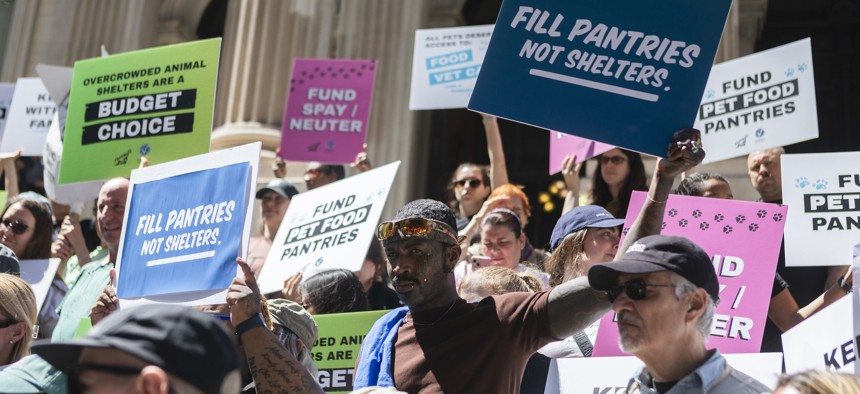
The New York City Animal Welfare Caucus hosted a rally to fund shelters on June 16, 2026. Emil Cohen/NYC Council Media Unit


For 160 years, the ASPCA has worked to protect animals and strengthen the communities they’re part of. In New York City – our home – we collaborate every day with human and social services organizations, as well as our longstanding partners at Animal Care Centers of NYC and the New York City Police Department to respond to cruelty cases, expand access to care and support pet owners across the five boroughs, providing innovative programs and free or low-cost services to support animals in underserved communities.
And as the needs of New Yorkers have evolved, so has our work. Today, as costs rise across New York City, one of the greatest threats to animal welfare isn’t just cruelty, it’s affordability.
Across the city, families are regularly being forced to make impossible choices; and when costs go up, pet owners consistently choose their pet’s wellbeing over their own. In fact, a recent national ASPCA survey revealed that 4 in 10 pet owners have already made, or seriously considered, sacrifices in other parts of their lives in order to maintain their current level of care for their animals.
Community organizations and animal welfare groups are stepping up every day by providing veterinary care, pet food, adoption support and other critical resources for pets and families. But philanthropy and nonprofits cannot, and should not, be expected to shoulder these gaps alone.
As public systems face growing strain, animal welfare organizations are increasingly being asked to provide services that are fundamentally municipal responsibilities. We want to work alongside New York City as a partner in supporting animals and communities – not as a substitute for the city’s role. Our work is designed to strengthen and complement city services, not replace them.
If we want to keep people and their pets together, the city must play a more proactive role.
We laud the recent formation of the Animal Welfare Caucus in the New York City Council, led by Speaker Julie Menin and Council Member Harvey Epstein, as a meaningful step forward. It signals a growing recognition that supporting pet ownership in New York is not a niche issue, but a core part of supporting families and communities. The next step is translating this commitment into action via three key areas where a targeted investment can make the greatest impact:
Increase funding for ACC operations
As the city’s only open-admission shelter system, ACC provides lifesaving care to animals and essential support to New Yorkers in need. Since 2002, the ASPCA has contributed more than $12.6 million to support this work – including $1.8 million in 2026 alone – to advance their efforts to increase adoption and placement numbers, reduce euthanasia and improve access to care for the city’s most vulnerable animals. But like shelters nationwide, ACC is under strain. While the city has made meaningful investments, new shelters, increased operating expenses and rising costs require sustained funding that keeps pace with the growth of the shelter system and inflation. To meet demand and maintain humane outcomes, ACC must be resourced for the true cost of staffing and operations.
Expand access to affordable veterinary care and spay/neuter services
Cost remains one of the biggest barriers to keeping pets in their homes. According to recent ASPCA data, 6 in 10 pet owners lack confidence they could afford a medical emergency, and more than 40% aren’t sure they can even cover routine care.
The ASPCA is helping to close that gap – delivering more than 60,000 veterinary services via our Community Medicine program in 2025 alone – but demand far exceeds capacity. Last year’s $500,000 city investment in spay/neuter services was a strong step forward, but more is needed. Expanding access to affordable care will keep families together and reduce pressure on shelters.
Fund sustainable pet food assistance programs
Pet food insecurity is a growing, urgent challenge. Families are being forced to choose between basic needs – like rent, groceries and medical care – and feeding their pets.
We see the impact every day through our community engagement work: pet owners stretching their own meals, running out of food or considering surrender as a last resort. A dedicated, city-funded pet food assistance program – developed in partnership with human services and community providers – would offer immediate relief and help prevent unnecessary surrenders.
The ASPCA has been a voice for animals for over 160 years, stepping in to support New Yorkers and their pets. But it’s clear that the need for affordable veterinary care, sheltering and basic resources far exceeds what any one organization can deliver. It’s time for the city to do more, which is why we urge the City Council to increase its investment and advance practical policy solutions to help ensure that no New Yorker is forced to choose between caring for themselves and keeping a beloved pet.
Matt Bershadker is the president and CEO of the American Society for the Prevention of Cruelty to Animals, an animal welfare nonprofit organization founded in 1866.
NEXT STORY: Opinion: Asian immigrant communities need to be protected, too