

Healthcare
Opinion: The legal loophole robbing New Yorkers of mental healthcare
Patients on Medicaid should be able to have virtual appointments, too.
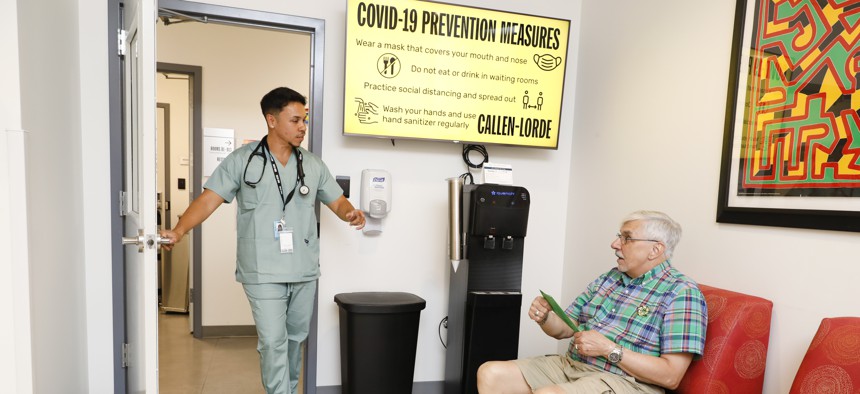
A community member receives care at Callen-Lorde. Callen-Lorde Community Health Center


Gov. Kathy Hochul and the state of New York have made progress in providing greater access to behavioral health services, with one notable exception.
Community health centers are building innovative care where it matters most: meeting patients where they are and removing barriers to care. But when it comes to accessing behavioral health remotely, many people on Medicaid are left out.
During the pandemic, virtual visit options became widely available, including for behavioral health services like talk therapy, substance-abuse support and psychiatric appointments. Although virtual visits continue to be a widely accepted practice for many types of healthcare, mental and behavioral health services lead in overall virtual visits according to a data review of commercially insured patients.
For commercially insured patients, the proliferation of app-based services focuses on matching people with licensed therapists who, most often, work in remote locations. Yet, when it comes to virtual visits for community health center patients, the New York State Department of Health requires behavioral health clinicians to be on site, with limited space at health center locations.
Community health centers like Callen-Lorde and Community Healthcare Network, which have long been leaders in delivering innovative, community-based care for beneficiaries of Medicaid, often face limits in square footage per clinic as they provide preventive care across a wide range of healthcare needs, in addition to behavioral health. Because of space limitations, we aren’t able to provide the number of behavioral health appointments necessary to meet the needs of our clinic’s Medicaid patients.
Behavioral health care provided by clinics that are governed by two other areas of mental healthcare law (known as Article 31 and 32 clinics) are allowed to provide virtual visit services in which both the provider and the patient are off site and receive the full Medicaid reimbursement.
However, Article 28 clinics like Callen-Lorde and Community Health Network were left out of this accommodation, a jarring omission for care that was reimbursed at the full rate during the pandemic. This is an oversight that has a deep impact on the patients we serve.
Community Healthcare Network and Callen-Lorde are not-for-profit Federally Qualified Health Center organizations that provide a combined 87,000 New Yorkers with primary, behavioral, wellness and other needed health and support services. We provide judgement-free, high-quality healthcare, without regard to race, religion, orientation, gender identity, immigration status or ability to pay. We turn no one away.
Innovation in community health centers removes barriers that prevent patients from accessing care when and where they need it. Virtual visits are one of the most effective tools we have to do that.
The need for behavioral health services has outpaced our ability to recruit and retain qualified behavioral health providers as many choose to work remotely, often for Article 31 and 32 clinics, or venture capital-backed for-profit app-based corporations. As such, Callen-Lorde has lost many seasoned, licensed providers in the last 18 months due to the in-person requirement.
More than 88% of Callen-Lorde’s behavioral health services are delivered via virtual visits to patients, many of whom may not feel safe leaving home, or who are working multiple jobs with little flexibility or who, like millions of other people, want the flexibility virtual visits provide.
In previous years, Community Healthcare Network has lost $1.2 million annually in unreimbursed virtual visit appointments. This stands in contrast to the full reimbursement it received for the over 6,000 virtual visits in 2020, before the carveout of Article 28 clinics from this benefit. While this budget impact is minimal for the state, it is unsustainable for community health centers to absorb.
Hochul and the New York Legislature have the power to fix this inequity by ensuring community health centers receive equitable Medicaid reimbursement for behavioral health services delivered virtually, regardless of where the patient or clinician is located. Doing so will strengthen the workforce, improve access and allow health centers to better meet the needs of the communities we serve.
This barrier to care makes no sense for a state that prides itself on caring for its most vulnerable residents, and it’s time to fix it.
Patrick McGovern is CEO of Callen-Lorde Community Health Center and Robert M. Hayes is president and CEO of Community Healthcare Network.
NEXT STORY: Taylor Swift’s wedding spurs fandom-led philanthropy