

NYN Media
Opinion: Child welfare workers don’t just protect – they create
New York City’s children’s services commissioner takes a moment to appreciate not just the frontline workers, but those behind the scenes.
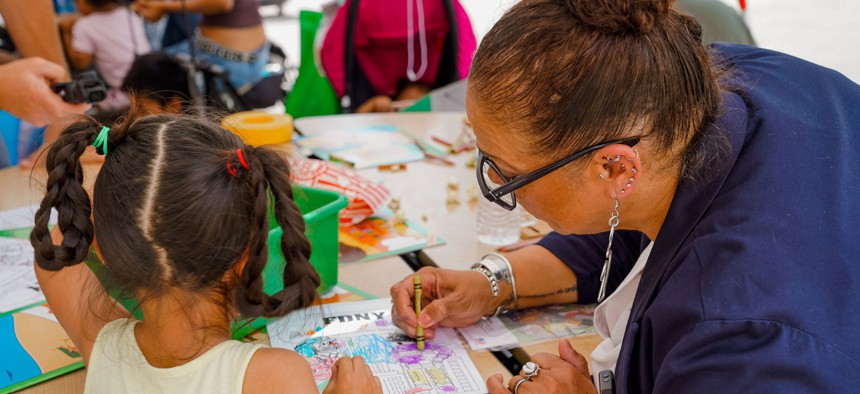
ACS Commissioner Rebecca Jones Gaston participates in annual National Coloring Book Day. Martha de La Cruz/ Administration for Children’s Services


Every day, child welfare professionals help create opportunities, restore hope, strengthen families, protect children and change the trajectory of lives. Much of that work happens outside the spotlight. It happens one conversation, one decision, one child, one family and one community at a time.
September is Child Welfare Workforce Appreciation Month, an opportunity to recognize the professionals who do this important work. For me, recognizing them is about much more than a month on the calendar. It’s personal, and it’s fundamental to the future of our field.
As Commissioner of the New York City Administration for Children’s Services, and throughout my career, I have been inspired by those who do this work and by the compassion, commitment and expertise they bring.
Like many in this field, I did not choose this work simply because it was a career path. I chose it because it’s personal.
I know firsthand what it means when someone believes in a child. I know the difference that caring adults, strong families and responsive systems can make. That experience shaped my life and purpose. It led me to become a social worker, to frontline child welfare practice, to leadership roles at the state and federal levels, and ultimately here to New York City.
My experiences taught me that we cannot celebrate this work without being clear-eyed about its history.
Child welfare has not always gotten it right. For too many families and communities, child welfare involvement has meant disruption, separation and trauma. We must acknowledge that history and learn from it. Doing so does not diminish the importance of the child welfare workforce – it underscores how important a skilled and thoughtful workforce is to changing families’ experiences with child welfare.
Our mission is not simply to protect children from harm. It’s to help create the conditions where children can be safe and thrive with their families and within their communities whenever possible.
This requires a workforce that understands both the enormous responsibility and the power that comes with this work. It requires professionals who recognize risk and strengths; who know when intervention is necessary and when support can prevent a crisis from becoming a separation; and who understand a need for help does not automatically mean foster care.
It requires compassion and patience, but also expertise and sound judgment. It requires us to listen before assuming, to build relationships, trust, and to continually ask ourselves how we can do better.
When we talk about the child welfare workforce, we often think first of frontline workers. Their work is indispensable. But they do not do it alone.
A family’s experience with child welfare is also shaped by the supervisors who help our frontline workers think through difficult decisions; the prevention professionals who help families access support before a crisis escalates; the trainers who strengthen practice; the quality improvement professionals who identify where we can do better; the administrative and operational staff who make services possible; the community partners who brings trusted relationships; the parent advocates who help us learn from our past mistakes; and the leaders for creating the conditions for good practice to flourish.
Investing in our workforce is not separate from investing in children and families. The two are inseparable.
If we want a child welfare system that keeps children safe while strengthening families, reducing unnecessary separation and helping children remain connected to the people and communities they know and love, we need a workforce equipped to make that vision real. We must give people the training, supervision and support they need to exercise good judgment, build authentic relationships and respond to families with both urgency and humanity.
We must listen to them.
This workforce can see clearly both what’s working and where systems create unnecessary barriers for families. Listening to their experiences is essential to building a system that families experience not simply as an authority in moments of crisis, but increasingly as a partner in helping them become stronger.
During Child Welfare Workforce Appreciation Month, we should celebrate the people who have dedicated themselves to this mission. But our appreciation must extend beyond words.
It should be reflected in how we support them, develop their skills, listen to their ideas and experiences, and create a culture in which they can continually learn, improve and lead change.
To my colleagues throughout New York City’s child welfare community: Thank you for your compassion, expertise and willingness to keep learning. Thank you for seeing a family’s strengths, even during their most difficult moments. And thank you for helping us build a system that measures success not simply by how we respond when children are in danger, but by how effectively we help families become stronger so that more children can grow up safe, supported and connected to family and community.
Rebecca Jones Gaston is the commissioner of the New York City Administration for Children’s Services
NEXT STORY: Restler joins the neverending war against late nonprofit payments