

Opinion
Opinion: Data must lead the way toward universal childcare
The Mamdani administration needs to look at supply and demand to guide every dollar spent on 2-K.
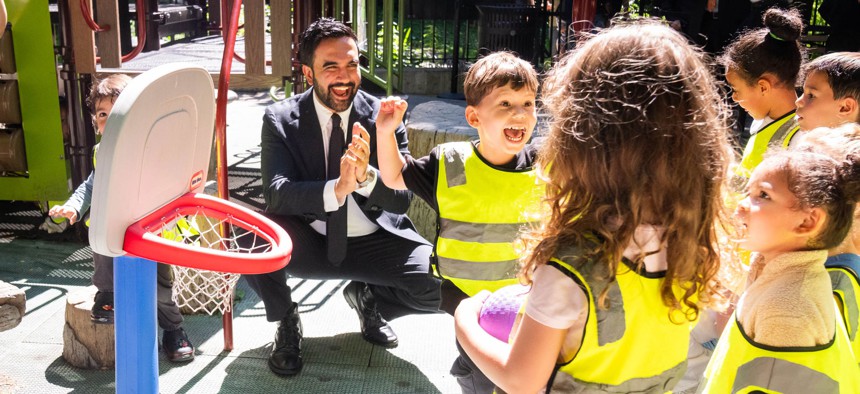
Mayor Zohran Mamdani plays with two-year-old preschool students at Ewen Playground in the Northwest Bronx. Ed Reed/Mayoral Photography Office.


In South Ozone Park, 37 preschool-aged children compete for every one available licensed, center-based childcare seat. Across New York City, center-based care for an infant or toddler costs $23,750 a year, forcing families to choose between paying for care, paying utilities, and stocking the fridge – or leaving work altogether. Uneven access to care makes those choices harder.
It’s why New York City families celebrated the launch of the 2-K pilot, the city’s first free child care program for two-year-olds, spearheaded by the Mamdani administration.
Last month, the administration announced 10,000 new seats for its second year, expanding to all of Staten Island and every school district in the Bronx. The expansion into the Bronx and Staten Island represents an important step toward reaching more families and addressing geographic gaps in access to publicly funded child care. But building toward a truly universal child care system goes beyond just seats – it’s about addressing the disparities that still limit access. As the city implements the next round of 2-K, it must use hyperlocal data on childcare supply and demand to guide every dollar.
In a city where 90% of families with young children can’t afford childcare without a publicly funded option, the demand is clear. Even after the city moves more than 10,000 children off the childcare voucher waitlist, roughly 20,000 will still be waiting. Vouchers are the most common way New York City families access publicly funded child care, and voucher enrollment for two-year-olds has more than tripled since 2022. But vouchers are only useful if providers have the space, seats and staff to meet local needs.
Citizens’ Committee for Children of New York’s new report, Building Toward Universal 2-K, found that the conditions that affect childcare access vary widely between and within each of the 2-K pilot districts. In Community School District 10, in the Bronx, median family income runs from just over $43,000 in some ZIP codes to more than $130,000 in others. To make sure every family can access care, it’s imperative that the administration understands these differences and uses neighborhood-level data to guide its investments. To ensure that 2-K implementation reaches areas with the greatest needs, the administration must take three steps.
First, use neighborhood-level data to identify communities with the greatest gaps in enrollment and capacity, alongside indicators of child and family well-being, including child poverty, income, and rent burden. Childcare access and family circumstances can vary significantly even within a single school district, making it essential to understand these differences and direct new seats and investments to the communities where they can have the greatest impact.
Second, fix the contracting and administrative rules that limit family childcare providers’ participation in 2-K expansion. Family child care providers play a crucial role in our early care system. In the West Bronx pilot district, these providers deliver more than half of preschool-age childcare. To get to a universal system, we must include them.
Third, fund startup support in districts with the steepest seat shortages and thinnest infrastructure. City and state investments must help providers navigate licensing, hire and develop qualified staff, secure adequate space, and access financing tools to open and grow programs.
At the core, the 2-K expansion needs to strengthen the existing early care and education system while addressing longstanding barriers to access. Seats alone do not ensure equitable access. Families need care options that work for them. Public investments in 2-K need to ensure that families can find, enroll in and use programs that meet their location, schedule and language and care preferences. As 2-K is rolled out, measuring and evaluating these outcomes is critical.
The expansion of 2-K represents an important step toward universal childcare, but the decisions about where new seats go and how providers are supported will determine whether that promise is realized. Those decisions must be guided by the needs of children and families, not simply where it is easiest to add capacity. Accurate, hyperlocal data is essential to ensuring that this investment reaches the communities that need it most and moves us closer to a system that works for every child and every family.
Raya Rodriguez is executive director of the Citizens’ Committee for Children of New York, a nonprofit focusing on keeping every child healthy, housed, educated and safe.
NEXT STORY: Opinion: Taxing AI labor to protect the future of work